NSAA 2023 Mathematics S1
20 questions20 marksUpdated June 2026
The NSAA 2023 Mathematics S1 paper in full: all 20 questions, each with its answer. NSAA is the Natural Sciences Admissions Assessment. Sit it cold under exam timing, mark it, then work back through anything you missed using the solutions below.
Download the original PDF →Questions and answers are free. Full step-by-step worked solutions unlock with a free account. Start practising.
Question 1
1 markThe surface area of a solid sphere of radius R is equal to the total surface area of 10 solid closed cylinders of radius r and height 4r.
\nWhich of the following is an expression for R in terms of r?
(The surface area of a sphere of radius R is .)
\nWhich of the following is an expression for R in terms of r?
(The surface area of a sphere of radius R is .)
- A.
- B.
- C.
- D.
- E.
- F.
- G.
Answer: A
Question 2
1 markWhich of the following statements is/are correct?
1\.
2\. 53% of 84 = 84% of 53
3\.
1\.
2\. 53% of 84 = 84% of 53
3\.
- A.none of them
- B.1 only
- C.2 only
- D.3 only
- E.1 and 2 only
- F.1 and 3 only
- G.2 and 3 only
- H.1, 2 and 3
Answer: E
Question 3
1 markWhich of the following is a correct rearrangement of
\nto make x the subject?
\nto make x the subject?
- A.
- B.
- C.
- D.
- E.
- F.
Answer: C
Question 4
1 markSix numbers in increasing order are:
2, x, x, y, 23.5, 27.5
\nThe mean of the six numbers is 12.
\nThe median of the six numbers is 7.25.
\nWhat is the mode of the six numbers?
2, x, x, y, 23.5, 27.5
\nThe mean of the six numbers is 12.
\nThe median of the six numbers is 7.25.
\nWhat is the mode of the six numbers?
- A.4.5
- B.4.75
- C.5
- D.9.625
- E.10
- F.11.75
Answer: A
Question 5
1 markWXYZ is a square of side length 1.
What is the area of triangle MNP?
[diagram not to scale]
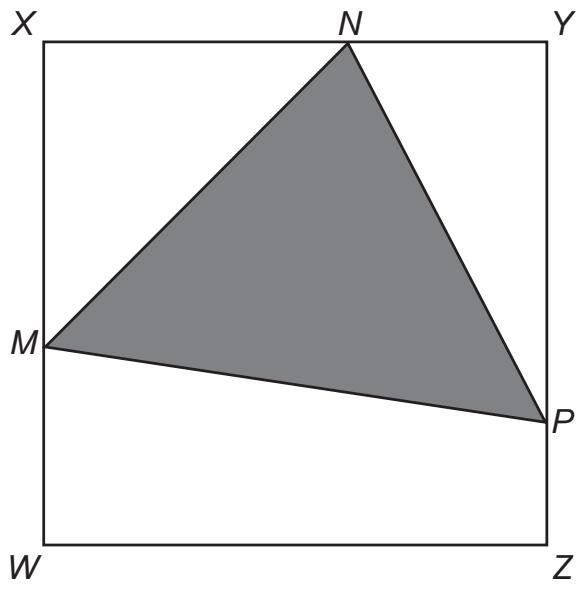
What is the area of triangle MNP?
[diagram not to scale]
- A.
- B.
- C.
- D.
- E.
- F.
Answer: F
Question 6
1 markWhich of the following is a simplification of
- A.
- B.
- C.4
- D.4x
- E.
- F.
- G.
- H.
Answer: D
Question 7
1 markGiven that
\nwhat is the value of x?
\nwhat is the value of x?
- A.0
- B.2.5
- C.3
- D.6
- E.7.5
- F.9
- G.10.5
- H.12
Answer: D
Question 8
1 markThe solutions of the equation are p and q, where .
\nWhat is the value of ?
\nWhat is the value of ?
- A.
- B.
- C.
- D.
- E.
- F.
- G.
- H.
Answer: E
Question 9
1 markLast year, the salary of the coach of a football club was 80% of the salary of the star player.
\nAt the start of the new year, the coach received a 15% increase in salary and the star player received a 38% increase in salary.
\nWhat percentage of the star player's new salary is the coach's new salary?
\nAt the start of the new year, the coach received a 15% increase in salary and the star player received a 38% increase in salary.
\nWhat percentage of the star player's new salary is the coach's new salary?
- A.46%
- B.57%
- C.
- D.
- E.77%
- F.
Answer: D
Question 10
1 markTwo of the angles of a triangle are and , where
\nThe length of the hypotenuse of the triangle is cm.
\nWhat is the area of the triangle, in cm?
\nThe length of the hypotenuse of the triangle is cm.
\nWhat is the area of the triangle, in cm?
- A.
- B.
- C.
- D.
- E.
- F.
- G.
Answer: B
Question 11
1 markAn athlete's training session consists of several complete repetitions of a three-part programme:
1. Walk 100 m at an average speed of 6 km h
2. Jog 200 m at an average speed of 10 km h
3. Run 100 m at an average speed of 20 km h
\nWhat is the athlete's average speed for the complete training session, in km h?
1. Walk 100 m at an average speed of 6 km h
2. Jog 200 m at an average speed of 10 km h
3. Run 100 m at an average speed of 20 km h
\nWhat is the athlete's average speed for the complete training session, in km h?
- A.7.2
- B.9.6
- C.11.5
- D.12
- E.14.4
Answer: B
Question 12
1 markThe line joining the points with coordinates and is perpendicular to the line with equation
\nWhat is the value of q?
\nWhat is the value of q?
- A.
- B.
- C.1
- D.
- E.
- F.
- G.6
Answer: C
Question 13
1 markTwo objects X and Y are similar.
\nThe surface area of object Y is double the surface area of object X.
\nThe volume of object Y is cm more than the volume of object X.
\nWhat is the volume of object X, in cm?
\nThe surface area of object Y is double the surface area of object X.
\nThe volume of object Y is cm more than the volume of object X.
\nWhat is the volume of object X, in cm?
- A.
- B.
- C.
- D.
- E.
- F.
- G.
- H.
Answer: H
Question 14
1 markx, y and z are positive variables.
\ny is inversely proportional to the square of x.
\nWhen y = 20, x = 3
\nz is directly proportional to x.
\nWhen z = 1.2, x = 6
\nWhat is z when y = 80?
\ny is inversely proportional to the square of x.
\nWhen y = 20, x = 3
\nz is directly proportional to x.
\nWhen z = 1.2, x = 6
\nWhat is z when y = 80?
- A.0.0225
- B.0.03
- C.0.15
- D.0.3
- E.0.36
- F.0.6
- G.1.2
Answer: D
Question 15
1 markThe equation
\nhas two solutions for a.
\nWhat is the positive difference between these two solutions?
\nhas two solutions for a.
\nWhat is the positive difference between these two solutions?
- A.0
- B.
- C.
- D.
- E.
- F.
Answer: B
Question 16
1 markFor any real number x, the function V(x) is defined as:
\nWhat is the smallest value of V(x)?
\nWhat is the smallest value of V(x)?
- A.0.001
- B.0.01
- C.0.1
- D.1
- E.10
- F.100
- G.1000
Answer: B
Question 17
1 markX and Y are the end-points of a line segment.
\nPoint P has coordinates (-8,5).
\nP lies on the line segment XY such that XP: PY is 1:2 and .
\nA point Q is such that .
\nWhat are the coordinates of point Q?
\nPoint P has coordinates (-8,5).
\nP lies on the line segment XY such that XP: PY is 1:2 and .
\nA point Q is such that .
\nWhat are the coordinates of point Q?
- A.(7, 5)
- B.(3, 8)
- C.(1, -12)
- D.(-3, -10)
- E.(-7, -7)
- F.(-11, -4)
Answer: E
Question 18
1 markThe 2nd term of a linear (arithmetic) sequence is equal to twice the 8th term.
\nThe 5th term is .
\nWhat is the 20th term of the sequence?
\nThe 5th term is .
\nWhat is the 20th term of the sequence?
- A.-9
- B.
- C.
- D.6
- E.
- F.
Answer: C
Question 19
1 markFind the maximum value of
\nwhere .
\nwhere .
- A.
- B.1
- C.
- D.2
- E.3
- F.6
Answer: C
Question 20
1 markTwo bags contain counters which are identical except for colour.
\nThe first bag contains 3 blue and 2 yellow counters.
\nThe second bag contains x red, 1 blue and 2 yellow counters.
\nA counter is picked at random from the first bag and placed in the second bag.
\nA counter is then picked at random from the second bag. The probability that this counter is yellow is 0.2. What is the probability that this counter is red?
\nThe first bag contains 3 blue and 2 yellow counters.
\nThe second bag contains x red, 1 blue and 2 yellow counters.
\nA counter is picked at random from the first bag and placed in the second bag.
\nA counter is then picked at random from the second bag. The probability that this counter is yellow is 0.2. What is the probability that this counter is red?
- A.
- B.
- C.
- D.
- E.
- F.
- G.
- H.
Answer: E