NSAA 2023 Physics PART X
20 questions20 marksUpdated June 2026
The NSAA 2023 Physics PART X paper in full: all 20 questions, each with its answer. NSAA is the Natural Sciences Admissions Assessment. Sit it cold under exam timing, mark it, then work back through anything you missed using the solutions below.
Download the original PDF →Questions and answers are free. Full step-by-step worked solutions unlock with a free account. Start practising.
Question 1
1 markA block of weight slides down a rough plane at a constant speed.
\nThe plane is at an angle of 30° to the horizontal.
\nThe block is now pulled by a force of acting parallel to and up the plane. The block has constant acceleration.
\nWhich expression gives the acceleration of the block?
(gravitational field strength = )
\nThe plane is at an angle of 30° to the horizontal.
\nThe block is now pulled by a force of acting parallel to and up the plane. The block has constant acceleration.
\nWhich expression gives the acceleration of the block?
(gravitational field strength = )
- A.
- B.
- C.
- D.
- E.
- F.
- G.
Answer: A
Question 2
1 markThe speed of an object moving in a straight line is related to time by the equation
\nwhere is a constant.
\nAt the speed of the object is and the resultant force on the object is .
\nWhat is the mass of the object?
\nwhere is a constant.
\nAt the speed of the object is and the resultant force on the object is .
\nWhat is the mass of the object?
- A.0.15 kg
- B.0.40 kg
- C.1.2 kg
- D.2.5 kg
- E.6.7 kg
Answer: D
Question 3
1 markTwo waves P and Q, which superpose, are shown in the diagram in a particular region at time .
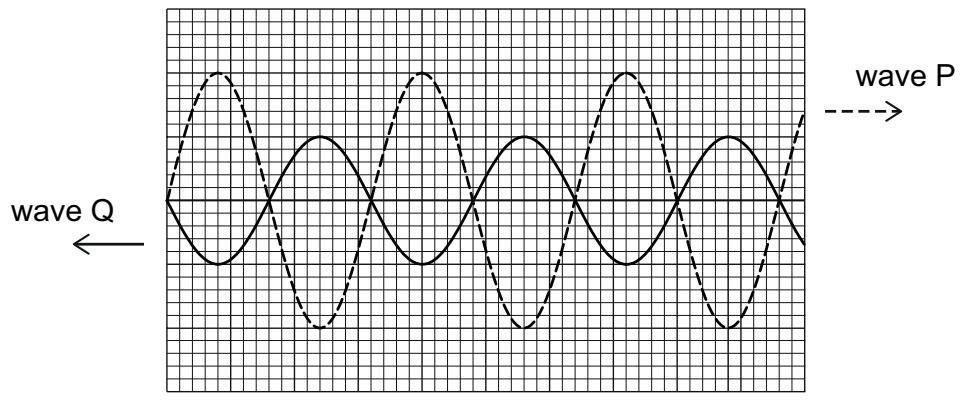
Both waves have period and are moving in the directions shown by the arrows. Wave P has amplitude 2.0 cm and wave Q has amplitude 1.0 cm.
Which diagram represents the resultant wave formed in the same region by waves P and Q at time ?
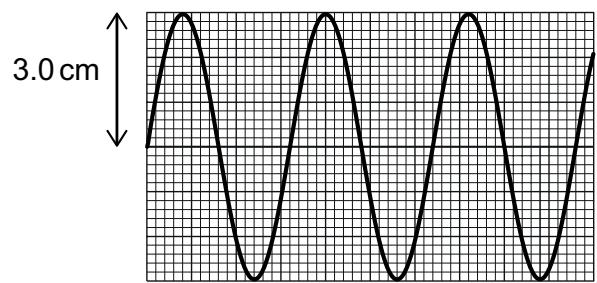
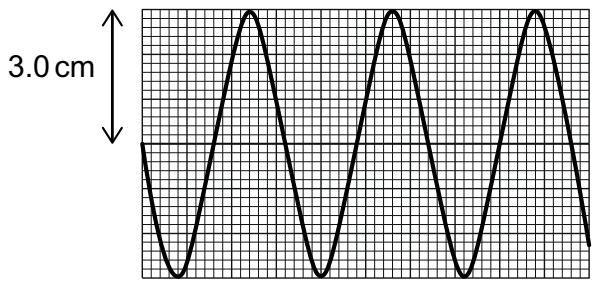
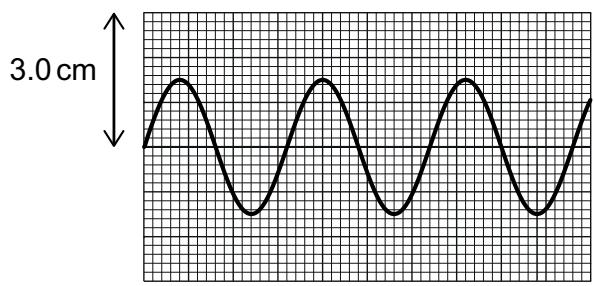
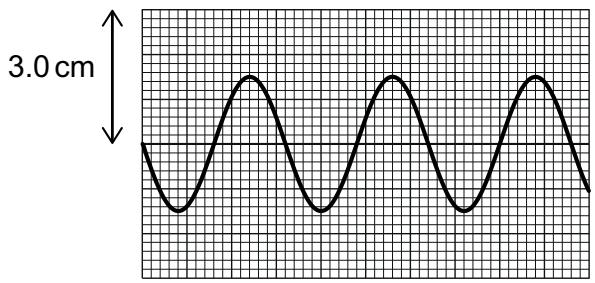
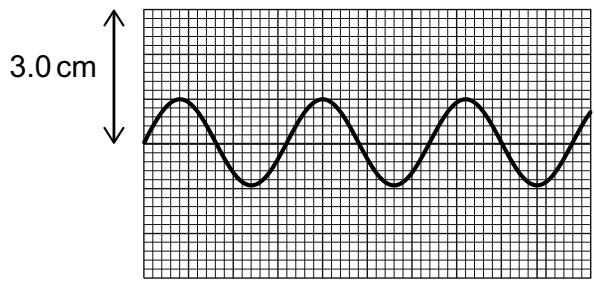
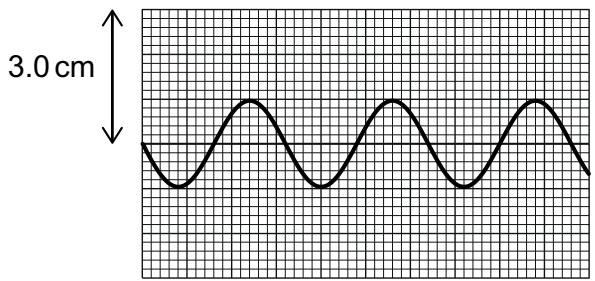
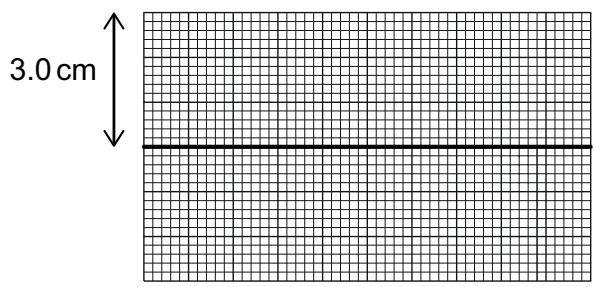
Both waves have period and are moving in the directions shown by the arrows. Wave P has amplitude 2.0 cm and wave Q has amplitude 1.0 cm.
Which diagram represents the resultant wave formed in the same region by waves P and Q at time ?
- A.Diagram A with amplitude 3.0 cm
- B.Diagram B with amplitude 3.0 cm
- C.Diagram C with amplitude 3.0 cm
- D.Diagram D with amplitude 3.0 cm
- E.Diagram E with amplitude 3.0 cm
- F.Diagram F with amplitude 3.0 cm
- G.Diagram G with amplitude 3.0 cm
Answer: F
Question 4
1 markFour identical springs are arranged as shown and suspended from a support.
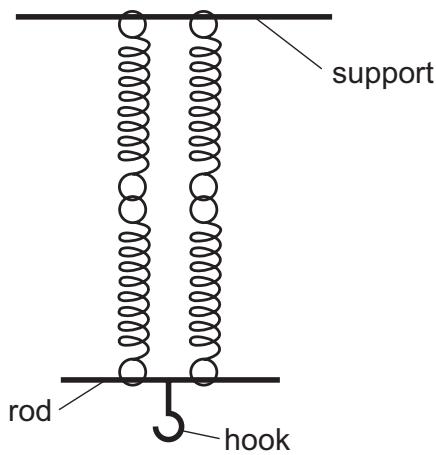
The mass of the springs, rod and hook are negligible.
A load of weight 8.4 N is attached to the hook at the lower end of the springs and this causes a total extension of the system of 24 mm.
The arrangement is then changed to:
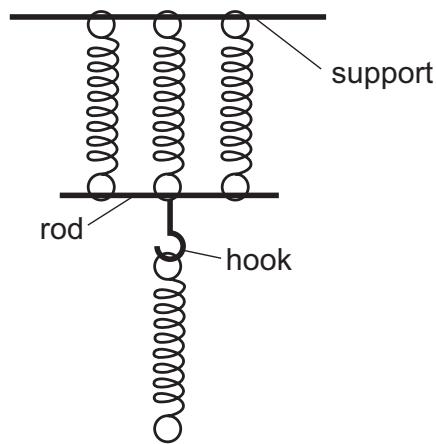
The load of 8.4 N is attached to the bottom of the lower spring.
What is the total extension of the system at equilibrium in the second arrangement?
(The springs obey Hooke's law.)
The mass of the springs, rod and hook are negligible.
A load of weight 8.4 N is attached to the hook at the lower end of the springs and this causes a total extension of the system of 24 mm.
The arrangement is then changed to:
The load of 8.4 N is attached to the bottom of the lower spring.
What is the total extension of the system at equilibrium in the second arrangement?
(The springs obey Hooke's law.)
- A.3 mm
- B.12 mm
- C.16 mm
- D.24 mm
- E.32 mm
- F.48 mm
- G.64 mm
Answer: E
Question 5
1 markA student and a child are standing on trolleys X and Y, respectively, which are close to each other but not touching. The trolleys are initially stationary on a straight, horizontal frictionless track. The student is initially holding a ball of mass 5.0 kg.
\nThe total mass of the student, the ball and trolley X is 80 kg.
\nThe total mass of the child and trolley Y is 20 kg.
\nThe student on trolley X throws the ball to the child on trolley Y. The ball travels at a horizontal speed of relative to the ground. The child then catches the ball.
\nWhat is the speed of separation of the trolleys after the child has caught the ball?
(Assume that air resistance is negligible.)
\nThe total mass of the student, the ball and trolley X is 80 kg.
\nThe total mass of the child and trolley Y is 20 kg.
\nThe student on trolley X throws the ball to the child on trolley Y. The ball travels at a horizontal speed of relative to the ground. The child then catches the ball.
\nWhat is the speed of separation of the trolleys after the child has caught the ball?
(Assume that air resistance is negligible.)
- A.1.6 ms
- B.2.4 ms
- C.3.2 ms
- D.3.8 ms
- E.24 ms
Answer: C
Question 6
1 markThe variation of the acceleration with time of an object moving in a straight line is shown on the graph.
\nAt time = 0 s the velocity of the object is .
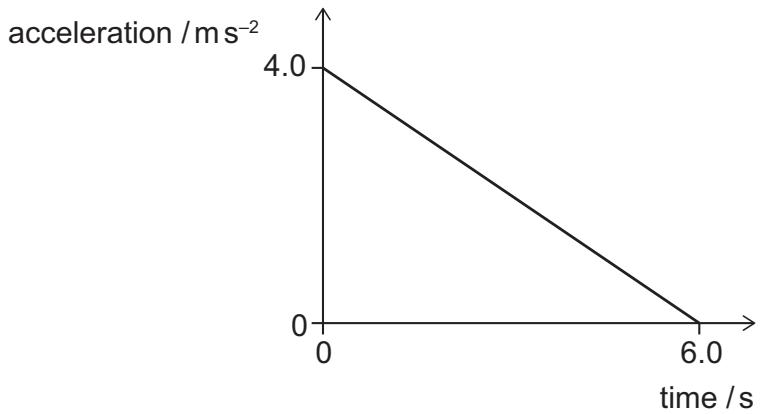
\nWhat is the maximum velocity of the object between time = 0 s and time = 6 s?
\nAt time = 0 s the velocity of the object is .
\nWhat is the maximum velocity of the object between time = 0 s and time = 6 s?
- A.
- B.
- C.
- D.
- E.
- F.
Answer: D
Question 7
1 markThe diagram shows a circuit that includes a battery with an emf of 18 V and internal resistance .
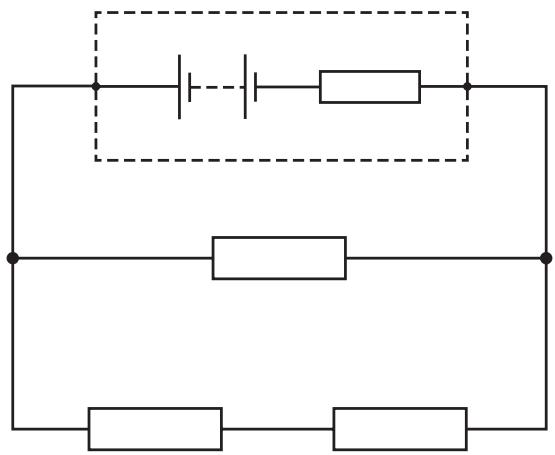
\nThe three identical resistors in the external circuit each have resistance .
\nThe terminal potential difference across the battery is 16 V.
\nWhich expression gives in terms of ?
\nThe three identical resistors in the external circuit each have resistance .
\nThe terminal potential difference across the battery is 16 V.
\nWhich expression gives in terms of ?
- A.
- B.
- C.
- D.
- E.
- F.
- G.
Answer: D
Question 8
1 markThree identical bar magnets, each of mass , and two identical trolleys, X and Y, also each of mass , are arranged with the bar magnets fixed to the trolleys as shown. The trolleys are held at rest a short distance apart on a smooth horizontal track.
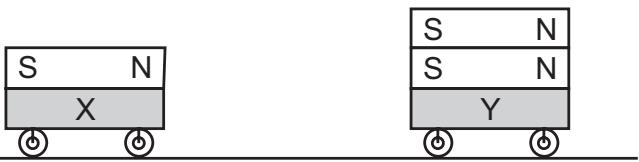
\nThe trolleys are released at the same time. They move towards each other and collide.
\nFind the value of the ratio
\nThe trolleys are released at the same time. They move towards each other and collide.
\nFind the value of the ratio
- A.
- B.
- C.
- D.1
- E.
- F.2
- G.
Answer: E
Question 9
1 markA uniform rod XY of length 3.0 m has a weight of 20 N. The rod is supported by two light wires, P and Q, as shown. P and Q are attached 0.50 m from ends X and Y, respectively.
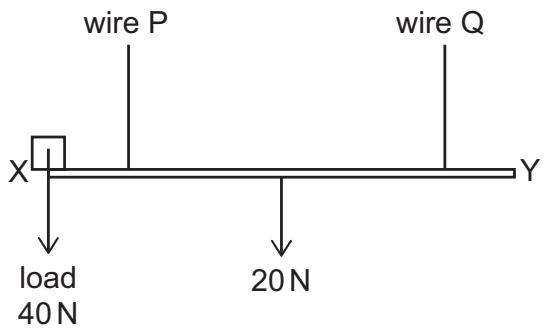
A 40 N load is moved from end X to end Y. The rod remains horizontal at all times.
Which graph shows the variation of the tension in wire P with the position of the load as it is moved along the rod?
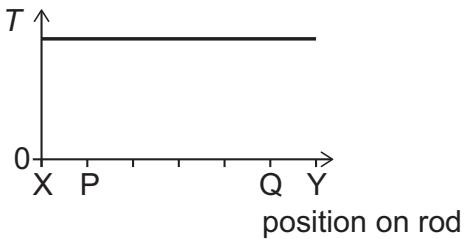
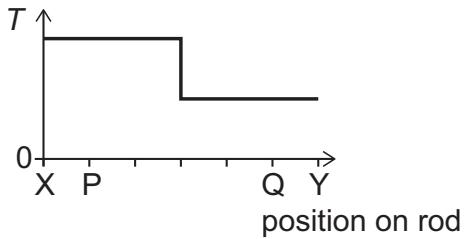
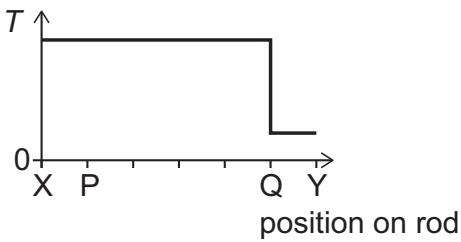
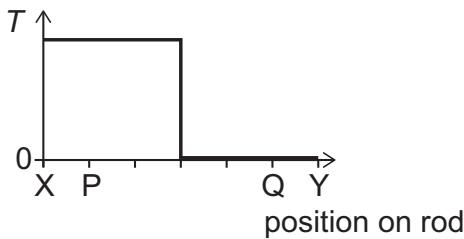
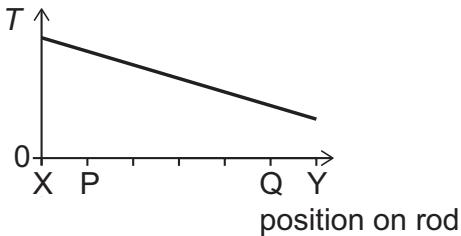
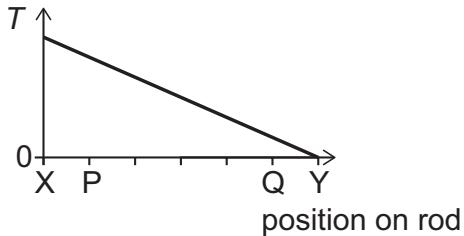
A 40 N load is moved from end X to end Y. The rod remains horizontal at all times.
Which graph shows the variation of the tension in wire P with the position of the load as it is moved along the rod?
- A.Graph A
- B.Graph B
- C.Graph C
- D.Graph D
- E.Graph E
- F.Graph F
Answer: F
Question 10
1 markA pipe of length open at both ends contains a stationary sound wave with 1 node, as shown in the diagram.
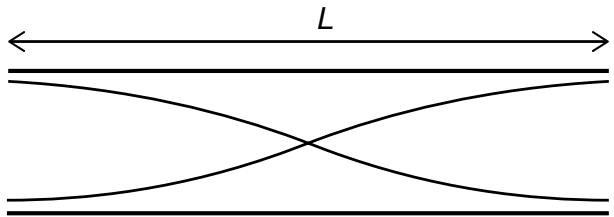
\nThe frequency of the stationary wave in this pipe is .
\nA second pipe is open at one end and closed at the other end. A stationary sound wave in this pipe contains one more node than the stationary wave shown in the diagram.
\nThe frequency of the stationary wave in the second pipe is .
\nThe speed of sound is the same in both pipes.
\nWhat is the length of the second pipe?
\nThe frequency of the stationary wave in this pipe is .
\nA second pipe is open at one end and closed at the other end. A stationary sound wave in this pipe contains one more node than the stationary wave shown in the diagram.
\nThe frequency of the stationary wave in the second pipe is .
\nThe speed of sound is the same in both pipes.
\nWhat is the length of the second pipe?
- A.4L
- B.6L
- C.8L
- D.10L
- E.12L
Answer: B
Question 11
1 markThe resistors in the following four circuits are identical.
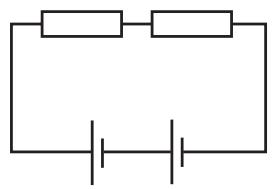
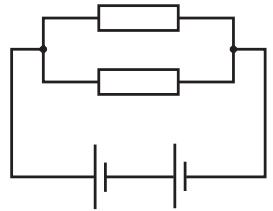
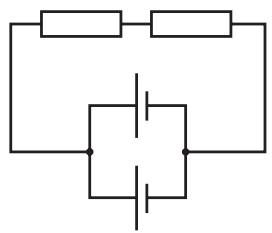
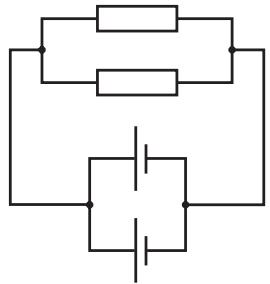
\nThe cells are identical and have no internal resistance. Each cell can supply the same total amount of energy at a constant voltage before becoming exhausted.
and are the lengths of time after which the cells in circuits 1, 2, 3 and 4, respectively, become exhausted.
\nWhich comparison of and is correct?
\nThe cells are identical and have no internal resistance. Each cell can supply the same total amount of energy at a constant voltage before becoming exhausted.
and are the lengths of time after which the cells in circuits 1, 2, 3 and 4, respectively, become exhausted.
\nWhich comparison of and is correct?
- A.
- B.
- C.
- D.
- E.
- F.
Answer: C
Question 12
1 markA particle of mass is accelerated from rest by a resultant force of varying magnitude that acts in a constant direction. The kinetic energy of the particle increases with time according to the equation
\nwhere is a constant.
\nWhich expression gives the resultant force on the particle at time ?
\nwhere is a constant.
\nWhich expression gives the resultant force on the particle at time ?
- A.
- B.
- C.
- D.
- E.
- F.
- G.
Answer: D
Question 13
1 markA light horizontal wire of cross-sectional area is fixed at two points a distance apart. The initial tension in the wire is zero.
\nAn object of weight is fixed directly to the centre of the wire. The wire stretches so that the object rests in equilibrium at a vertical distance of below the original position of the wire.
\nWhat is the Young modulus of the wire?
(Assume that the wire does not exceed its limit of proportionality.)
\nAn object of weight is fixed directly to the centre of the wire. The wire stretches so that the object rests in equilibrium at a vertical distance of below the original position of the wire.
\nWhat is the Young modulus of the wire?
(Assume that the wire does not exceed its limit of proportionality.)
- A.
- B.
- C.
- D.
- E.
- F.
- G.
Answer: E
Question 14
1 markA triangular ramp with angles to the horizontal of 60° and 30° is placed with its largest face horizontal. A block of mass 1.5 kg and a block of mass are joined by a light, inextensible string and placed on the ramp as shown.
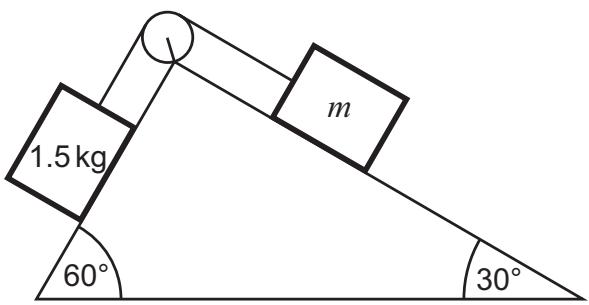
\nThe string passes over a light, frictionless pulley.
\nThe maximum force of friction between the block of mass 1.5 kg and the surface of the ramp is 3.5 N.
\nThe maximum force of friction between the block of mass and the surface of the ramp is 5.0 N.
\nWhat is the maximum value of that allows the blocks to remain stationary on the surfaces?
(gravitational field strength = )
\nThe string passes over a light, frictionless pulley.
\nThe maximum force of friction between the block of mass 1.5 kg and the surface of the ramp is 3.5 N.
\nThe maximum force of friction between the block of mass and the surface of the ramp is 5.0 N.
\nWhat is the maximum value of that allows the blocks to remain stationary on the surfaces?
(gravitational field strength = )
- A.1.5 kg
- B.1.65 kg
- C.2.35 kg
- D.
- E.
- F.
- G.
Answer: G
Question 15
1 markA sound wave travels through medium J, reaches a boundary, and then travels through medium K as shown. The thickness of each medium is .
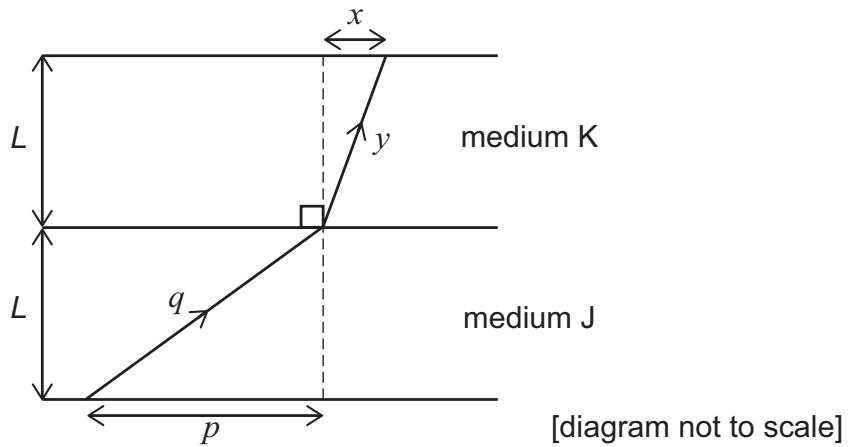
\nThe wave travels a distance in medium J and a distance in medium K.
\nThe horizontal distance travelled in medium J is . The horizontal distance travelled in medium K is .
\nThe wave travels at speed in medium J. The graph shows how the speed of the wave varies with time as it travels distances and , and that the wave leaves medium K at .
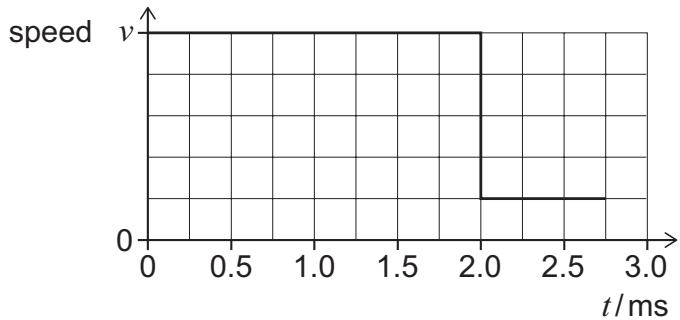
\nWhat is the value of ?
\nThe wave travels a distance in medium J and a distance in medium K.
\nThe horizontal distance travelled in medium J is . The horizontal distance travelled in medium K is .
\nThe wave travels at speed in medium J. The graph shows how the speed of the wave varies with time as it travels distances and , and that the wave leaves medium K at .
\nWhat is the value of ?
- A.
- B.
- C.
- D.
- E.
- F.
- G.
Answer: A
Question 16
1 markThe drag force acting on a sphere of radius falling at constant speed though air is given by
\nwhere is a constant.
\nFor a sphere of uniform density and mass falling at a constant speed, the drag force heats the surrounding air at a constant rate .
\nAnother sphere of the same material but with mass falls through the air at a different constant speed.
\nWhat is the rate at which the drag force on the heavier sphere heats the surrounding air?
\nwhere is a constant.
\nFor a sphere of uniform density and mass falling at a constant speed, the drag force heats the surrounding air at a constant rate .
\nAnother sphere of the same material but with mass falls through the air at a different constant speed.
\nWhat is the rate at which the drag force on the heavier sphere heats the surrounding air?
- A.2P
- B.4P
- C.8P
- D.16P
- E.32P
- F.64P
Answer: E
Question 17
1 markA projectile is launched from an inclined plane.
\nThe graphs show the variation of the horizontal and vertical components of the velocity of the projectile with time from when it is launched until it hits the plane at time .
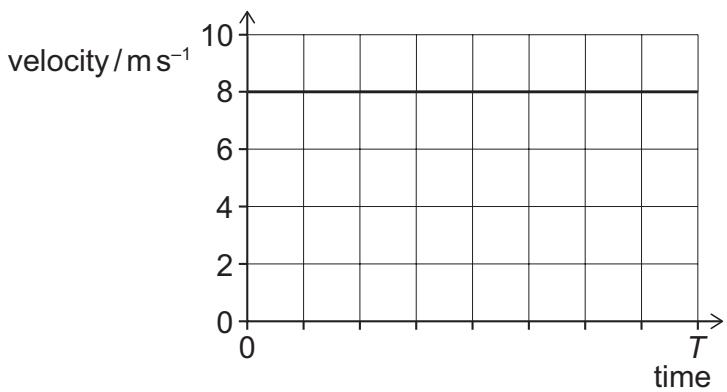
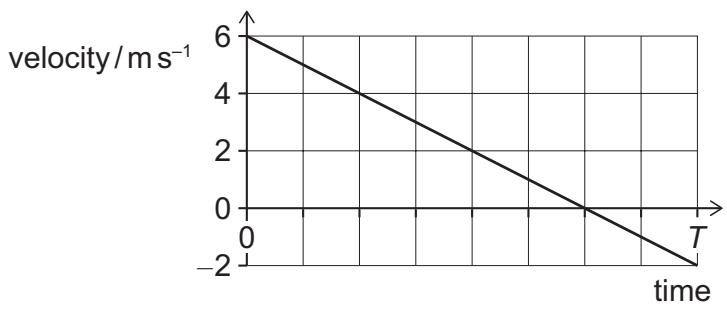
\nWhat is the angle of the plane to the horizontal?
(gravitational field strength = )
\nThe graphs show the variation of the horizontal and vertical components of the velocity of the projectile with time from when it is launched until it hits the plane at time .
\nWhat is the angle of the plane to the horizontal?
(gravitational field strength = )
- A.
- B.
- C.
- D.
- E.
- F.
Answer: C
Question 18
1 markA tennis ball of mass 0.060 kg travels horizontally and strikes a vertical wall at . It leaves the wall in the opposite direction at .
\nThe graph shows how the resultant horizontal force acting on the ball varies with time during this collision.
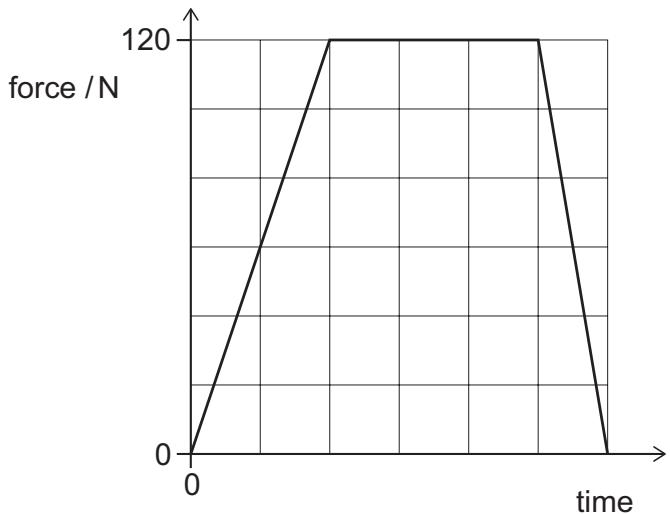
\nWhat is the duration of the collision?
\nThe graph shows how the resultant horizontal force acting on the ball varies with time during this collision.
\nWhat is the duration of the collision?
- A. s
- B. s
- C. s
- D. s
- E. s
- F. s
Answer: E
Question 19
1 markA battery with an emf of 8.0 V and internal resistance and another battery with an emf of 4.0 V and internal resistance are connected to a cell with an emf of 2.0 V and internal resistance in the circuit shown.
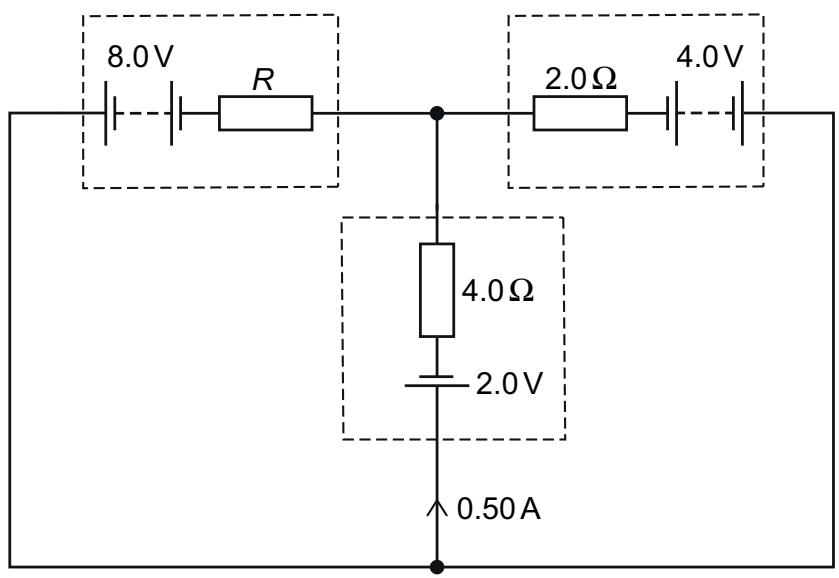
\nThe current in the 2.0 V cell is 0.50 A in the direction shown in the diagram.
\nWhat is the resistance ?
\nThe current in the 2.0 V cell is 0.50 A in the direction shown in the diagram.
\nWhat is the resistance ?
- A.
- B.
- C.
- D.
- E.
Answer: D
Question 20
1 markA model for how the resistivity of damp soil varies with depth from the surface is given by
\nwhere is the maximum depth, and and are other constants.
\nWhat is the resistance of a vertical column of damp soil of cross-sectional area and depth ?
\nwhere is the maximum depth, and and are other constants.
\nWhat is the resistance of a vertical column of damp soil of cross-sectional area and depth ?
- A.
- B.
- C.
- D.
- E.
- F.
- G.
Answer: E