TMUA 2016 D513/02
20 questions20 marks75Updated July 2025
The TMUA 2016 D513/02 paper in full: all 20 questions, each with its answer. TMUA is the Test of Mathematics for University Admission. Sit it cold under exam timing, mark it, then work back through anything you missed using the solutions below.
Download the original PDF →Questions and answers are free. Full step-by-step worked solutions unlock with a free account. Start practising.
Question 1
1 markFind the value of
- A.
- B.3
- C.
- D.
- E.
- F.18
Answer: A
Question 2
1 markLet . Which one of the following is equal to ?
- A.
- B.
- C.
- D.
Answer: B
Question 3
1 markWhat is the value, in radians, of the largest angle in the range that satisfies the equation ?
- A.
- B.
- C.
- D.
- E.
- F.
Answer: D
Question 4
1 markFive sealed urns, labelled P, Q, R, S, and T, each contain the same (non-zero) number of balls. The following statements are attached to the urns.
Urn P This urn contains one or four balls.
Urn Q This urn contains two or four balls.
Urn R This urn contains more than two balls and fewer than five balls.
Urn S This urn contains one or two balls.
Urn T This urn contains fewer than three balls.
Exactly one of the urns has a true statement attached to it.
Which urn is it?
Urn P This urn contains one or four balls.
Urn Q This urn contains two or four balls.
Urn R This urn contains more than two balls and fewer than five balls.
Urn S This urn contains one or two balls.
Urn T This urn contains fewer than three balls.
Exactly one of the urns has a true statement attached to it.
Which urn is it?
- A.Urn P
- B.Urn Q
- C.Urn R
- D.Urn S
- E.Urn T
Answer: C
Question 5
1 markConsider the statement:
(*) A whole number is prime if it is 1 less or 5 less than a multiple of 6.
How many counterexamples to (*) are there in the range ?
(*) A whole number is prime if it is 1 less or 5 less than a multiple of 6.
How many counterexamples to (*) are there in the range ?
- A.2
- B.3
- C.4
- D.5
- E.6
Answer: C
Question 6
1 markThe sequence of functions , , , ... is defined as follows:
for
where .
Find the value of
for
where .
Find the value of
- A.
- B.
- C.
- D.
- E.
- F.
- G.
- H.
Answer: C
Question 7
1 markThe four real numbers , and are all greater than 1.
Suppose that they satisfy the equation .
Use some of the lines given to construct a proof that, in this case, it follows that
(*) .
(1) Let and
(2)
(3)
(4)
(5)
(6)
(7)
(8)
(9)
Suppose that they satisfy the equation .
Use some of the lines given to construct a proof that, in this case, it follows that
(*) .
(1) Let and
(2)
(3)
(4)
(5)
(6)
(7)
(8)
(9)
- A.(1). Then (2), so (6), so (8), so (7), and therefore (4), hence (*) as required.
- B.(1). Then (2), so (7), so (8), so (6), and therefore (4), hence (*) as required.
- C.(1). Then (3), so (5), so (9), so (7), and therefore (4), hence (*) as required.
- D.(1). Then (3), so (7), so (9), so (5), and therefore (4), hence (*) as required.
- E.(1). Then (4), so (5), so (9), so (7), and therefore (3), hence (*) as required.
- F.(1). Then (4), so (6), so (8), so (7), and therefore (2), hence (*) as required.
- G.(1). Then (4), so (7), so (8), so (6), and therefore (2), hence (*) as required.
- H.(1). Then (4), so (7), so (9), so (5), and therefore (3), hence (*) as required.
Answer: C
Question 8
1 markA region is defined by the inequalities and
Consider the three statements:
1
2
3
Which of the above statements is/are true for every point in the region?
Consider the three statements:
1
2
3
Which of the above statements is/are true for every point in the region?
- A.none
- B.1 only
- C.2 only
- D.3 only
- E.1 and 2 only
- F.1 and 3 only
- G.2 and 3 only
- H.1, 2 and 3
Answer: B
Question 9
1 markTriangles and have the same area.
Which of these extra conditions, taken independently, would imply that they are congruent?
(1) and
(2) and
(3) and
Which of these extra conditions, taken independently, would imply that they are congruent?
(1) and
(2) and
(3) and
- A.Condition (1): Does not imply congruent; Condition (2): Does not imply congruent; Condition (3): Does not imply congruent
- B.Condition (1): Does not imply congruent; Condition (2): Does not imply congruent; Condition (3): Implies congruent
- C.Condition (1): Does not imply congruent; Condition (2): Implies congruent; Condition (3): Does not imply congruent
- D.Condition (1): Does not imply congruent; Condition (2): Implies congruent; Condition (3): Implies congruent
- E.Condition (1): Implies congruent; Condition (2): Does not imply congruent; Condition (3): Does not imply congruent
- F.Condition (1): Implies congruent; Condition (2): Does not imply congruent; Condition (3): Implies congruent
- G.Condition (1): Implies congruent; Condition (2): Implies congruent; Condition (3): Does not imply congruent
- H.Condition (1): Implies congruent; Condition (2): Implies congruent; Condition (3): Implies congruent
Answer: D
Question 10
1 markIn this question and are non-zero real numbers.
Which one of the following is sufficient to conclude that ?
Which one of the following is sufficient to conclude that ?
- A.
- B.
- C.
- D.
- E.
- F.
Answer: E
Question 11
1 mark is a polynomial with real coefficients.
The equation has exactly two real roots, and , where .
Consider the following three statements:
1 for exactly one value of between and
2 The area between the curve , the -axis and the lines and is given by
3 The graph of intersects the -axis at the points and only
Which of the above statements must be true?
The equation has exactly two real roots, and , where .
Consider the following three statements:
1 for exactly one value of between and
2 The area between the curve , the -axis and the lines and is given by
3 The graph of intersects the -axis at the points and only
Which of the above statements must be true?
- A.none
- B.1 only
- C.2 only
- D.3 only
- E.1 and 2 only
- F.1 and 3 only
- G.2 and 3 only
- H.1, 2 and 3
Answer: D
Question 12
1 markThe first term of an arithmetic sequence is and the common difference is .
The sum of the first terms is denoted by .
If , what can be deduced about the sign of and the sign of ?
The sum of the first terms is denoted by .
If , what can be deduced about the sign of and the sign of ?
- A.both and are negative
- B. is positive, is negative
- C. is negative, is positive
- D.a is negative, but the sign of cannot be deduced
- E. is negative, but the sign of cannot be deduced
- F.neither the sign of nor the sign of can be deduced
Answer: F
Question 13
1 markIn this question, , and are positive integers.
The following is an attempted proof of the false statement:
If divides , then divides or divides .
[' divides ' means ' is a factor of ']
Which line contains the error in this proof?
1. The statement is equivalent to ‘if does not divide and does not divide then does not divide '.
2. Suppose does not divide and does not divide . Then the remainder when dividing by is , where , and the remainder when dividing by is , where .
3. So and for some integers and .
4. Thus .
5. So the remainder when dividing by is .
6. Since and , it follows that .
7. Hence does not divide .
The following is an attempted proof of the false statement:
If divides , then divides or divides .
[' divides ' means ' is a factor of ']
Which line contains the error in this proof?
1. The statement is equivalent to ‘if does not divide and does not divide then does not divide '.
2. Suppose does not divide and does not divide . Then the remainder when dividing by is , where , and the remainder when dividing by is , where .
3. So and for some integers and .
4. Thus .
5. So the remainder when dividing by is .
6. Since and , it follows that .
7. Hence does not divide .
- A.Line 1
- B.Line 2
- C.Line 3
- D.Line 4
- E.Line 5
- F.Line 6
Answer: E
Question 14
1 mark, where , and are real numbers.
Suppose has distinct real solutions, has distinct real solutions,
has distinct real solutions, and has distinct real solutions.
Which one of the following is not possible?
Suppose has distinct real solutions, has distinct real solutions,
has distinct real solutions, and has distinct real solutions.
Which one of the following is not possible?
- A. and
- B. and
- C. and
- D. and
- E. and
Answer: B
Question 15
1 markConsider the quadratic and the statement:
(*) has two real roots whose difference is greater than 2 and less than 4.
Which one of the following statements is true if and only if (*) is true?
(*) has two real roots whose difference is greater than 2 and less than 4.
Which one of the following statements is true if and only if (*) is true?
- A.
- B.
- C.
- D.
- E.
Answer: D
Question 16
1 markIn the figure, is a trapezium with parallel to .
The diagonals of the trapezium meet at .
lies on and lies on such that is a line segment through parallel to .
The length of is 12 cm and the length of is 3 cm.
What, in centimetres, is the length of ?
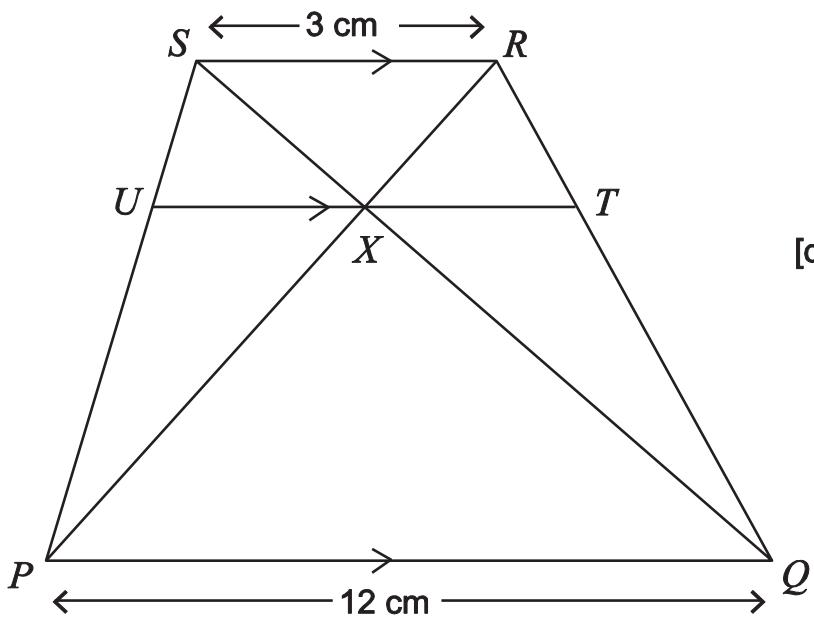
The diagonals of the trapezium meet at .
lies on and lies on such that is a line segment through parallel to .
The length of is 12 cm and the length of is 3 cm.
What, in centimetres, is the length of ?
- A.4.2
- B.4.5
- C.4.8
- D.5.25
- E.6
Answer: C
Question 17
1 markConsider these simultaneous equations, where is a constant:
Which of the following statements is/are true?
1 For some value of : there is exactly one solution with and there is at least one solution with .
2 For some value of : there is exactly one solution with and there are no solutions with .
3 For some value of : there is exactly one solution with and there are no solutions with .
Which of the following statements is/are true?
1 For some value of : there is exactly one solution with and there is at least one solution with .
2 For some value of : there is exactly one solution with and there are no solutions with .
3 For some value of : there is exactly one solution with and there are no solutions with .
- A.none
- B.1 only
- C.2 only
- D.3 only
- E.1 and 2 only
- F.1 and 3 only
- G.2 and 3 only
- H.1, 2 and 3
Answer: H
Question 18
1 markConsider this statement about a function :
(*) If for all then
Which one of the following functions provides a counterexample to (*)?
(*) If for all then
Which one of the following functions provides a counterexample to (*)?
- A.
- B.
- C.
- D.
- E.
- F.
Answer: D
Question 19
1 markSome identical unit cubes are used to construct a three-dimensional object by gluing them together face to face.
Sketches of this object are made by looking at it from the right-hand side, from the front and from above. These sketches are called the side elevation, the front elevation, and the plan view respectively.
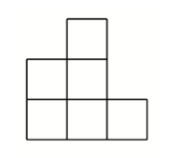 This is the side elevation of the object.
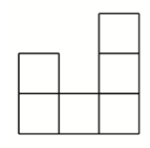 This is the front elevation of the object.
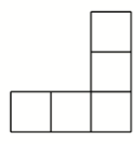 This is the plan view of the object.
How many cubes were used to construct the object?
Sketches of this object are made by looking at it from the right-hand side, from the front and from above. These sketches are called the side elevation, the front elevation, and the plan view respectively.
How many cubes were used to construct the object?
- A.exactly 6
- B.either 6 or 7
- C.exactly 7
- D.either 7 or 8
- E.exactly 8
- F.either 8 or 9
- G.exactly 9
Answer: F
Question 20
1 markEach interior angle of a regular polygon with sides is of each interior angle of a second regular polygon with sides.
How many pairs of positive integers and are there for which this statement is true?
How many pairs of positive integers and are there for which this statement is true?
- A.none
- B.1
- C.2
- D.3
- E.4
- F.5
- G.6
- H.infinitely many
Answer: E