TMUA 2017 D513/01
20 questions20 marks75Updated July 2025
The TMUA 2017 D513/01 paper in full: all 20 questions, each with its answer. TMUA is the Test of Mathematics for University Admission. Sit it cold under exam timing, mark it, then work back through anything you missed using the solutions below.
Download the original PDF →Questions and answers are free. Full step-by-step worked solutions unlock with a free account. Start practising.
Question 1
1 markTHIS IS WRONG, PLEASE REVIEW AGAIN!
Given that ,
and when , find in terms of .
Given that ,
and when , find in terms of .
- A.
- B.
- C.
- D.
- E.
- F.
Answer: C
Question 2
1 markThe function is given by
()
What is the value of ?
What is the value of ?
- A.-3
- B.-1
- C.5
- D.17
- E.29
- F.80
Answer: C
Question 3
1 markA line has equation
A second line is perpendicular to and passes through the point .
Find the area of the region enclosed by the two lines and the -axis.
A second line is perpendicular to and passes through the point .
Find the area of the region enclosed by the two lines and the -axis.
- A.
- B.18
- C.
- D.27
- E.
Answer: A
Question 4
1 markWhen is multiplied by and the resulting product is divided by
, the remainder is .
What is the value of ?
, the remainder is .
What is the value of ?
- A.-4
- B.2
- C.4
- D.
- E.
Answer: B
Question 5
1 mark is the complete set of values of which satisfy both the inequalities
and
The set can also be represented as a single inequality.
Which one of the following single inequalities represents the set ?
and
The set can also be represented as a single inequality.
Which one of the following single inequalities represents the set ?
- A.
- B.
- C.
- D.
- E.
- F.
- G.
- H.
Answer: C
Question 6
1 markA tangent to the circle passes through the point and crosses the positive -axis.
What is the value of at the point where the tangent meets the -axis?
What is the value of at the point where the tangent meets the -axis?
- A.12
- B.15
- C.
- D.20
- E.
- F.
Answer: B
Question 7
1 markThe first three terms of an arithmetic progression are , and respectively, where
The first three terms of a geometric progression are , and respectively.
Find the sum of the first terms of the arithmetic progression.
The first three terms of a geometric progression are , and respectively.
Find the sum of the first terms of the arithmetic progression.
- A.
- B.
- C.
- D.
Answer: B
Question 8
1 markFind the complete set of values of , with , for which
- A.
- B.
- C.
- D.
Answer: A
Question 9
1 markA circle has equation
A regular hexagon is drawn inside this circle so that the vertices of the hexagon touch the circle.
What is the area of the hexagon?
A regular hexagon is drawn inside this circle so that the vertices of the hexagon touch the circle.
What is the area of the hexagon?
- A.6
- B.
- C.18
- D.
- E.36
- F.
- G.48
- H.
Answer: F
Question 10
1 markA curve has equation where
and is real.
The gradient of the normal to the curve at the point where is .
What is the greatest possible value of as varies?
and is real.
The gradient of the normal to the curve at the point where is .
What is the greatest possible value of as varies?
- A.
- B.
- C.
- D.
- E.
- F.
Answer: E
Question 11
1 markThe sequence is defined by the rules
The first three terms in the sequence are
What is the value of ?
The first three terms in the sequence are
What is the value of ?
- A.-5
- B.0
- C.1
- D.3
- E.7
Answer: A
Question 12
1 markThe polynomial function is such that for all values of .
Given , which one of the following statements must be correct?
Given , which one of the following statements must be correct?
- A.
- B.
- C.
- D.
- E.
- F.
Answer: B
Question 13
1 markIn the expansion of the coefficient of is times the coefficient of .
Given that and are non-zero positive integers, what is the smallest possible
value of ?
Given that and are non-zero positive integers, what is the smallest possible
value of ?
- A.3
- B.4
- C.5
- D.9
- E.13
- F.17
Answer: C
Question 14
1 markThe solution of the simultaneous equations
is , .
Find the value of
is , .
Find the value of
- A.
- B.
- C.
- D.
- E.
- F.
Answer: F
Question 15
1 markIt is given that
Consider the following three curves:
the curve reflected in the line
The trapezium rule is used to estimate the area under each of these three curves between
and .
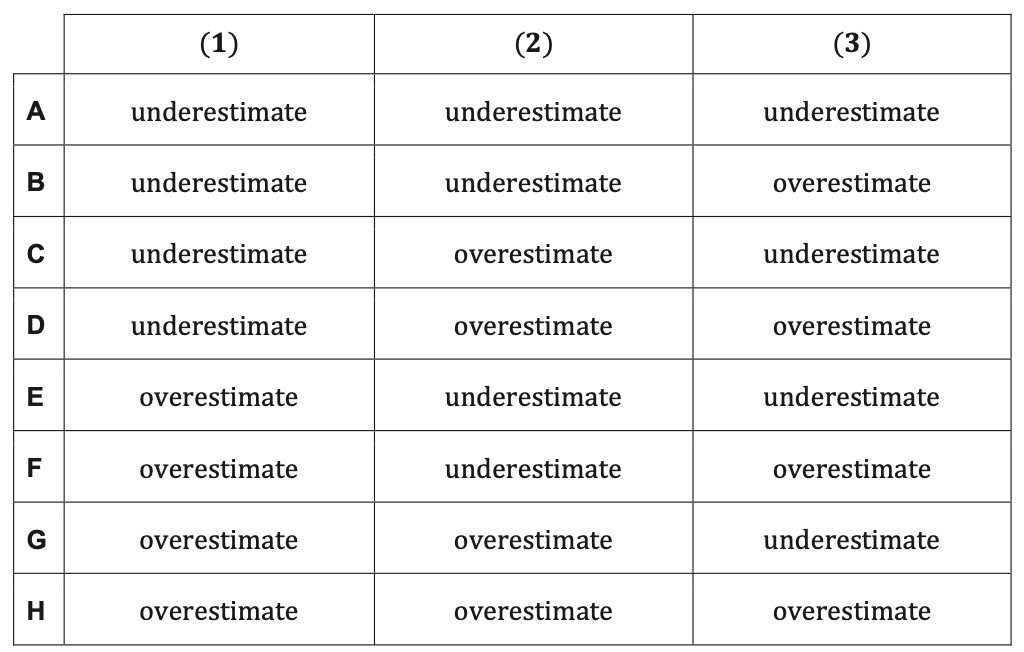
State whether the trapezium rule gives an overestimate or underestimate for each of these areas.
Consider the following three curves:
the curve reflected in the line
The trapezium rule is used to estimate the area under each of these three curves between
and .
State whether the trapezium rule gives an overestimate or underestimate for each of these areas.
- A.underestimate, underestimate, underestimate
- B.underestimate, underestimate, overestimate
- C.underestimate, overestimate, underestimate
- D.underestimate, overestimate, overestimate
- E.overestimate, underestimate, underestimate
- F.overestimate, underestimate, overestimate
- G.overestimate, overestimate, underestimate
- H.overestimate, overestimate, overestimate
Answer: B
Question 16
1 markThe functions and are given by and .
What is the complete set of values of for which one of the functions is increasing and the
other decreasing?
What is the complete set of values of for which one of the functions is increasing and the
other decreasing?
- A.
- B.
- C.,
- D.,
- E.,
- F.,
- G.
Answer: E
Question 17
1 markThe two functions and are defined as follows for positive integers :
What is the smallest positive integer such that ?
What is the smallest positive integer such that ?
- A.22
- B.23
- C.24
- D.25
- E.26
Answer: D
Question 18
1 markThe graph of is translated in the positive -direction by units.
This translation is equivalent to a stretch of factor parallel to the -axis.
What is the value of ?
This translation is equivalent to a stretch of factor parallel to the -axis.
What is the value of ?
- A.0.01
- B.
- C.0.5
- D.2
- E.
- F.100
Answer: A
Question 19
1 markThe set of solutions to the inequality is the interval
where and are real constants with .
In terms of and , what is the set of solutions to the inequality ?
where and are real constants with .
In terms of and , what is the set of solutions to the inequality ?
- A.
- B.
- C.
- D.
- E.
- F.
Answer: D
Question 20
1 markThe lengths of the sides , and in triangle are , and respectively, where and are positive and such that .
What is the full range, in degrees, of possible values for angle ?
What is the full range, in degrees, of possible values for angle ?
- A.
- B.
- C.
- D.
- E.
Answer: E