TMUA 2018 D513/01
20 questions20 marks75Updated July 2025
The TMUA 2018 D513/01 paper in full: all 20 questions, each with its answer. TMUA is the Test of Mathematics for University Admission. Sit it cold under exam timing, mark it, then work back through anything you missed using the solutions below.
Download the original PDF →Questions and answers are free. Full step-by-step worked solutions unlock with a free account. Start practising.
Question 1
1 markFind the value of
- A.
- B.
- C.
- D.-1
- E.
- F.
- G.7
Answer: D
Question 2
1 markAn arithmetic progression has first term and common difference .
The sum of the first 5 terms is equal to the sum of the first 8 terms.
Which one of the following expresses the relationship between and ?
The sum of the first 5 terms is equal to the sum of the first 8 terms.
Which one of the following expresses the relationship between and ?
- A.
- B.
- C.
- D.
- E.
- F.
Answer: C
Question 3
1 markFind the shortest distance between the two circles with equations:
- A.0
- B.4
- C.16
- D.
- E.
Answer: E
Question 4
1 markConsider the simultaneous equations
where is a real constant.
Find the complete set of values of for which the equations have two distinct real
solutions for .
where is a real constant.
Find the complete set of values of for which the equations have two distinct real
solutions for .
- A.There are no values of .
- B.
- C.
- D.
- E. or
- F. or
- G.All real values of
Answer: G
Question 5
1 markThe function is defined by .
, and take the values 1, 2 and 3 with no two of them being equal and not
necessarily in this order.
The remainder when is divided by is .
The remainder when is divided by is .
What is the largest possible value of ?
, and take the values 1, 2 and 3 with no two of them being equal and not
necessarily in this order.
The remainder when is divided by is .
The remainder when is divided by is .
What is the largest possible value of ?
- A.-26
- B.5
- C.7
- D.17
- E.29
Answer: D
Question 6
1 markFind the number of solutions of the equation
with .
with .
- A.0
- B.1
- C.2
- D.3
- E.4
Answer: E
Question 7
1 markThe non-zero constant is chosen so that the coefficients of in the expansions of
and are equal.
What is the value of ?
and are equal.
What is the value of ?
- A.
- B.6
- C.
- D.
- E.
- F.
Answer: A
Question 8
1 markThe sum to infinity of a geometric progression is 6.
The sum to infinity of the squares of each term in the progression is 12.
Find the sum to infinity of the cubes of each term in the progression.
The sum to infinity of the squares of each term in the progression is 12.
Find the sum to infinity of the cubes of each term in the progression.
- A.8
- B.18
- C.24
- D.
- E.72
- F.216
Answer: D
Question 9
1 markFind the complete set of values of the constant for which the cubic equation
has three distinct real solutions.
has three distinct real solutions.
- A.
- B.
- C.
- D.
- E.
- F.
Answer: B
Question 10
1 mark and satisfy and .
What is the greatest possible value of ?
What is the greatest possible value of ?
- A.16
- B.24
- C.32
- D.40
- E.48
- F.There is no greatest possible value.
Answer: E
Question 11
1 markThe line , where , is normal to the curve at the
point .
What is the value of ?
point .
What is the value of ?
- A.
- B.
- C.
- D.
- E.
- F.
Answer: C
Question 12
1 markA curve has equation , where
with .
You are given that:
What is the total area enclosed by the curve and the -axis for ?
with .
You are given that:
What is the total area enclosed by the curve and the -axis for ?
- A.0
- B.1
- C.4
- D.5
- E.6
- F.10
Answer: F
Question 13
1 markThe function has derivative .
The diagram below shows the graph of .
Which point corresponds to a local minimum of ?
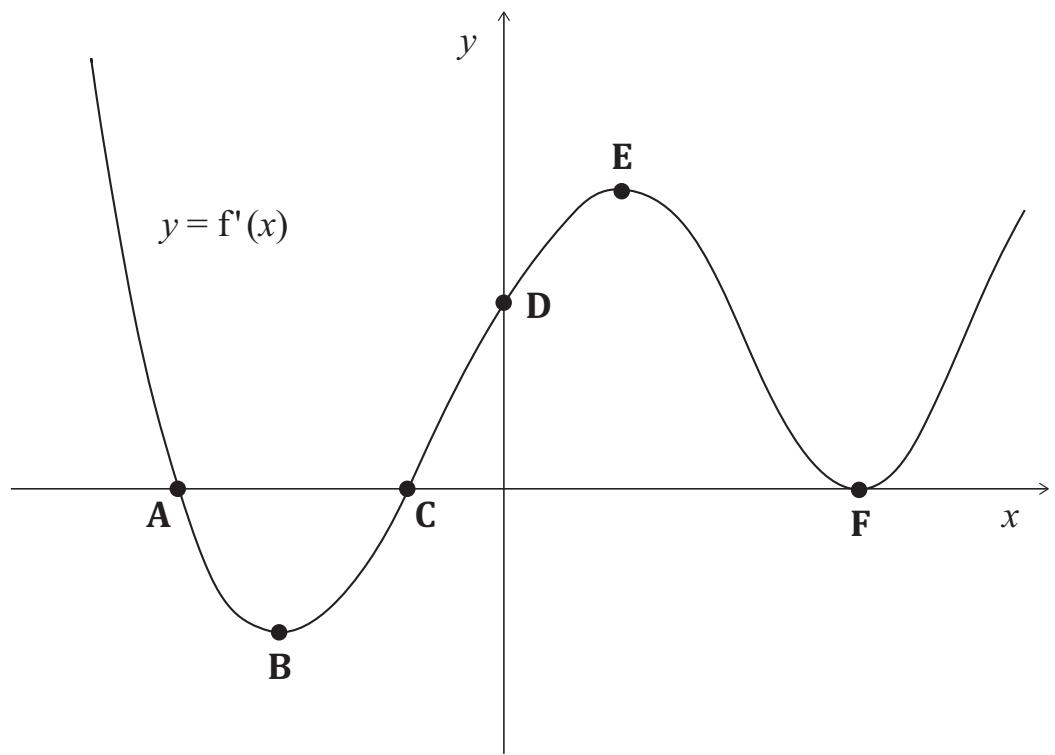
The diagram below shows the graph of .
Which point corresponds to a local minimum of ?
- A.A
- B.B
- C.C
- D.D
- E.E
- F.F
Answer: C
Question 14
1 markThe line passes through the points and .
What are the possible values of ?
What are the possible values of ?
- A. and
- B. and
- C. and
- D. and
- E. and
- F. and
Answer: B
Question 15
1 markFind the sum of the real solutions of the equation:
- A.1
- B.4
- C.9
- D.
- E.
- F.
Answer: E
Question 16
1 markThe curve has equation , where .
Find the value of that minimises the distance between the origin and the
stationary point of the curve .
Find the value of that minimises the distance between the origin and the
stationary point of the curve .
- A.
- B.
- C.
- D.
- E.
- F.
Answer: F
Question 17
1 markThere are two sets of data: the mean of the first set is 15, and the mean of the
second set is 20.
One of the pieces of data from the first set is exchanged with one of the pieces of
data from the second set.
As a result, the mean of the first set of data increases from 15 to 16, and the mean of
the second set of data decreases from 20 to 17.
What is the mean of the set made by combining all the data?
second set is 20.
One of the pieces of data from the first set is exchanged with one of the pieces of
data from the second set.
As a result, the mean of the first set of data increases from 15 to 16, and the mean of
the second set of data decreases from 20 to 17.
What is the mean of the set made by combining all the data?
- A.
- B.
- C.
- D.
- E.
Answer: A
Question 18
1 markWhat is the smallest positive value of for which the line is a line of
symmetry of the graph of ?
symmetry of the graph of ?
- A.
- B.
- C.
- D.
- E.
Answer: B
Question 19
1 markA triangle is to be drawn with , and the angle at equal to , where is a certain specified angle.
Of the two possible triangles that could be drawn, the larger triangle has three times
the area of the smaller one.
What is the value of ?
Of the two possible triangles that could be drawn, the larger triangle has three times
the area of the smaller one.
What is the value of ?
- A.
- B.
- C.
- D.
- E.
- F.
Answer: D
Question 20
1 markFind the value of
- A.0.5
- B.1
- C.1.5
- D.45
- E.45.5
- F.46
Answer: E