TMUA 2020 D513/02
20 questions20 marks75Updated July 2025
The TMUA 2020 D513/02 paper in full: all 20 questions, each with its answer. TMUA is the Test of Mathematics for University Admission. Sit it cold under exam timing, mark it, then work back through anything you missed using the solutions below.
Download the original PDF →Questions and answers are free. Full step-by-step worked solutions unlock with a free account. Start practising.
Question 1
1 markFind the complete set of values of for which the line crosses or touches the curve
- A.
- B.
- C.
- D. or
- E. or
- F. or
Answer: E
Question 2
1 markGiven that and , find the value of
- A.
- B.
- C.
- D.
- E.
- F.
- G.
- H.
Answer: F
Question 3
1 markA student makes the following claim:
For all integers , the expression is divisible by 3.
Here is the student's argument:
(I)
(II)
(III)
(IV)
(V)
which is always a multiple of 3. (VI)
So the expression is always divisible by 3.
Which one of the following is true?
For all integers , the expression is divisible by 3.
Here is the student's argument:
(I)
(II)
(III)
(IV)
(V)
which is always a multiple of 3. (VI)
So the expression is always divisible by 3.
Which one of the following is true?
- A.The argument is correct.
- B.The argument is incorrect, and the first error occurs on line (I).
- C.The argument is incorrect, and the first error occurs on line (II).
- D.The argument is incorrect, and the first error occurs on line (III).
- E.The argument is incorrect, and the first error occurs on line (IV).
- F.The argument is incorrect, and the first error occurs on line (V).
- G.The argument is incorrect, and the first error occurs on line (VI).
Answer: C
Question 4
1 markConsider the following statement:
Every positive integer that is greater than 6 can be written as the sum of two non-prime integers that are greater than 1.
Which of the following is/are counterexample(s) to this statement?
I
II
III
Every positive integer that is greater than 6 can be written as the sum of two non-prime integers that are greater than 1.
Which of the following is/are counterexample(s) to this statement?
I
II
III
- A.none of them
- B.I only
- C.II only
- D.III only
- E.I and II only
- F.I and III only
- G.II and III only
- H.I, II and III
Answer: G
Question 5
1 markWhich one of the following shows the graph of
(Dotted lines indicate asymptotes.)
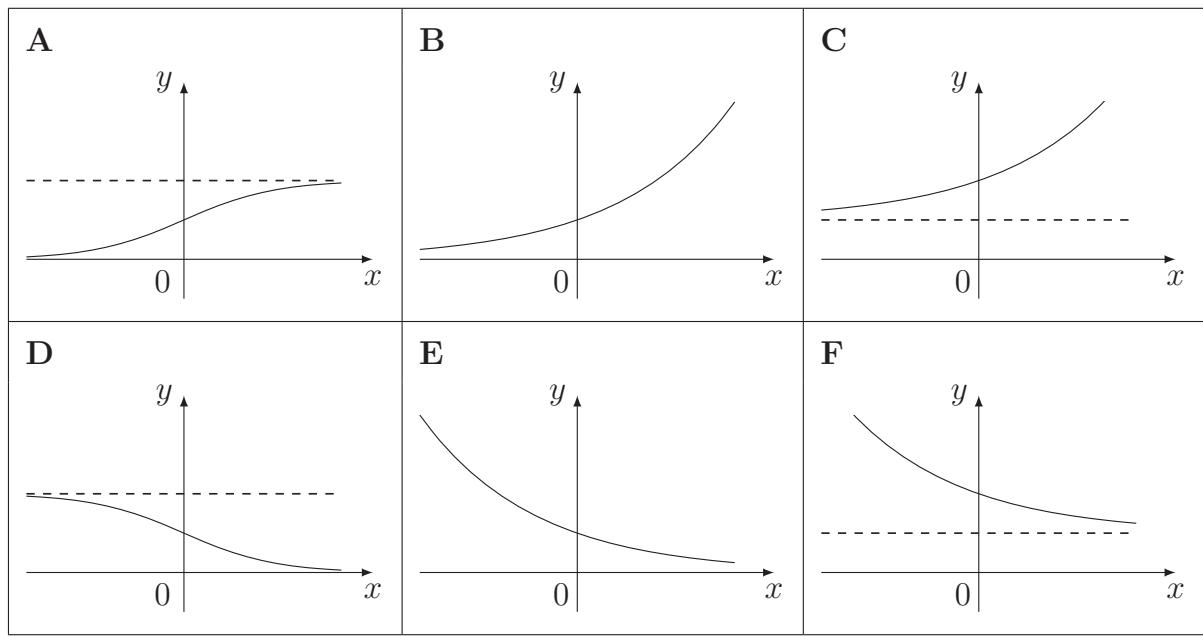
(Dotted lines indicate asymptotes.)
- A.Graph A
- B.Graph B
- C.Graph C
- D.Graph D
- E.Graph E
- F.Graph F
Answer: A
Question 6
1 markThe function is defined for all real values of .
Which of the following conditions on is/are necessary to ensure that
Condition I: for
Condition II: for , where is a constant
Condition III: for
Which of the following conditions on is/are necessary to ensure that
Condition I: for
Condition II: for , where is a constant
Condition III: for
- A.none of them
- B.I only
- C.II only
- D.III only
- E.I and II only
- F.I and III only
- G.II and III only
- H.I, II and III
Answer: A
Question 7
1 markConsider the following conditions on a parallelogram , labelled anticlockwise:
I length of = length of
II The diagonal intersects the diagonal at right angles
III
Which of these conditions is/are individually sufficient for the parallelogram to be a square?
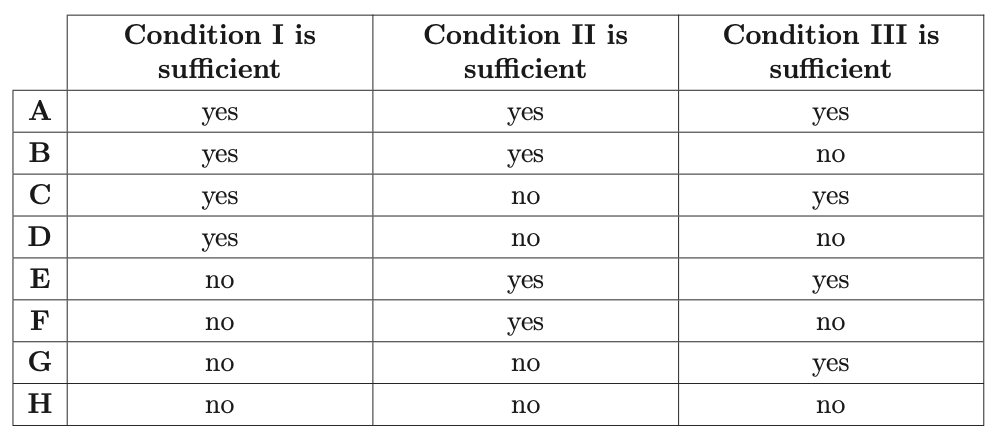
I length of = length of
II The diagonal intersects the diagonal at right angles
III
Which of these conditions is/are individually sufficient for the parallelogram to be a square?
- A.Condition I is sufficient: yes, Condition II is sufficient: yes, Condition III is sufficient: yes
- B.Condition I is sufficient: yes, Condition II is sufficient: yes, Condition III is sufficient: no
- C.Condition I is sufficient: yes, Condition II is sufficient: no, Condition III is sufficient: yes
- D.Condition I is sufficient: yes, Condition II is sufficient: no, Condition III is sufficient: no
- E.Condition I is sufficient: no, Condition II is sufficient: yes, Condition III is sufficient: yes
- F.Condition I is sufficient: no, Condition II is sufficient: yes, Condition III is sufficient: no
- G.Condition I is sufficient: no, Condition II is sufficient: no, Condition III is sufficient: yes
- H.Condition I is sufficient: no, Condition II is sufficient: no, Condition III is sufficient: no
Answer: H
Question 8
1 markA student is asked to prove whether the following statement (*) is true or false:
(*) For all real numbers and ,
The student's proof is as follows:
Statement (*) is false. A counterexample is , , as and , but is false.
Which of the following best describes the student's proof?
(*) For all real numbers and ,
The student's proof is as follows:
Statement (*) is false. A counterexample is , , as and , but is false.
Which of the following best describes the student's proof?
- A.The statement (*) is true, and the student's proof is not correct.
- B.The statement (*) is false, but the student's proof is not correct: the counterexample is not valid.
- C.The statement (*) is false, but the student's proof is not correct: the student needs to give all the values of and where is false.
- D.The statement (*) is false, but the student's proof is not correct: the student should have instead stated that for all real numbers and , .
- E.The statement (*) is false, and the student's proof is fully correct.
Answer: E
Question 9
1 markA student wishes to evaluate the function , where is in radians, but has a calculator that only works in degrees.
What could the student type into their calculator to correctly evaluate ?
What could the student type into their calculator to correctly evaluate ?
- A.
- B.
- C.
- D.
- E.
- F.
Answer: F
Question 10
1 markThe real numbers , , and satisfy both
and
Which of the following inequalities must be true?
I
II
III
and
Which of the following inequalities must be true?
I
II
III
- A.none of them
- B.I only
- C.II only
- D.III only
- E.I and II only
- F.I and III only
- G.II and III only
- H.I, II and III
Answer: F
Question 11
1 markA spiral line is drawn as shown.
This spiral pattern continues indefinitely.
Which one of the following points is not on the spiral line?
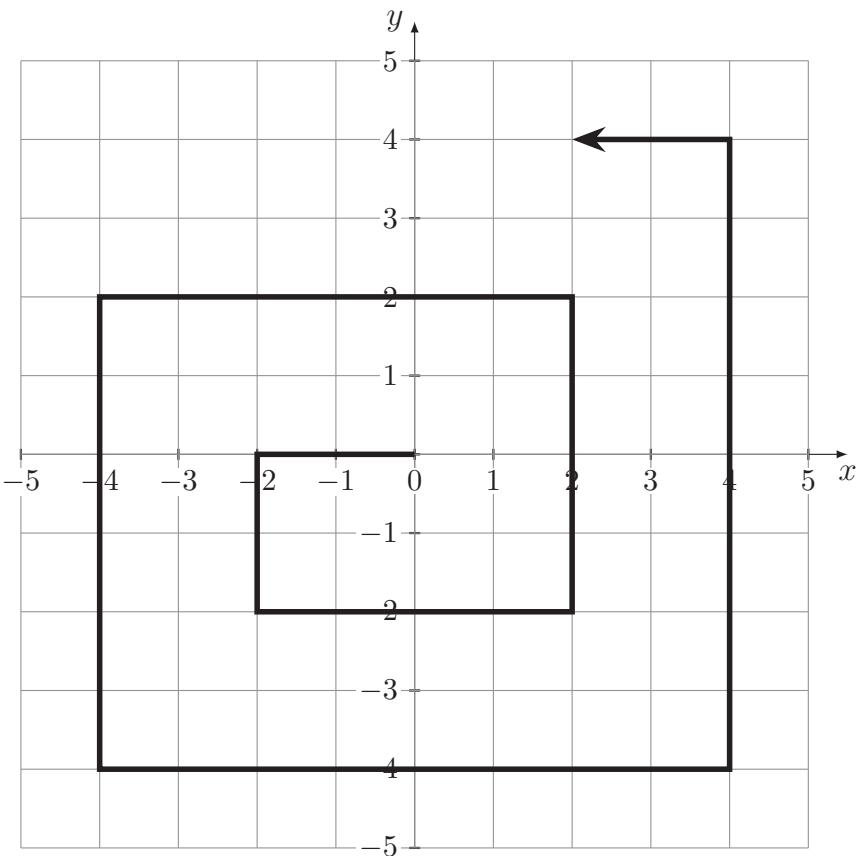
This spiral pattern continues indefinitely.
Which one of the following points is not on the spiral line?
- A.
- B.
- C.
- D.
- E.
- F.
- G.
- H.
Answer: G
Question 12
1 markWhich one of A-F correctly completes the following statement?
Given that , and for all with , the trapezium rule produces an overestimate for ...
Given that , and for all with , the trapezium rule produces an overestimate for ...
- A.... if and for all with
- B.... only if and for all with
- C.... if and only if and for all with
- D.... if and for all with
- E.... only if and for all with
- F.... if and only if and for all with
Answer: D
Question 13
1 mark is a function for which
Which of the following claims about is/are necessarily true?
I for some with
II
Which of the following claims about is/are necessarily true?
I for some with
II
- A.neither of them
- B.I only
- C.II only
- D.I and II
Answer: D
Question 14
1 markAn arithmetic sequence has first term and common difference , where and are non-zero integers.
Property P is:
For some positive integer , the sum of the first terms of the sequence is equal to the sum of the first terms of the sequence.
For example, when and , the sequence has property P, because
i.e. the sum of the first 4 terms equals the sum of the first 8 terms.
Which of the following statements is/are true?
I For to have property P, it is sufficient that .
II For to have property P, it is necessary that is even.
Property P is:
For some positive integer , the sum of the first terms of the sequence is equal to the sum of the first terms of the sequence.
For example, when and , the sequence has property P, because
i.e. the sum of the first 4 terms equals the sum of the first 8 terms.
Which of the following statements is/are true?
I For to have property P, it is sufficient that .
II For to have property P, it is necessary that is even.
- A.neither of them
- B.I only
- C.II only
- D.I and II
Answer: A
Question 15
1 markWhich one of the following is a necessary and sufficient condition for
to be true?
to be true?
- A.
- B. is a multiple of 3
- C. is a multiple of 6
- D. is 1 more than a multiple of 3
- E. is 1 more than a multiple of 6
- F. is 1 more than a multiple of 6 or is 2 more than a multiple of 6
Answer: D
Question 16
1 markThe Fundamental Theorem of Calculus (FTC) tells us that for any polynomial :
A student calculates as follows:
(I)
(II) By FTC,
(III) By FTC,
(IV) So
(V) giving
Which of the following best describes the student's calculation?
A student calculates as follows:
(I)
(II) By FTC,
(III) By FTC,
(IV) So
(V) giving
Which of the following best describes the student's calculation?
- A.The calculation is completely correct.
- B.The calculation is incorrect, and the first error occurs on line (I).
- C.The calculation is incorrect, and the first error occurs on line (II).
- D.The calculation is incorrect, and the first error occurs on line (III).
- E.The calculation is incorrect, and the first error occurs on line (IV).
- F.The calculation is incorrect, and the first error occurs on line (V).
Answer: D
Question 17
1 markA set of six distinct integers is split into two sets of three.
The first set of three integers has a mean of 10 and a median of 8.
The second set of three integers has a mean of 12 and a median of 9.
What is the smallest possible range of the set of all six integers?
The first set of three integers has a mean of 10 and a median of 8.
The second set of three integers has a mean of 12 and a median of 9.
What is the smallest possible range of the set of all six integers?
- A.8
- B.10
- C.11
- D.12
- E.14
- F.15
Answer: E
Question 18
1 markIn this question, and are cubic polynomials.
If for every real , which of the following is/are necessarily true?
I
II if then
III
If for every real , which of the following is/are necessarily true?
I
II if then
III
- A.none of them
- B.I only
- C.II only
- D.III only
- E.I and II only
- F.I and III only
- G.II and III only
- H.I, II and III
Answer: G
Question 19
1 markNine people are sitting in the squares of a 3 by 3 grid, one in each square, as shown.
Two people are called neighbours if they are sitting in squares that share a side.
(People in diagonally adjacent squares, which only have a point in common, are not called neighbours.)
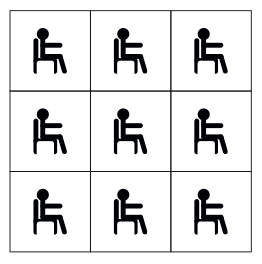
Each of the nine people in the grid is either a truth-teller who always tells the truth, or a liar who always lies.
Every person in the grid says: 'My neighbours are all liars'.
Given only this information, what are the smallest number and the largest number of people who could be telling the truth?
Two people are called neighbours if they are sitting in squares that share a side.
(People in diagonally adjacent squares, which only have a point in common, are not called neighbours.)
Each of the nine people in the grid is either a truth-teller who always tells the truth, or a liar who always lies.
Every person in the grid says: 'My neighbours are all liars'.
Given only this information, what are the smallest number and the largest number of people who could be telling the truth?
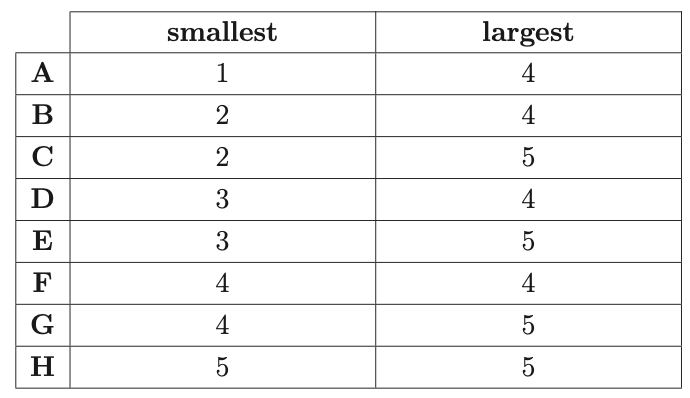
- A.smallest: 1, largest: 4
- B.smallest: 2, largest: 4
- C.smallest: 2, largest: 5
- D.smallest: 3, largest: 4
- E.smallest: 3, largest: 5
- F.smallest: 4, largest: 4
- G.smallest: 4, largest: 5
- H.smallest: 5, largest: 5
Answer: E
Question 20
1 mark is a real number and is a function.
Given that exactly one of the following statements is true, which one is it?
Given that exactly one of the following statements is true, which one is it?
- A. only if
- B. if
- C. only if
- D. if
- E. only if
- F. if and only if
Answer: C