TMUA 2023 D513/02
20 questions20 marks75Updated July 2025
The TMUA 2023 D513/02 paper in full: all 20 questions, each with its answer. TMUA is the Test of Mathematics for University Admission. Sit it cold under exam timing, mark it, then work back through anything you missed using the solutions below.
Download the original PDF →Questions and answers are free. Full step-by-step worked solutions unlock with a free account. Start practising.
Question 1
1 markGiven that
what is the value of x?
what is the value of x?
- A.
- B.
- C.
- D.
- E.50
- F.58
- G.60
- H.80
Answer: H
Question 2
1 markEvaluate
- A.0
- B.2
- C.4
- D.7
- E.14
- F.28
- G.75
- H.175
Answer: F
Question 3
1 markConsider the claim:
For all positive real numbers x and y,
Which of the following is/are a counterexample to the claim?
I
II
III
For all positive real numbers x and y,
Which of the following is/are a counterexample to the claim?
I
II
III
- A.none of them
- B.I only
- C.II only
- D.III only
- E.I and II only
- F.I and III only
- G.II and III only
- H.I, II and III
Answer: C
Question 4
1 markA student attempts to answer the following question.
What is the largest number of consecutive odd integers that are all prime?
The student's attempt is as follows:
I There are two consecutive odd integers that are prime (for example: 17, 19).
II Any three consecutive odd integers can be written in the form for some n.
III If n is one more than a multiple of 3, then is a multiple of 3.
IV If n is two more than a multiple of 3, then is a multiple of 3.
V The only other possibility is that n is a multiple of 3.
VI In each case, one of the integers is a multiple of 3, so not prime.
VII Therefore the largest number of consecutive odd integers that are all prime is two.
Which of the following best describes this attempt?
What is the largest number of consecutive odd integers that are all prime?
The student's attempt is as follows:
I There are two consecutive odd integers that are prime (for example: 17, 19).
II Any three consecutive odd integers can be written in the form for some n.
III If n is one more than a multiple of 3, then is a multiple of 3.
IV If n is two more than a multiple of 3, then is a multiple of 3.
V The only other possibility is that n is a multiple of 3.
VI In each case, one of the integers is a multiple of 3, so not prime.
VII Therefore the largest number of consecutive odd integers that are all prime is two.
Which of the following best describes this attempt?
- A.It is completely correct.
- B.It is incorrect, and the first error is on line I.
- C.It is incorrect, and the first error is on line II.
- D.It is incorrect, and the first error is on line III.
- E.It is incorrect, and the first error is on line IV.
- F.It is incorrect, and the first error is on line V.
- G.It is incorrect, and the first error is on line VI.
- H.It is incorrect, and the first error is on line VII.
Answer: G
Question 5
1 markConsider the two statements
R: k is an integer multiple of
S:
Which of the following statements is true?
R: k is an integer multiple of
S:
Which of the following statements is true?
- A.R is necessary and sufficient for S.
- B.R is necessary but not sufficient for S.
- C.R is sufficient but not necessary for S.
- D.R is not necessary and not sufficient for S.
Answer: A
Question 6
1 markConsider the following equation where a is a real number and :
(*)
Which of the following equations must have the same number of real solutions as (*)?
I
II
III
(*)
Which of the following equations must have the same number of real solutions as (*)?
I
II
III
- A.none of them
- B.I only
- C.II only
- D.III only
- E.I and II only
- F.I and III only
- G.II and III only
- H.I, II and III
Answer: F
Question 7
1 markThe graph of the line is drawn, where a, b and c are real non-zero constants.
Which one of the following is a necessary but not sufficient condition for the line to have a positive gradient and a positive y-intercept?
Which one of the following is a necessary but not sufficient condition for the line to have a positive gradient and a positive y-intercept?
- A. and
- B. and
- C.
- D.
- E.a and c have opposite signs
- F.a and c have the same sign
Answer: E
Question 8
1 markA student draws a triangle that is acute-angled or obtuse-angled but not right-angled.
The student counts the number of straight lines that divide the triangle into two triangles, at least one of which is right-angled.
Which of the following statements is/are true?
I The student can draw a triangle for which there is exactly 1 such straight line.
II The student can draw a triangle for which there are exactly 2 such straight lines.
III The student can draw a triangle for which there are exactly 3 such straight lines.
The student counts the number of straight lines that divide the triangle into two triangles, at least one of which is right-angled.
Which of the following statements is/are true?
I The student can draw a triangle for which there is exactly 1 such straight line.
II The student can draw a triangle for which there are exactly 2 such straight lines.
III The student can draw a triangle for which there are exactly 3 such straight lines.
- A.none of them
- B.I only
- C.II only
- D.III only
- E.I and II only
- F.I and III only
- G.II and III only
- H.I, II and III
Answer: D
Question 9
1 markConsider the following statement about a pentagon P:
(*) If at least one of the interior angles in P is , then all the interior angles in P form an arithmetic sequence.
Which of the following is/are true?
I The statement (*)
II The contrapositive of (*)
III The converse of (*)
(*) If at least one of the interior angles in P is , then all the interior angles in P form an arithmetic sequence.
Which of the following is/are true?
I The statement (*)
II The contrapositive of (*)
III The converse of (*)
- A.none of them
- B.I only
- C.II only
- D.III only
- E.I and II only
- F.I and III only
- G.II and III only
- H.I, II and III
Answer: D
Question 10
1 markHere is an attempt to solve the inequality by completing the square:
I if and only if
II if and only if
III if and only if
IV if and only if
V if and only if
VI if and only if
Which of the following statements is true?
I if and only if
II if and only if
III if and only if
IV if and only if
V if and only if
VI if and only if
Which of the following statements is true?
- A.The argument is completely correct.
- B.The first error occurs in line I.
- C.The first error occurs in line II.
- D.The first error occurs in line III.
- E.The first error occurs in line IV.
- F.The first error occurs in line V.
- G.The first error occurs in line VI.
Answer: A
Question 11
1 markIn this question, k is a positive integer.
Consider the following theorem:
If is a prime, then k is a power of 2. (*)
Which of the following statements, taken individually, is/are equivalent to (*)?
I If k is a power of 2, then is prime.
II is not prime only if k is not a power of 2.
III A sufficient condition for k to be a power of 2 is that is prime.
Consider the following theorem:
If is a prime, then k is a power of 2. (*)
Which of the following statements, taken individually, is/are equivalent to (*)?
I If k is a power of 2, then is prime.
II is not prime only if k is not a power of 2.
III A sufficient condition for k to be a power of 2 is that is prime.
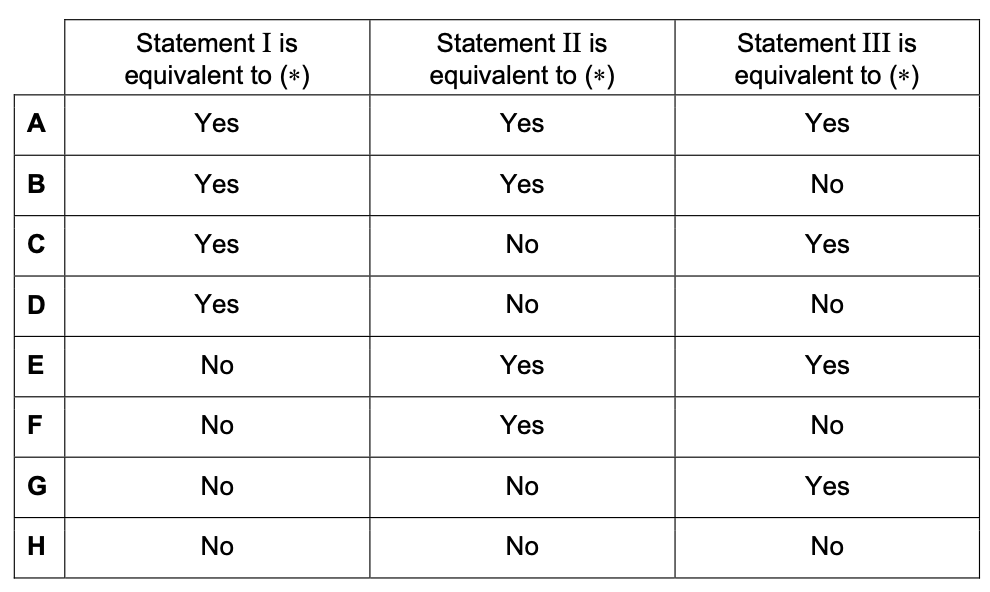
- A.Statement I is equivalent to (*): Yes, Statement II is equivalent to (*): Yes, Statement III is equivalent to (*): Yes
- B.Statement I is equivalent to (*): Yes, Statement II is equivalent to (*): Yes, Statement III is equivalent to (*): No
- C.Statement I is equivalent to (*): Yes, Statement II is equivalent to (*): No, Statement III is equivalent to (*): Yes
- D.Statement I is equivalent to (*): Yes, Statement II is equivalent to (*): No, Statement III is equivalent to (*): No
- E.Statement I is equivalent to (*): No, Statement II is equivalent to (*): Yes, Statement III is equivalent to (*): Yes
- F.Statement I is equivalent to (*): No, Statement II is equivalent to (*): Yes, Statement III is equivalent to (*): No
- G.Statement I is equivalent to (*): No, Statement II is equivalent to (*): No, Statement III is equivalent to (*): Yes
- H.Statement I is equivalent to (*): No, Statement II is equivalent to (*): No, Statement III is equivalent to (*): No
Answer: G
Question 12
1 markIn this question, p is a real constant.
The equation has n distinct solutions in the range
Which of the following statements is/are true?
I is sufficient for
II only if
The equation has n distinct solutions in the range
Which of the following statements is/are true?
I is sufficient for
II only if
- A.none of them
- B.I only
- C.II only
- D.I and II
Answer: C
Question 13
1 markLet x be a real number.
Which one of the following statements is a sufficient condition for exactly three of the other four statements?
Which one of the following statements is a sufficient condition for exactly three of the other four statements?
- A.
- B.
- C. or
- D. or
- E. and
Answer: C
Question 14
1 markThree lines are given by the equations:
where a, b and c are non-zero real numbers.
Which one of the following is correct?
where a, b and c are non-zero real numbers.
Which one of the following is correct?
- A.If two of the lines are parallel, then all three are parallel.
- B.If two of the lines are parallel, then the third is perpendicular to the other two.
- C.If two of the lines are parallel, then the third is parallel to .
- D.If two of the lines are parallel, then the third is perpendicular to .
- E.If two of the lines are perpendicular, then all three meet at a point.
- F.If two of the lines are perpendicular, then the third is parallel to .
- G.If two of the lines are perpendicular, then the third is perpendicular to .
Answer: F
Question 15
1 markThe base 10 number 0.03841 has the value
Similarly, the base 2 number 0.01101 has the value
What is the value of the recurring base 2 number
Similarly, the base 2 number 0.01101 has the value
What is the value of the recurring base 2 number
- A.
- B.
- C.
- D.
- E.
- F.
- G.
- H.
Answer: B
Question 16
1 markA sequence is defined by:
for
where a and b are positive integers. The highest common factor of a and b is 7.
Which of the following statements must be true?
I is a multiple of 7
II If is not a factor of , then is not a factor of for any
III The highest common factor of and is 7
for
where a and b are positive integers. The highest common factor of a and b is 7.
Which of the following statements must be true?
I is a multiple of 7
II If is not a factor of , then is not a factor of for any
III The highest common factor of and is 7
- A.none of them
- B.I only
- C.II only
- D.III only
- E.I and II only
- F.I and III only
- G.II and III only
- H.I, II and III
Answer: B
Question 17
1 markThe ceiling of , written , is defined to be the value of rounded up to the nearest integer.
For example: , ,
What is the value of the following integral?
For example: , ,
What is the value of the following integral?
- A.
- B.
- C.
- D.
- E.
- F.
Answer: F
Question 18
1 markThe equation has four distinct real roots if and only if which of the following conditions is satisfied?
- A.
- B.
- C. and
- D. and
- E. and
- F. and
Answer: D
Question 19
1 markIn this question, is a non-constant polynomial, and
for exactly M real values of x.
for exactly N real values of x.
Which of the following statements is/are true?
I It is possible that
II It is possible that
III It is possible that
for exactly M real values of x.
for exactly N real values of x.
Which of the following statements is/are true?
I It is possible that
II It is possible that
III It is possible that
- A.none of them
- B.I only
- C.II only
- D.III only
- E.I and II only
- F.I and III only
- G.II and III only
- H.I, II and III
Answer: H
Question 20
1 markLet f be a polynomial with real coefficients.
The integral where is defined by
Which of the following statements must be true?
1 only if
2 for all x only if for all
3 only if
The integral where is defined by
Which of the following statements must be true?
1 only if
2 for all x only if for all
3 only if
- A.none of them
- B.1 only
- C.2 only
- D.3 only
- E.1 and 2 only
- F.1 and 3 only
- G.2 and 3 only
- H.1, 2 and 3
Answer: D