Laws of Logarithms
Updated July 2026
Laws of logarithms
including the special cases:
Questions requiring knowledge of the change of base formula will not be set.
Logarithms are very closely related to indices; in fact, they are really the "inverse of indices". They tell you what power a number has to be raised to rather than raising a number to a power. Let's unpack that idea a little bit to get an idea of how logs work. We will start with a few examples to help you get the feel for things and then we will look at logarithms graphically; and then we will move on to exploring [briefly!] how the logarithm rules work.
But before we begin, a teeny little bit of history is useful. Before calculators existed, doing lots of calculations, especially with big numbers, could be complicated. So, logarithms were invented to make the calculations easier [it is worth looking at the history a little bit to understand how clever and inventive mathematicians can be – see the Wikipedia page on the History of Logarithms. Even if you are not keen on history, the background to logarithms is worth exploring.]
Here are some examples using . tells you what power 10 needs to be raised to get a given number:
- because 10 needs to be raised to the power of 1 to get 10:
- because 10 needs to be raised to the power of 2 to get 100:
- because 10 needs to be raised to the power of 3 to get 1000:
- because [you can check this with your calculator]
We can also try using logs to other "bases". tells you what power 2 needs to be raised to get a given number: here are some other [reasonably obvious] examples:
- because 2 needs to be raised to the power of 5 to get 32:
- because 2 needs to be raised to the power of to get :
So, we have in general the following relationship between log and powers:
You should make sure you are very familiar and comfortable with this idea.
A few things to note about this [things might change when you meet more mathematics but then definitions get honed and changed too]:
- We only take logs with a positive base number: so [but ]
- We can only take the logs of positive numbers: so
- The log of a number can be negative: so can be any number [even 0]
You should be able to work out why all three of these statements apply – look back to our discussion on indices if you are not sure. It is important to remember that the log function is not defined for negative numbers – that is we must have . [This was important in a TMUA/ESAT question from a few years ago: TMUA paper 1 2021 question 20.]
Exercise
Work out each of the following:
We can take a brief look at logs and graphs. We will work with base 2 as that gives nice graphs.
First, we draw and look at a few values:
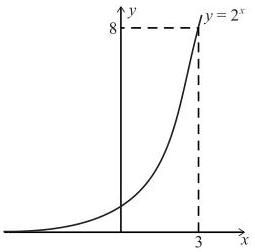
From this, you can see that takes numbers from the -axis and gives us numbers on the -axis: it maps . And also, if you start on the -axis [say with 8] and trace back to what number corresponds to it on the -axis you get the log of the number of the -axis, namely 3. So going backwards from the -axis to the -axis we get .
We can now draw the log graph as it is just the graph of with the and axes swapped [use a graph package to draw and to see how fast they grow – that is exponential growth]:
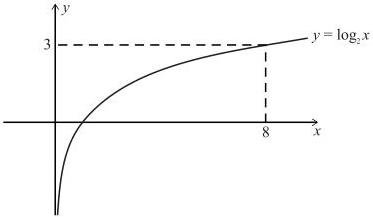
A few things to note here too:
- You can see the graph is only defined for as we expected.
- The graph of crosses the -axis at 1. Can you explain why? [Because and so .]
Now we can look at all the logarithm rules we expect you to know – you should make sure you understand them [i.e. you know how they work and where they come from] and you should make sure you can use them correctly.
We start with . This is really the logarithm equivalent of [think about how this relates to the log equation]. We can see how this equation works as follows:
And make sure you can see what rule we have used at each stage of this. Note we have used one idea that we haven't drawn attention to as yet: . We hope this idea is "obvious" as it is essentially the very definition of a logarithm.
We can now look at the other rules in the same way:
And finally
which should be "obvious" because .
The specification mentions the change of base formula and says it will not be examined in TMUA/ESAT. Nevertheless, it is a useful formula and we recommend you have it in your "remembered formulae" maths kit, and make sure you can derive it and understand it too! We will take a brief look at the formula here [but you can skip this section as it is not part of the TMUA/ESAT and we won't ask questions that depend on it].
The change of base formula allows you to convert from a log with one base to a log with another base; for instance, changing from base 4 to base 7: to .
Before we explore this idea, have a think about how you might go about this task; for instance, how might you find in terms of ?
Let's start with the example we just gave:
Example
Find in terms of .
Let , then . Take of both sides: , which gives , so
We can use the same method to derive the change of base formula:
Example
Change from to .
Let , then . Take of both sides: , which gives , so
and this gives us the change of base formula:
And as a final note, this leads to one more useful formula if we set :
and as we have: