Function Mappings and Common Graphs
Updated July 2026
Functions
Qualitative understanding that a function is a many-to-one (or sometimes just a one-to-one) mapping. Familiarity with the properties of common functions, including (which always means the 'positive square root') and .
Let's start exploring what is meant by a 'function'. In simple terms a function is a mapping [or, better, it is a rule] from a set of input values to a set of output values. Not all algebraic expression are functions and, in this section, we will clarify what special features make something a function.
First, let's look at input and output values. We will be a little loose on notation here and so we will use to denote an algebraic expression and we will usually combine this with an expression for how the rule takes input values [the values] to output values such as . (Strictly a function is denoted by or etc and the value of the function is denoted by or etc; and sometimes functions are written in a different notation as .) And we will often also need to specify what values we are allowed to input into the function – usually this is just all values on the -axis which we call the 'real numbers'. We can be even more casual about things and write '' and whilst this is not strictly perfect, it is ok as mathematicians will know what you are talking about. (In TMUA/ESAT we try to be as accurate as possible in the way we word our questions. We also make sure that the care we take does not get in the way of your understanding what we are asking. So, we might talk about 'the function defined by...' or we might just talk about 'the function ' depending on the needs of the question.)
Now we have a rough idea of how our notation works, we can ask if ALL different expressions that we can construct using are functions. So, is a function, is a function, is a function?
The answer is that not all these expressions are allowed to be called functions. We need one more restriction: an algebraic expression is a function, if for any given value [in the collection of permitted inputs] the expression gives only one output value. So is a function as any value only gives one output value. But is not a function as a single value leads to more than one output value (there is one exception: when ): for instance, if we use we get or .
So here are the things we need to define a function:
- A rule [an algebraic expression] that maps input values to output values.
- A clear list of what we are allowed to input into the rule [this is called the Domain of the function].
- We need to be sure that for each input value in the domain there is only one output value.
We will look in a little more detail and point 2 and point 3:
Point 2: usually the Domain of a function is just assumed to be the whole of the x-axis – that is all the real numbers. And often, if it is assumed that the Domain is just the whole x-axis, then it tends not to be mentioned explicitly. Sometimes you are expected to know the domain of functions so they are not mentioned [an example would be the log function - its domain is just positive x values]. And sometimes the domain of a function is deliberately restricted and then it is always mentioned explicitly [for instance, we could say f(x) = x² + 3 for x ≥ 2]. In the TMUA/ESAT we tend to mention the domain most of the time and you should spend a moment each time thinking about why the domain is as mentioned [usually it is just to make the maths as precise as we can, but this is not always the reason, so you should always look at the details we put in a question]. (The term "domain" for function is not on the TMUA/ESAT specification so you will not see it in the test. Nevertheless, you should know what it means as it is a very common term. Also, we recommend you explore the concept of range [You could also explore the idea of codomain but that can get a bit muddled when you read about it, so it is probably best left alone for the moment.])
Point 3. Whilst there is only one output for each input, it does not follow that two different inputs must have different outputs. For instance, consider f(x) = x² and g(x) = x³. These are both functions – you should check this for yourself using the above definitions. For g(x) = x³ each x input value gives us a unique output, so no two input values give the same output. But for f(x) = x² this is not true as both f(2) = 4 and f(-2) = 4. Even though two different x values give the same output here for f(x) we know that f(x) is a function as each x input value only gives us one output. Functions where each output is unique [occurs only once] are known as one-to-one functions, and any functions that have the same output for [at least some] different input values are known as many-to-one.
There is another way to think about functions which is easier than all the formal stuff above, and that is to consider their graphs. You can tell if an expression is a function from its graph by looking to see if there are any values that have more than one value – if they do then they are not functions. In other words, any vertical line drawn on the graph [through an input value] will only cross the function once.
Here are a few diagrams to help you see what we mean.
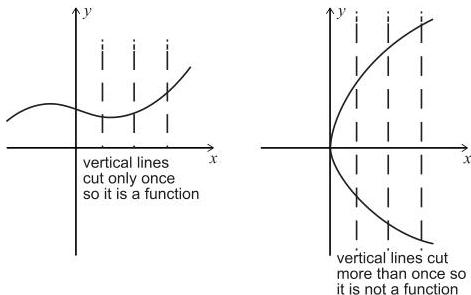
In addition, once we know we have a function using our "vertical line test" we can see if it is one-to-one or many-to-one. If every horizontal line only crosses the function at most in one place then it is one-to-one, but if we can find a horizontal line that crosses the function more than once, then we have a many-to-one function. (The idea of one-to-one and many-to-one is useful when exploring inverses of functions. Only one-to-one functions have inverses because we require the inverse of a function also to be a function. Note that the TMUA/ESAT does not require you to know in general about inverse functions.)
Here are diagrams to help you see what we mean:
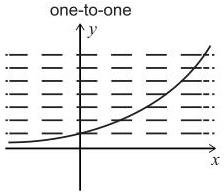
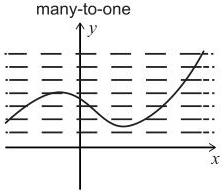
Let's now look at a couple of functions that you will probably meet in the TMUA/ESAT. We will also meet some functions later in these notes and there you should think carefully about domains – for instance, in the logarithm section and in the trigonometry section.
Here we will look briefly at and .
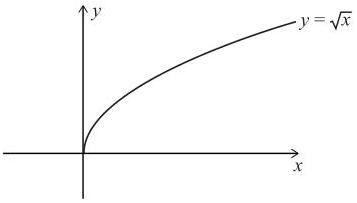
First always means the positive square root of . This is a standard maths convention, and we adopt it without comment in the TMUA/ESAT – whenever we use the square root sign, we will ALWAYS mean the positive square root and we will not comment on that in a question – you are expected to know it! The other thing to notice with this function, and again this is often just assumed, is that the input values will only be the positive real numbers and zero [i.e., ]. (Complex numbers, which you might have met, are not on the TMUA/ESAT specification and we mostly ignore their existence. Occasionally when their existence might add complications to a question, we tend to add a comment to restrict the question to real numbers.)
Here is the graph of [you can see using horizontal and vertical line test that it is one-to-one]:
And now or 'the modulus function'. This takes the positive value of whatever is inside the vertical straight lines. So , , and so on. You should make sure you can deal with expressions including the modulus both algebraically and graphically.
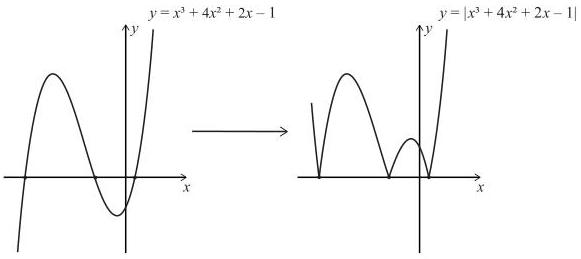
As an aside: a quick way to sketch is to sketch and then reflect everything that is below the -axis in the -axis but leave everything above the -axis alone. Here is a diagram to show what we mean: