Solving Trigonometric Equations
Updated July 2026
Solving trigonometric equations
Solution of simple trigonometric equations in a given interval (this may involve the use of the identities in MM4.5); for example: for ;
You should be comfortable solving equations involving trigonometry and using either graphical or CAST type methods to list the full set of solutions. We will look at a couple of examples and make some useful comments as we work through them. There are lots of approaches to solving equations with trigonometry – you will have learnt some – and you might find you prefer methods that are different from the ones we use and that is fine. What is important is that you make sure you are comfortable with a range of methods and that you do not lose or inadvertently add extra solutions in whatever approach you decide to take.
Example
Solve for
First, we take the square root of both sides and recall that, in this case, we need to consider both positive and negative square roots (don't get confused with what we mentioned about the square root symbol always meaning the positive square root). We get two equations to solve:
Let's look at the first one. We begin by getting the basic solution [essentially, the one that your calculator would give you if you put in ]. We know from earlier that the basic solution here is 30 degrees [or radians].
We can illustrate this solution on a graph or on a CAST diagram. We have also added the next solution of 150 degrees [You should be comfortable using both, even though you might prefer one method over the other].
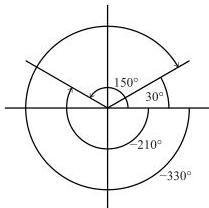
Now we need to be careful as it is very easy to make an error and lose some of the solutions. We will first look at what we should do to get the full set of solutions, and then we will look at a common error to see how easy it is to lose solutions by doing things in the wrong order.
We have a basic solution of
But as we need all solutions between we are going to list some more solutions [BEFORE we do any rearranging]; and because we will be diving by 2 and subtracting 60 to get we need to go beyond the range to . We will list all the relevant solutions [and at the ends of our list we might just list ones that will not be relevant just to be sure – in red]:
Rearranging to get :
And those in the range :
As we mentioned we will also look at a common error that can mean you lose solutions. If you rearrange the basic solution first and then look for general solutions, you will lose some of the solutions. Let's look at this INCORRECT way of solving. We start with
And rearrange to get
And we then use this to generate all the other solutions for in the range . When we do this, we get
We can see how we got these using a simple graph:
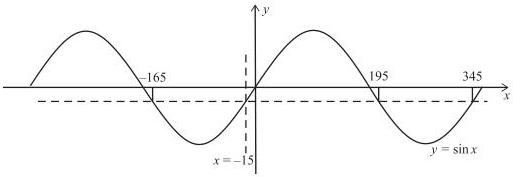
And you can see things have gone wrong. So better to find all your solutions first and then rearrange to find at the end.
We have so far only solved half the question, as we also need to deal with but we will leave that as an "exercise for the reader".
Exercise
Repeat the above solutions for the same question but in radians:
Often trigonometry is mixed with other topics such as quadratics or cubics or inequalities etc. In those cases, you often need to aim to get to expressions of the form or or . Here is an example:
Example
Solve for .
This looks like a quadratic but has both and in it. The first thing we should do (often mathematicians will think of an idea and check it roughly in their heads first before proceeding to check the idea is likely to work; sometimes, an idea that seems like it might work well will flounder later and then you will need to start again and rethink — STEP mathematics questions are a useful resource to help you learn to think through different approaches to questions, see https://www.ocr.org.uk/students/step-mathematics/preparing-for-step/) is convert the to using :
Rearrange [and put to simplify the "look"]:
Factorise and solve for :
So, we get or and solutions .