Mapped to the TMUA specification
ENGAA 2021 (Paper 2)
Engineering Admissions Assessment 2021 is one of the closest available past papers for the Test of Mathematics for University Admission. Below, all 40 questions are mapped to the TMUA topics they test, each with its answer. Sit it cold under exam timing, then work back through anything you missed using the solutions.
What this paper covers on the TMUA
Every question mapped to the Test of Mathematics for University Admission specification, so you know exactly which areas it tests.
- Algebra (26)
- Geometry (17)
- Number (5)
- Ratio and proportion (4)
- Units (4)
- Probability (3)
- Statistics (1)
- Algebra and functions (11)
- Differentiation (5)
- Trigonometry (5)
- Graphs of functions (4)
- Coordinate geometry in the (x,y)-plane (2)
- Integration (2)
- Sequences and series (2)
- Exponentials and logarithms (1)
Question 1
1 markwhere x and y are positive.
- A.
- B.
- C.
- D.
- E.
- F.
- G.
- H.
Answer: E
Question 2
1 mark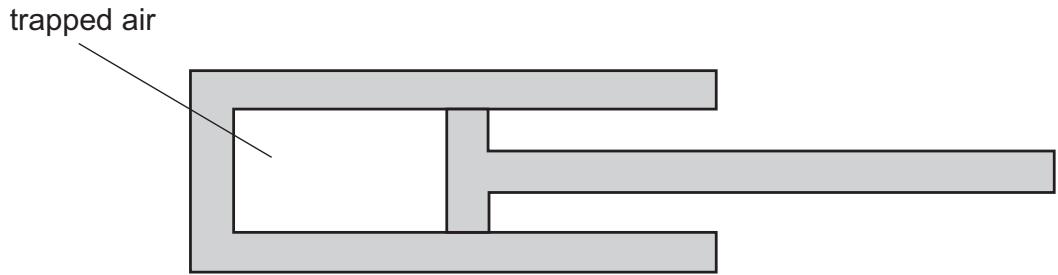
The piston is moved so that the pressure of the trapped air increases by 20%. The temperature of the trapped air does not change.
What is the new density of the trapped air?
(Assume that air is an ideal gas.)
- A.
- B.
- C.
- D.
- E.
- F.
Answer: E
Question 3
1 markso that q is the subject?
- A.
- B.
- C.
- D.
- E.
- F.
- G.
- H.
Answer: D
Question 4
1 markIt is provided with 3.0 kW of electrical power at a current of 12.5 A.
The voltage output is the same as for an ideal transformer, but the current in the output coil is 40 A.
What is the efficiency of the transformer?
- A.20%
- B.25%
- C.31%
- D.69%
- E.75%
- F.80%
- G.91%
- H.100%
Answer: F
Question 5
1 mark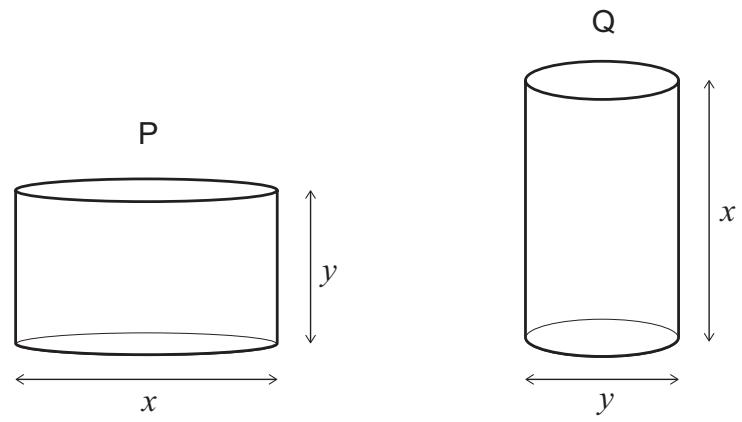
Cylinder P has diameter x and height y.
Cylinder Q has diameter y and height x.
What is the positive difference between the total surface areas of P and Q?
- A.0
- B.
- C.
- D.
- E.
- F.
- G.
Answer: C
Question 6
1 mark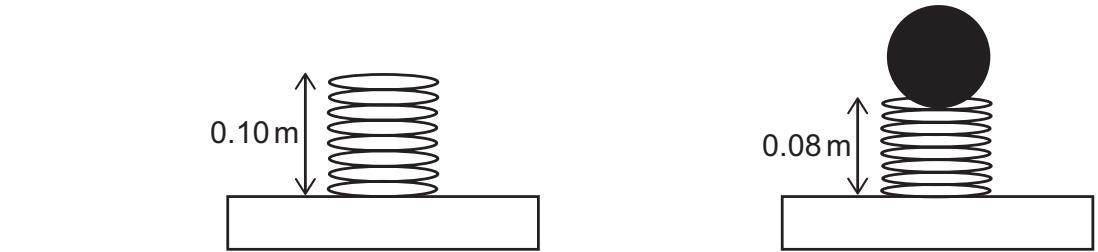
What is the energy stored in the spring due to the compression?
(gravitational field strength = ; the spring obeys Hooke's law)
- A.0.005 J
- B.0.02 J
- C.0.05 J
- D.0.1 J
- E.0.2 J
- F.0.4 J
Answer: C
Question 7
1 markThe price of item Q is increased by 10%. The next day, the new price is reduced by 10%.
How does the final price of each item compare to the original price of that item?
| | item P final price | item Q final price |
| :--- | :--- | :--- |
| A | lower than original | lower than original |
| B | lower than original | higher than original |
| C | higher than original | lower than original |
| D | higher than original | higher than original |
| E | the same as original | the same as original |
- A.item P final price: lower than original, item Q final price: lower than original
- B.item P final price: lower than original, item Q final price: higher than original
- C.item P final price: higher than original, item Q final price: lower than original
- D.item P final price: higher than original, item Q final price: higher than original
- E.item P final price: the same as original, item Q final price: the same as original
Answer: A
Question 8
1 markThe total power transferred by all the lamps is P.
The set is designed so that if one of the lamps fails, that lamp becomes short-circuited and it then has zero resistance. The remaining lamps are still lit.
If this happens, with the set connected to the same supply, what is the new total power transferred by the remaining 19 lamps?
(Assume that the resistance of each functioning lamp remains constant.)
- A.
- B.
- C.P
- D.
- E.
Answer: D
Question 9
1 mark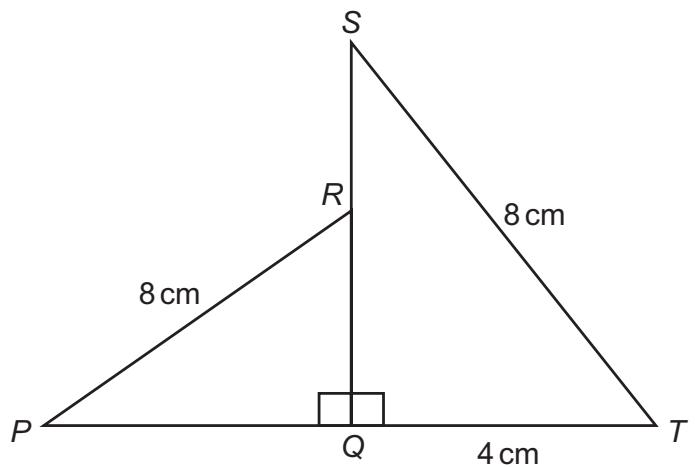
SQT is a right-angled triangle with the right angle at Q.
The point R is on SQ such that SR : RQ = 1:3
QRP is a right-angled triangle with the right angle at Q.
PR = ST = 8 cm
QT = 4 cm
What is the length of PQ, in cm?
- A.
- B.
- C.
- D.
- E.
- F.
Answer: D
Question 10
1 markThe force exerted on the train due to its motors is constant and there is a constant friction force of N.
The graph shows how the momentum of the train changes with time.
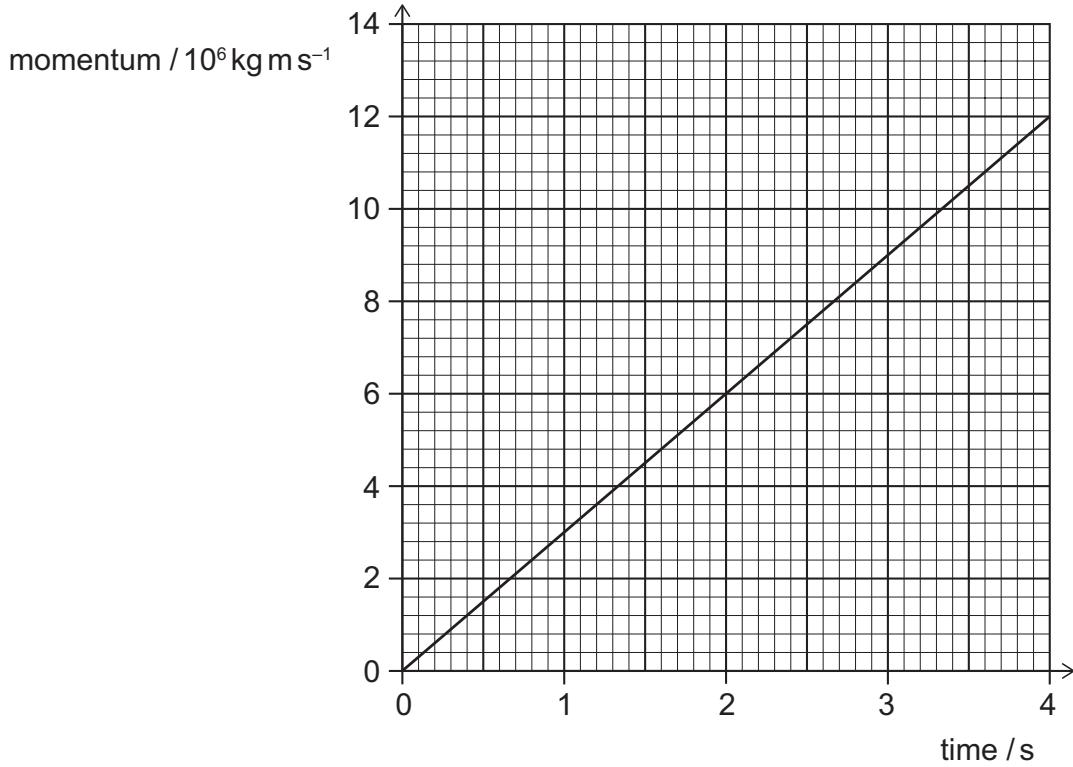
What is the force exerted on the train due to its motors?
- A. N
- B. N
- C. N
- D. N
- E. N
- F. N
- G. N
- H. N
Answer: E
Question 11
1 markGiven that , what is the value of the constant c?
- A.-43
- B.-12
- C.-2
- D.0
- E.2
- F.12
- G.43
Answer: F
Question 12
1 markThe ship has a horizontal speed of . The speed of the wave is .
The front of the ship rises and falls with a time period of 8.0 s.
What is the wavelength of the wave?
- A. m
- B. m
- C.1.0 m
- D. m
- E.24 m
- F.40 m
- G.64 m
- H.88 m
Answer: H
Question 13
1 markwhat is the value of ?
- A.
- B.
- C.
- D.
- E.
- F.
- G.
Answer: F
Question 14
1 mark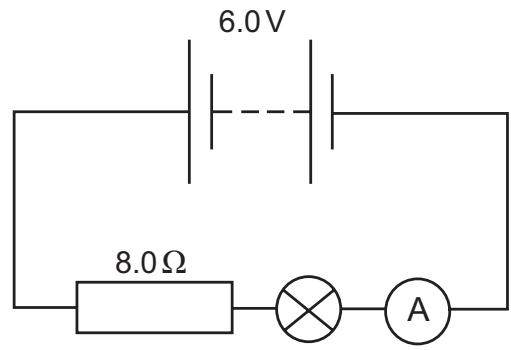
The reading on the ammeter is 0.25 A.
Which graph is a possible V-I graph for the filament lamp?
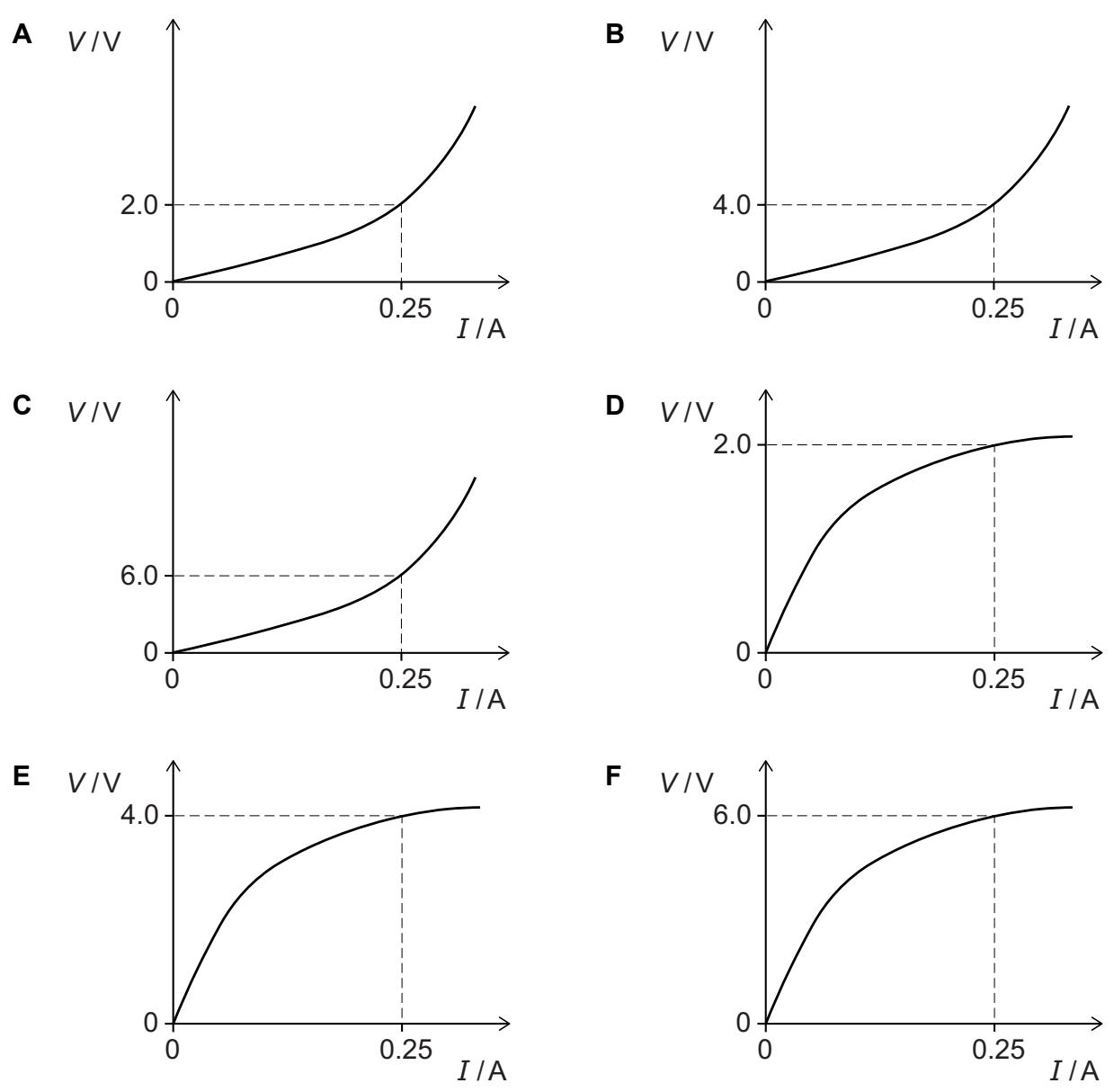
- A.Graph labeled A
- B.Graph labeled B
- C.Graph labeled C
- D.Graph labeled D
- E.Graph labeled E
- F.Graph labeled F
Answer: B
Question 15
1 markThere are nine sweets in total in the bowl.
Charlie eats two sweets from the bowl at random.
The probability of Charlie not eating any green sweets is .
What is the probability that Charlie eats two green sweets?
- A.
- B.
- C.
- D.
- E.
- F.
- G.
Answer: B
Question 16
1 markA radioactive nuclide Y decays in a single stage to a stable nuclide S.
When a rock formed it contained equal numbers of atoms of all four nuclides X, Y, R and S.
The half-life of X is T years and the half-life of Y is 2T years.
What is the value of at a time 4T years after the rock has formed?
(Assume that no other processes add or remove X, Y, R or S from the rock during this time.)
- A.
- B.
- C.
- D.
- E.
- F.2
Answer: C
Question 17
1 mark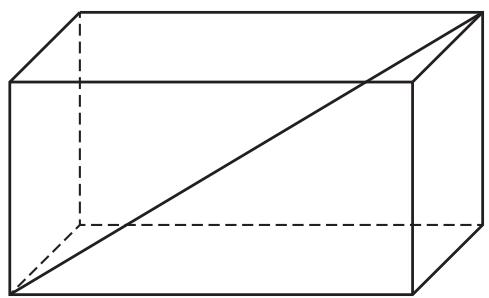
A similar cuboid has all its lengths exactly half the lengths of the original cuboid.
The sides of this smaller cuboid are 2 cm, 3 cm and x cm.
What is the value of x, in cm?
- A.
- B.5
- C.
- D.
- E.
- F.
Answer: A
Question 18
1 markNo heat is transferred between the water and the surroundings (including the beaker).
What is the final temperature of all the water in the beaker after all the ice has melted?
(Take the specific heat capacity of water to be and the specific latent heat of fusion of water to be .)
- A.2.5 °C
- B.8.3 °C
- C.10.0 °C
- D.15.0 °C
- E.16.7 °C
- F.22.5 °C
Answer: D
Question 19
1 markOne kilometre is equivalent to miles.
The car uses one litre of fuel to travel a distance of kilometres.
Fuel for the car costs pence per litre.
Which of the following expressions gives the cost of fuel for this journey, in pounds?
(There are 100 pence in one pound.)
- A.
- B.
- C.
- D.
- E.
- F.
- G.
- H.
Answer: H
Question 20
1 markThe pulse is partially reflected by a crack in the rod and partially by the far end of the rod.
These two reflected pulses travel back along the rod, arriving at the end from which they started at times and , where .
What is the distance between the crack and the of the rod?
- A.
- B.
- C.
- D.
- E.
- F.
Answer: E
Question 21
1 markfind the value of when
- A.-12
- B.
- C.3
- D.
- E.5
Answer: C
Question 22
1 markObject Q of mass 0.75 kg is on a smooth, horizontal plane. A constant force of magnitude F parallel to the plane is applied to Q. As a result Q moves along the plane with constant acceleration.
What is the acceleration of Q?
(gravitational field strength = )
- A.
- B.
- C.
- D.
- E.
- F.
- G.
- H.
Answer: G
Question 23
1 markThe sum of the first k terms of this series is denoted by
Which of the following is a simplification of ?
- A.d
- B.2d
- C.2a + d
- D.2a + 2d
- E.2a + nd
- F.2a + 2nd
- G.2a + (2n - 1)d
- H.2a + (4n - 2)d
Answer: G
Question 24
1 mark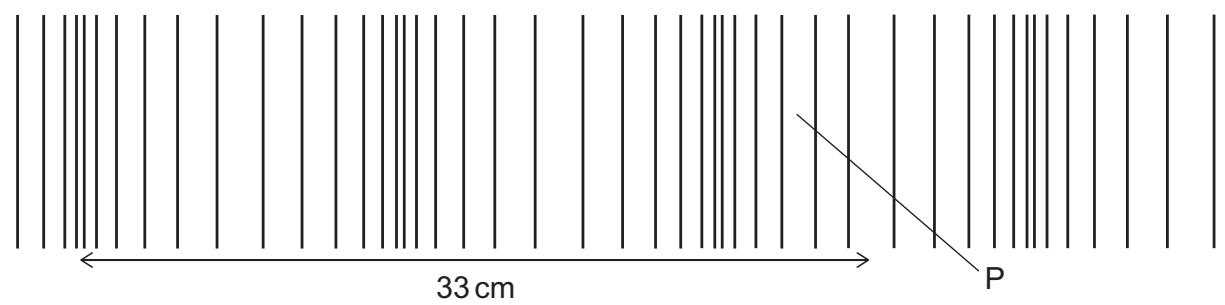
The speed of sound in air is .
What is the frequency of the sound and in which direction has the air at P been displaced from its mean position?
| | frequency of sound / Hz | displacement of air at P |
| :--- | :--- | :--- |
| A | 1000 | to the left |
| B | 2500 | to the left |
| C | 5000 | to the left |
| D | 1000 | to the right |
| E | 2500 | to the right |
| F | 5000 | to the right |
- A.frequency of sound / Hz: 1000, displacement of air at P: to the left
- B.frequency of sound / Hz: 2500, displacement of air at P: to the left
- C.frequency of sound / Hz: 5000, displacement of air at P: to the left
- D.frequency of sound / Hz: 1000, displacement of air at P: to the right
- E.frequency of sound / Hz: 2500, displacement of air at P: to the right
- F.frequency of sound / Hz: 5000, displacement of air at P: to the right
Answer: B
Question 25
1 mark- A.0
- B.1
- C.2
- D.3
- E.4
Answer: D
Question 26
1 mark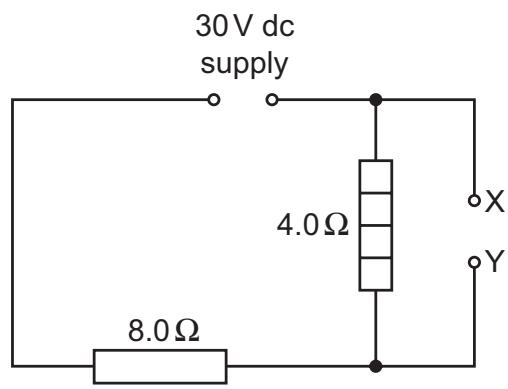
The power transferred in the 4.0 heater is 9.0 W.
What is the resistance of R?
- A.
- B.
- C.
- D.
- E.
Answer: D
Question 27
1 markWhat is the area of the smaller segment?
- A.
- B.
- C.
- D.
- E.
- F.
- G.
- H.
Answer: H
Question 28
1 mark[diagram not to scale]
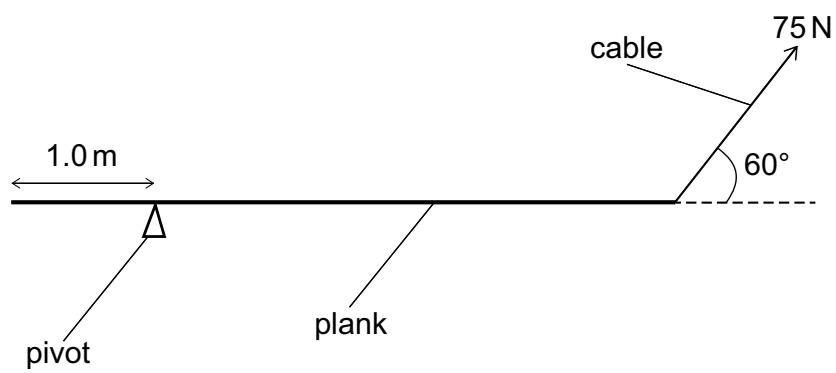
There is a pivot 1.0 m from one end of the plank.
A cable at an angle of to the horizontal supports the plank at the other end so that it is in equilibrium.
The tension in the cable is 75 N.
What is the weight of the plank?
- A.60 N
- B. N
- C.100 N
- D. N
- E.125 N
- F. N
Answer: D
Question 29
1 mark- A.
- B.
- C.
- D.
- E.
- F.
Answer: E
Question 30
1 markOil droplets from the lorry fall a small distance onto the road at a constant rate. The time interval between successive drips is t.
The diagram shows four successive oil droplets on the road after the lorry has passed.

The distance between the first two of these droplets is x and the distance between the final two is y.
Which expression gives the acceleration of the lorry?
- A.
- B.
- C.
- D.
- E.
- F.
Answer: B
Question 31
1 mark(All angles are in radians.)
- A.cos 0.5
- B.cos 0.75
- C.cos 1
- D.sin 0.5
- E.sin 0.75
- F.sin 1
Answer: A
Question 32
1 markWhat is the Young modulus of the metal and how much energy is stored in the extended wire?
(gravitational field strength = ; assume that the wire obeys Hooke's law and that changes in the cross-sectional area are negligible)
| | Young modulus / Pa | energy stored / J |
| :--- | :--- | :--- |
| A | | 0.018 |
| B | | 0.036 |
| C | | 0.018 |
| D | | 0.036 |
| E | | 18 |
| F | | 36 |
- A.Young modulus / Pa: , energy stored / J: 0.018
- B.Young modulus / Pa: , energy stored / J: 0.036
- C.Young modulus / Pa: , energy stored / J: 0.018
- D.Young modulus / Pa: , energy stored / J: 0.036
- E.Young modulus / Pa: , energy stored / J: 18
- F.Young modulus / Pa: , energy stored / J: 36
Answer: C
Question 33
1 markThe sum to infinity of the geometric progression is .
The sum to infinity of the even-numbered terms () is .
What is the value of ?
- A.
- B.
- C.
- D.
- E.
Answer: B
Question 34
1 markAt this instant, the child jumps backwards off the sledge and lands stationary on the slope.
What is the speed of the sledge immediately after the child jumps off?
- A.
- B.
- C.
- D.
- E.
Answer: D
Question 35
1 mark- A.0
- B.1
- C.2
- D.3
- E.4
- F.5
Answer: C
Question 36
1 markThe same piece of putty is now formed into a new uniform cylinder with half the diameter of the first cylinder.
What is the resistance between the ends of the new cylinder?
- A.
- B.
- C.
- D.2R
- E.4R
- F.8R
- G.16R
Answer: G
Question 37
1 mark- A.
- B.
- C.
- D.
- E.
- F.
- G.
- H.
Answer: H
Question 38
1 markwhere t is the time in seconds.
What is its displacement from its original position after 10 s?
- A.22 m
- B.110 m
- C.136 m
- D.140 m
- E.220 m
- F.1100 m
- G.1360 m
- H.1400 m
Answer: D
Question 39
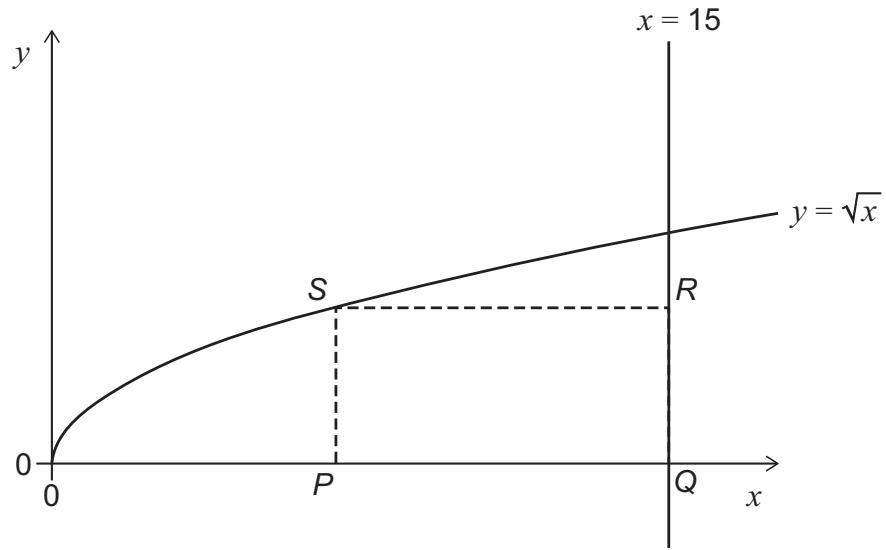
1 markP and Q lie on the x-axis.
Q and R lie on the line
S lies on the curve
What is the maximum possible area of the rectangle?
- A.
- B.
- C.50
- D.
- E.100
- F.125
Answer: B
Question 40
1 markThe trolleys have masses m and 4m and the work done by the spring as it expands is W. Assume that no work is done against frictional forces.
What is the difference in kinetic energy between the two trolleys when the spring has expanded?
- A.0
- B.
- C.
- D.
- E.
- F.
- G.
- H.W
Answer: E