The TMUA 2016 paper in full: all 20 questions, each with its answer and a worked solution that shows every step. TMUA is the Test of Mathematics for University Admission. Sit it cold under exam timing, mark it, then work back through anything you missed using the solutions below.
It is given that the expansion of (ax+b)3 is 8x3–px2+18x–33, where a, b and p are real constants. What is the value of p?
A.−123
B.−63
C.−43
D.−3
E.3
F.43
G.63
H.123
Answer: H
Worked solution
We expand (ax+b)3 and compare with the given expansion. (ax+b)3=a3x3+3a2bx2+3ab2x+b3=8x3−px2+18x−33. So we must have: a3=8 3a2b=−p 3ab2=18 b3=−33 The final equation can be rewritten as b3=−321, so b=−321=−3. Then the third equation becomes 3a×3=18, so a=2. Finally, the second equation gives 3×22×(−3)=−p, so p=123 and the answer is H.
Question 2
1 mark
The expression 3x3+13x2+8x+a, where a is a constant, has (x+2) as a factor. Which one of the following is a complete factorisation of the expression?
A.(x+2)(x−1)(3x–2)
B.(x+2)(x+1)(3x−2)
C.(x+2)(x+1)(3x+2)
D.(x+2)(x−3)(3x+2)
E.(x+2)(x+3)(3x−2)
F.(x+2)(x+3)(3x+2)
Answer: E
Worked solution
We can use the factor theorem to find the value of a; alternatively we can just divide by (x+2) and deduce a that way, as we will need to divide by (x+2) anyway to complete the factorisation. We show both methods. The factor theorem states that in this case, f(−2)=0, where f(x) is the polynomial. So 3(−2)3+13(−2)2+8(−2)+a=0, giving −24+52−16+a=0, so a=−12. We can now divide the polynomial by (x+2). Alternatively, dividing the given polynomial by (x+2) by considering the x3,x2 and x terms, but ignoring the constant term, gives:
3x3+13x2+8x+a=(x+2)(3x2+7x−6)
and so a=−12, though that is actually not needed to answer the question. Finally, we can factorise 3x2+7x−6 to determine the answer. Alternatively, we can use the suggested options: only options D and E give a constant term in the quadratic of −6, so it must be one of those. D expands to 3x2−7x−6 and E expands to 3x2+7x−6, so the answer is E.
Question 3
1 mark
A line is drawn normal to the curve y=x22 at the point on the curve where x=1. This line cuts the x-axis at P and the y-axis at Q. The length of PQ is
A.235
B.4317
C.4717
D.435
E.2355
F.2317
Answer: C
Worked solution
We need to find the gradient of the curve at (1,2). We have y=2x−2 and so dxdy=−4x−3. At x=1, this gives dxdy=−4 and so the normal has gradient 41. As it passes through (1,2), it has equation
y−2=41(x−1).
It cuts the x-axis (y=0) at P, so at P, we have −2=41(x−1), giving x=−7, and so P has coordinates (−7,0). It cuts the y-axis (x=0) at Q, so at Q, we have y−2=41(−1), giving y=47, and so Q has coordinates (0,47). Thus PQ has length
72+(47)2=4742+1=4717
(where we have written 7=47×4 for the first equality). Hence the answer is C.
Question 4
1 mark
The sequence an is defined by the rule: an=(−1)n–(−1)n−1+(−1)n+2 for n≥1. Find the value of
n=1∑39an
A.−39
B.−3
C.−1
D.0
E.1
F.3
G.39
Answer: B
Worked solution
Commentary: This looks quite scary! It is unlikely that you have ever seen a sequence looking like this, so a sensible thing to do is to work out the first few values and look for any patterns. We calculate the first few terms of the sequence: a1=(−1)1−(−1)0+(−1)3=(−1)−1+(−1)=−3 a2=(−1)2−(−1)1+(−1)4=1−(−1)+1=3 a3=(−1)3−(−1)2+(−1)5=(−1)−1+(−1)=−3 a4=(−1)4−(−1)3+(−1)6=1−(−1)+1=3 The pattern is now clear (and we could prove it if we wished to): the sequence goes −3,3,−3,3,⋯−3,3 and so on. So the sum of each pair of terms is zero: a1+a2=0, a3+a4=0, …, a37+a38=0. Thus
What is the total area enclosed between the curve y=x2–1, the x-axis and the lines x=−2 and x=2 ?
A.34
B.38
C.4
D.316
E.12
F.16
Answer: C
Worked solution
To answer this question, it is worth drawing a sketch. The graph is of y=x2−1=(x+1)(x−1), so the parabola intersects the x-axis at (1,0) and (−1,0): To find the area enclosed, we integrate over the three separate regions, from −2 to −1, from −1 to 1, and from 1 to 2:
∫−2−1x2−1dx=[31x3−x]−2−1=(−31+1)−(−38+2)=34
∫−11x2−1dx=[31x3−x]−11=(31−1)−(−31+1)=−34
∫12x2−1dx=[31x3−x]12=(38−2)−(31−1)=34
Thus the three areas are each 34, and the total area is 4, so the answer is C.
Question 6
1 mark
P, Q, and R are each mixtures of red and white paint. The percentage by volume of red paint in P is 30%. The percentage by volume of red paint in Q is 20%. The mixtures P, Q, and R are combined in the proportion 12 : 5 : 3 respectively. If the resulting mixture contains 25% by volume of red paint, what percentage by volume of mixture R is red paint?
A.25%
B.23%
C.1321%
D.1921%
E.943%
F.It is impossible to achieve this result.
Answer: C
Worked solution
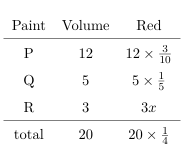
We can either work in fractions or percentages. This solution works in fractions. The fraction of red paint in P is 103 and in Q is 51. Let the fraction of red paint in R be x. The combination is in the ratio 12:5:3, with 41 red paint, so the composition is as follows:
We can now sum the individual red amounts, giving:
12×103+5×51+3x=20×41
so 1023+3x=5, giving 3x=107, so x=1331%. (Note: The arithmetic in the original solution for 23/10 and 7/10 is inconsistent with 12×3/10+5×1/5=4.6. However, the final percentage 1331% is correct for x=2/15, which satisfies 4.6+3x=5.) The correct answer is C.
Question 7
1 mark
60% of a sports club's members are women and the remainder are men. This sports club offers the opportunity to play tennis or cricket. Every member plays exactly one of the two sports. 52 of the male members of the club play cricket; 32 of the cricketing members of the club are women. What is the probability that a member of the club, chosen at random, is a woman who plays tennis?
A.51
B.257
C.31
D.2511
E.53
Answer: B
Worked solution
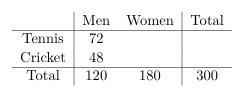
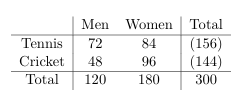
There are two factors for each member: whether the member is a man or woman, and whether the member plays tennis or cricket. We can either display this situation as a tree diagram or as a two-way table. Since the information given has both the fraction of male members who play cricket and the fraction of the cricketing members who are women, it will be simpler to use a two-way table. (In a tree diagram, we could easily display one of the two, but the other will be hard.) We could also work with fractions or with numbers of people. In this solution, we will work with numbers. The 60% suggests that we work with a multiple of 100 people, and the presence of a fraction 31, suggests that we work with a multiple of 3. So we start with 300 people. This is the information we obtain from the 60% of members are women and 31 of the resulting 120 male members play cricket:
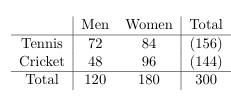
We are also told that 31 of the cricketing members are women, so the 48 cricketing men are 32 of the cricketers, hence 96 cricketers are women, leaving 84 women to play tennis:
(The parenthesised figures are not needed to finish the question.) Therefore the probability that a member of the club, chosen at random, is a woman who plays tennis is 30084=10028=257, and the answer is B.
Question 8
1 mark
Find the maximum angle x in the range 0∘≤x≤360∘ which satisfies the equation
cos2(2x)+3sin(2x)−47=0
A.30∘
B.60∘
C.120∘
D.150∘
E.210∘
F.240∘
G.300∘
H.330∘
Answer: F
Worked solution
We note that the only angle involved is 2x, and 0∘≤x≤360∘ gives 0∘≤2x<720∘. We start by writing everything in terms of sin2x, giving:
(1−sin22x)+3sin2x−47=0
which rearranges to give
sin22x−3sin2x+43=0.
We can apply the quadratic formula to this to obtain
sin2x=23±(3)2−4(1)(43)=23±3−3=23
and hence the possible values of 2x in the range are 2x=60∘,120∘,420∘ and 480∘. Thus the largest possible value of x in the range 0∘≤x≤360∘ is 240∘, and the answer is F.
Question 9
1 mark
The line segment joining the points (3,3) and (7,5) is a diameter of a circle. This circle is translated by 3 units in the negative x-direction, then reflected in the x-axis, and then enlarged by a scale factor of 4 about the centre of the resulting circle. The equation of the final circle is
A.(x−2)2+(y–4)2=320
B.(x–2)2+(y+4)2=320
C.(x−2)2+(y–4)2=80
D.(x–2)2+(y+4)2=80
E.(x–2)2+(y–4)2=20
F.(x−2)2+(y+4)2=20
Answer: D
Worked solution
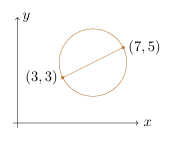
The initial circle looks like this:
The centre of the circle is at the midpoint of this diameter, which is (23+7,23+5)=(5,4), and the radius is therefore
(5−3)2+(4−3)2=5.
The transformations do the following to the centre and radius of the circle:
Therefore the final circle has equation
(x−2)2+(y+4)2=(45)2=80
and the answer is D.
Question 10
1 mark
How many solutions does the equation xtanx=1 have in the interval −2π≤x≤2π ?
A.0
B.1
C.2
D.3
E.4
F.5
G.6
Answer: E
Worked solution
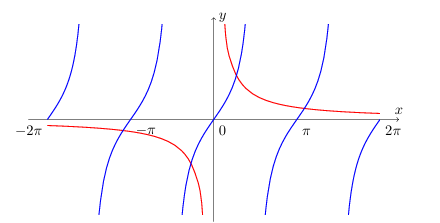
We can rearrange this equation as tanx=x1. (We note that x=0 is not a solution of the original equation xtanx=1, so we can divide by x without losing any solutions.) It is impossible to solve this equation exactly, but we are only asked for the number of solutions. Therefore we sketch the graphs of y=tanx and y=x1 on the same axes, and count the number of intersections.
There are four points of intersection with −2π≤x≤2π, so the answer is 4, which is option E.
Question 11
1 mark
The real roots of the equation 42x+12=22x+3 are p and q, where p>q. The value of p–q can be expressed as
A.43
B.1
C.4
D.−21+log1023
E.log104log103
F.log102log103
Answer: E
Worked solution
This is a quadratic in 22x, so we write y=22x and solve for y. The quadratic becomes
y2+12=8y
as 42x=(22)2x=24x=(22x)2 and 22x+3=22x×23. This rearranges to y2−8y+12=0, which factorises as (y−6)(y−2)=0, so y=6 or y=2. Thus 22x=6 or 22x=2, with the value of x being larger in the first than in the second, so 22p=6 and 22q=2. The options are given in terms of log to base 10, so we take log10 of the first equation. Thus 2plog102=log106 and 2q=1, and hence
p=2log102log106
and
q=21
Therefore
p−q=2log102log106−21
=2log102log106−log102
=log104log103
so the answer is E.
Question 12
1 mark
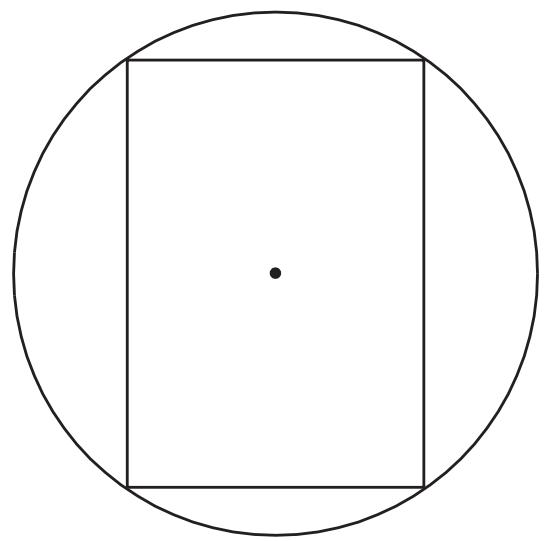
A right circular cylinder is contained within a sphere of radius 5 cm in such a way that the whole of the circumferences of both ends of the cylinder are in contact with the sphere. The diagram shows a planar cross section through the centre of the sphere and cylinder.
[diagram not to scale] Find, in cubic centimetres, the maximum possible volume of the cylinder.
A.250π
B.500π
C.1000π
D.32503π
E.95003π
F.910003π
Answer: E
Worked solution
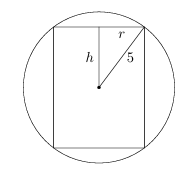
Let the radius of the cylinder be r. Then the diagram is as follows (with all measurements in cm), where we have drawn in two extra lines:
The 5cm is the radius of the sphere and hence of the circle shown (as the cross section is through the centre of the sphere). Pythagoras's theorem gives h2+r2=52, and the volume of the cylinder is V=πr2(2h)=π(52−h2)(2h)=2π(25h−h3). We can maximise this by differentiating with respect to h. (We could write everything in terms of r instead, but that would involve square roots.) We have dhdV=2π(25−3h2), which is zero when 25=3h2, so h=35. Substituting this into the formula for V gives the largest possible V as
How many real roots does the equation 3x5–10x3–120x+30=0 have?
A.1
B.2
C.3
D.4
E.5
Answer: C
Worked solution
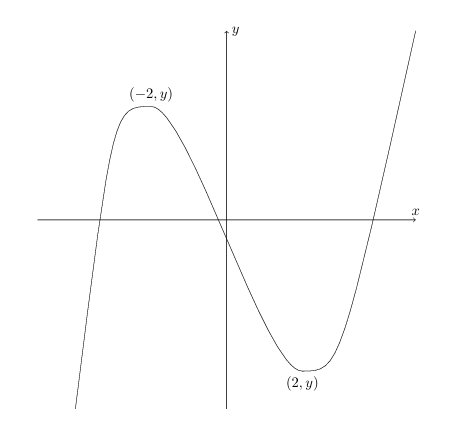
Commentary: This is not something that you will have learnt how to do, and in general, this is a very difficult problem indeed. But we can use the tools at our disposal to do something helpful. We don't know how to solve a quintic (x5) equation, but we can at least try to find the turning (stationary) points, and see where that gets us. We attempt to sketch the graph of y=3x5−10x3−120x+30, or at least think about what a sketch might look like. We calculate
dxdy=15x4−30x2−120=15(x4−2x2−8)=15(x2−4)(x2+2)
so there are stationary points when dxdy=0, that is, when x=2 and when x=−2. We can now calculate the y-coordinates: when x=−2, y=−36+80+240+30>0 (we do not need to calculate the exact value), and when x=2, y=36−80−240+30<0. So the graph must look something like the following:
There are clearly 3 points of intersection of this graph with y=0, so the original equation has 3 real roots, and the answer is C.
Question 14
1 mark
The terms of an infinite series S are formed by adding together the corresponding terms in two infinite geometric series, T and U. The first term of T and the first term of U are each 4. In order, the first three terms of the combined series S are 8, 3, and 45. What is the sum to infinity of S?
A.532
B.320
C.564
D.340
E.16
F.32
Answer: D
Worked solution
Let us write out the first few terms of the three sequences explicitly. Let the common ratio of T be R and the common ratio of U be r.
We are given the first three terms of S, so
8=8
4R+4r=3
4R2+4r2=45
Therefore R+r=43 and R2+r2=165. We can work out the values of R and r by guessing, or we can work them out by solving these equations. We show the second approach here. The first equation gives R=43−r, which we can substitute into the second equation to give
(43−r)2+r2=165
so 2r2−23r+41=0, hence 8r2−6r+1=0, which factorises as (4r−1)(2r−1)=0, giving r=41 or r=21 and R=21 or R=41 respectively. We can therefore work out the sums to infinity of T and U, taking R=21 and r=41:
sum to infinity of T=1−214=8
sum to infinity of U=1−414=316
giving the sum to infinity of S as 316+8=340, since S is the sum of T and U. If we took the values of R and r to be the other way round, we would have the series T and U swapped, but their sum would be unchanged. So the answer is D.
Question 15
1 mark
The least possible value of the gradient of the curve y=(2x+a)(x–2a)2 at the point where x=1, as a varies, is
A.−449
B.−8
C.−425
D.−47
E.−1647
Answer: C
Worked solution
We start by expanding the brackets to get
y=(2x+a)(x2−4ax+4a2)=2x3−7ax2+4a2x+8a3
so the derivative is given by
dxdy=6x2−14ax+4a2.
Therefore at x=1, the gradient is 6−14a+4a2. To find the least possible value of this as a varies, we can either differentiate this expression with respect to a or complete the square. The latter approach gives
so the minimum value is −425 and the answer is C.
Question 16
1 mark
Given the simultaneous equations
log102+log10(y−1)=2log10x
log10(y+3−3x)=0
the values of y are
A.25±235
B.3±3
C.7±33
D.3,9
E.1,13
Answer: C
Worked solution
The first equation involves the sum of two logarithms, so we can rewrite it as:
log10(2(y−1))=log10x2
and so 2(y−1)=x2. The second equation becomes y+3−3x=1, as loga1=0 for any base a. We therefore have two simultaneous equations:
2y−2=x2
y−3x+2=0.
We want to find the values of y, so we rewrite the second equation to eliminate x:
x=3y+2
and so the first equation becomes
2y−2=9(y+2)2
or
18y−18=y2+4y+4
which rearranges to give the quadratic y2−14y+22=0. The solutions to this quadratic are
214±142−4×22=7±72−22=7±27
and so the correct answer is C. It would be good to check whether both of these solutions are valid (though the question does not require us to do so). To be valid, we require both x>0 and y>1. Since 27<6, we see that y>1. Also, as x=31(y+2) and y>0, it follows that x>0. So there are, indeed, two valid solutions.
Question 17
1 mark
It is given that y=(1+2cosx)cos2x for 0<x<π The complete set of values of x for which y is negative is
A.0<x<32π or 43π<x<π
B.0<x<43π or 43π<x<π
C.0<x<32π or 43π<x<π
D.4π<x<32π or 43π<x<π
E.4π<x<32π
F.4π<x<43π
Answer: D
Worked solution
The formula for y is the product of two factors, namely 1+2cosx and cos2x. The whole expression is negative when one of the two factors is positive and the other is negative. The factors change sign when they cross a point where the factor is zero, and we can find these points: • 1+2cosx=0 when cosx=−21, which is when x=32π (within the range 0<x<π).$\n•cos2x=0 when x=4π and when x=43π. We can now make a table showing the signs of the two factors in the different parts of the interval 0<x<π. (This is a useful technique in general.)
Therefore y is negative when 4π<x<32π and when 43π<x<π, and so the answer is D.
Question 18
1 mark
The function x21−x is defined for all x=0. The complete set of values of x for which the function is decreasing is
A.x≤−2,x>0
B.−2<x<0
C.x≤1,x=0
D.x≥1
E.−2≤x≤1,x=0
F.x≤−2,x≥1
Answer: A
Worked solution
This requires us to first differentiate the function. We therefore write y=3x21−x=x−32−x31 which we can differentiate to get
dxdy=−32x−35−31x−32
This is zero when
−32x−35−31x−32=0
, so multiplying by 3x35 to clear fractions in both the coefficients and in the powers gives −2−x=0 so x=−2. (We could also have obtained this by writing −32x−35=31x−32 and dividing one side by the other.) We next need to determine the sign of dxdy in each region. We note that the function is not defined at x=0, so we have to deal with x<0 and x>0 separately. It is also not clear how to find the sign of dxdy directly from its given form, so we first factorise it, giving
dxdy=−31x−35(2+x).
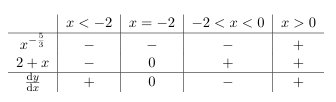
(Incidentally, this gives yet another way to see that the derivative is zero at x=−2.) We can now work out the signs of the two factors, and hence of the derivative, in the various ranges:
It is therefore increasing in the region x<−2 and x>0. (It it not increasing at x=−2, but rather it is stationary at that point.) The correct answer is therefore A (though the question mistakenly says x≤−2).
Question 19
1 mark
The coefficient of x3 in the expansion of (1+2x+3x2)6 is equal to twice the coefficient of x4 in the expansion of (1–ax2)5. Find all possible values of the constant a.
A.±22
B.±17
C.±34
D.±217
E.There are no possible values of a.
Answer: B
Worked solution
We expand the first expression up to powers of x3 to find its coefficient. We can think of the first expression as (1+(2x+3x2))6 and use the binomial theorem to expand it. We note that the first few binomial coefficients are (06)=1;(16)=6;(26)=2!6×5=15;(36)=3!6×5×4=20. We thus have
where we have stopped when the powers reach 3. We can read off the coefficient of x3 from this; it is
15×2×2×3+20×8=340.
(Note: This is interpreted as 15×(2×(2×3))+20×8=15×12+160=180+160=340) We can expand (1−ax2)5 similarly, and obtain
1+(15)(−ax2)+(25)(−ax2)2+⋯=1−5ax2+10a2x4+…
so the coefficient of x4 is 10a2. We are told how these two coefficients relate to each other: we have
340=2×10a2
so a2=17 and a=±17, giving the answer as option B.
Question 20
1 mark
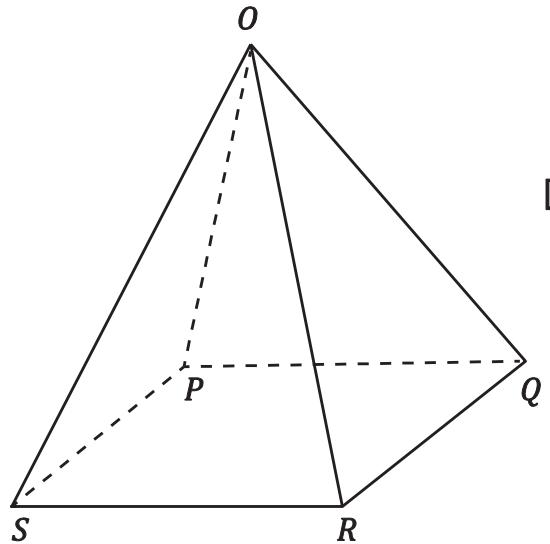
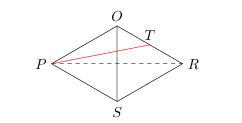
The diagram shows a square-based pyramid with base PQRS and vertex O. All the edges of the pyramid are of length 20 metres.
[diagram not to scale] Find the shortest distance, in metres, along the outer surface of the pyramid from P to the midpoint of OR.
A.105−23
B.103
C.105
D.107
E.105+23
Answer: D
Worked solution
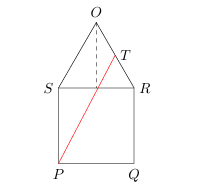
Let us label the midpoint of OR as T, so that we can refer to it. We first observe that since all the edges of the pyramid are of length 20m, the triangles are all equilateral. There are two ways to get from P to the midpoint of OR in a short distance: one can either travel along the base to RS and then along the triangular face to T, or one could travel along the triangular face OPS to the edge OS and from there to T. It is not obvious which route is shorter, so we will calculate both. (There are also routes which are mirror-reflections of these going via the edge QR or OQ.) To find these distances, we can "unfold" the tetrahedron, that is, make a net for the tetrahedron. For the first route, we draw just the faces PQRS and ORS:
The height of the triangle OSR is 20sin60∘=20×23=103, so T lies 53 above the line SR; T also lies 43×20=15 to the right of S (as it is at the midpoint of OR). We can therefore find the length PT using Pythagoras's theorem:
PT2=152+(20+53)2=225+400+2003+75=700+2003
We now look at the other route, which we can do by drawing the triangles OPS and OSR:
Using the height of the triangle as calculated above, P lies 103 to the left of OS and T lies 53 to its right, while T lies 5 above P (being a quarter of OS). Pythagoras's theorem therefore gives
PT2=(153)2+52=225×3+25=700
This is therefore the shorter of the two routes, and its length is 700=107, hence the solution is option D.
TMUA 2016: Questions & Worked Solutions | tmua.fyi