TMUA 2016 (Paper 2)
The TMUA 2016 (Paper 2) paper in full: all 20 questions, each with its answer and a worked solution that shows every step. TMUA is the Test of Mathematics for University Admission. Sit it cold under exam timing, mark it, then work back through anything you missed using the solutions below.
Download the original PDF →Question 1
1 mark- A.
- B.3
- C.
- D.
- E.
- F.18
Answer: A
Worked solution
and so the answer is A.
Question 2
1 mark- A.
- B.
- C.
- D.
Answer: B
Worked solution
so
which is option B.
Question 3
1 mark- A.
- B.
- C.
- D.
- E.
- F.
Answer: D
Worked solution
giving so .
The solutions to lie in the interval , while the solutions to lie in the interval , and thus the largest angle in the range which satisfies the original equation is the largest solution to . This is , which is option D.
Question 4
1 markUrn P This urn contains one or four balls.
Urn Q This urn contains two or four balls.
Urn R This urn contains more than two balls and fewer than five balls.
Urn S This urn contains one or two balls.
Urn T This urn contains fewer than three balls.
Exactly one of the urns has a true statement attached to it.
Which urn is it?
- A.Urn P
- B.Urn Q
- C.Urn R
- D.Urn S
- E.Urn T
Answer: C
Worked solution
* Urn P's statement is true, so the urns each contain one or four balls. As Urn Q has a false statement, there cannot be two or four balls in the urns, and so there is one ball in each urn. But then Urn S has a true statement, which is impossible.
* Urn Q's statement is true, so the urns each contain two or four balls. As Urn P has a false statement, there cannot be one or four balls in each urn, so there are two balls in each urn. But then Urn S has a true statement, which is impossible.
* Urn R's statement is true, so there are three or four balls in each urn. As Urn P's statement is false, there cannot be four balls in the urn, so there are three balls in each urn. This means that Urn Q, Urn S and Urn T each have a false statement, and therefore this is possible.
* Urn S's statement is true, so the urns each contain one or two balls. As Urn P's statement is false, there cannot be one ball in each urn, so there are two balls in each urn. But then Urn Q has a true statement, which is impossible.
* Urn T's statement is true, so the urns each contain one or two balls. But then Urn S's statement is true, which is impossible.
Therefore the only urn which has a true statement is Urn R, so option C is correct.
Question 5
1 mark(*) A whole number is prime if it is 1 less or 5 less than a multiple of 6.
How many counterexamples to (*) are there in the range ?
- A.2
- B.3
- C.4
- D.5
- E.6
Answer: C
Worked solution
If a whole number is less or less than a multiple of , then is prime.
A counterexample to this statement is a whole number which makes this if statement false, that is, it is a whole number that is less or less than a multiple of , but which is not prime. So we list these numbers and check whether they are prime:
| | Prime? |
|---|--------|
| | no |
| | yes |
| | yes |
| | yes |
| | yes |
| | yes |
| | yes |
| | yes |
| | no |
| | yes |
| | yes |
| | no |
| | yes |
| | yes |
| | yes |
| | yes |
| | no |
Thus there are numbers which are counterexamples in this range, and so the answer is C.
Question 6
1 markfor
where .
Find the value of
- A.
- B.
- C.
- D.
- E.
- F.
- G.
- H.
Answer: C
Worked solution
and so the pattern is clear: .
The sum expands to
where on the final line we have summed the geometric series with , , using the formula
The answer is therefore option C.
Question 7
1 markSuppose that they satisfy the equation .
Use some of the lines given to construct a proof that, in this case, it follows that
(*) .
(1) Let and
(2)
(3)
(4)
(5)
(6)
(7)
(8)
(9)
- A.(1). Then (2), so (6), so (8), so (7), and therefore (4), hence (*) as required.
- B.(1). Then (2), so (7), so (8), so (6), and therefore (4), hence (*) as required.
- C.(1). Then (3), so (5), so (9), so (7), and therefore (4), hence (*) as required.
- D.(1). Then (3), so (7), so (9), so (5), and therefore (4), hence (*) as required.
- E.(1). Then (4), so (5), so (9), so (7), and therefore (3), hence (*) as required.
- F.(1). Then (4), so (6), so (8), so (7), and therefore (2), hence (*) as required.
- G.(1). Then (4), so (7), so (8), so (6), and therefore (2), hence (*) as required.
- H.(1). Then (4), so (7), so (9), so (5), and therefore (3), hence (*) as required.
Answer: C
Worked solution
Let and .
We are then given a choice of writing in various ways (line (2), (3) or (4)). We are given
so we can rewrite this using as . Therefore , which is line (3).
Our next choice is between lines (5) and (7) (these are the only options, as the correct answer must be C or D); these are equivalent, but expressed differently. How can we get from to being a power of ? We must rewrite in terms of : since , it follows that , so , which is line (5).
Without doing any more work, the answer must therefore be option C, and the whole proof reads as follows:
Suppose that .
(1) Let and . Then (3) , so (5) , so
(9) , so (7) , and therefore (4) , hence (*) as required.
Question 8
1 markConsider the three statements:
1
2
3
Which of the above statements is/are true for every point in the region?
- A.none
- B.1 only
- C.2 only
- D.3 only
- E.1 and 2 only
- F.1 and 3 only
- G.2 and 3 only
- H.1, 2 and 3
Answer: B
Worked solution
The boundaries of the regions intersect when and ; adding these equations gives , so and , that is, they intersect at .
Therefore for every point in the white region, condition 1, , is satisfied.
However, there are clearly points for which condition 2, , is not satisfied, for example .
Finally, is not immediately clear. This is obtained by multiplying the two inequalities together, but is this permissible? We could try finding a counterexample to this condition. means that is always positive, so a counterexample must have (that is, ) to give a product less than . We could take , giving , and then if we had , the product would be less than . (Recall that the first inequality is equivalent to , so we may do this.) So we have a counterexample: take , , giving , and . Hence this third condition is not true for every point in the region.
Therefore the answer is option B.
Question 9
1 markWhich of these extra conditions, taken independently, would imply that they are congruent?
(1) and
(2) and
(3) and
- A.Condition (1): Does not imply congruent; Condition (2): Does not imply congruent; Condition (3): Does not imply congruent
- B.Condition (1): Does not imply congruent; Condition (2): Does not imply congruent; Condition (3): Implies congruent
- C.Condition (1): Does not imply congruent; Condition (2): Implies congruent; Condition (3): Does not imply congruent
- D.Condition (1): Does not imply congruent; Condition (2): Implies congruent; Condition (3): Implies congruent
- E.Condition (1): Implies congruent; Condition (2): Does not imply congruent; Condition (3): Does not imply congruent
- F.Condition (1): Implies congruent; Condition (2): Does not imply congruent; Condition (3): Implies congruent
- G.Condition (1): Implies congruent; Condition (2): Implies congruent; Condition (3): Does not imply congruent
- H.Condition (1): Implies congruent; Condition (2): Implies congruent; Condition (3): Implies congruent
Answer: D
Worked solution
* side-side-side (SSS): all three corresponding pairs of sides are equal in length
* side-angle-side (SAS): two corresponding pairs of sides are equal in length, and the corresponding included angles are equal
* angle-side-angle (ASA): two corresponding pairs of angles are equal, and the corresponding sides between these angles are equal in length
(1) If we knew that either or the angle equals the angle , then they would certainly be congruent by SSS or SAS. We know that the areas are equal, so we have , and so . This does not imply that though: we could have , for example:
(2) We now have an angle at the end of the given side, so we can use the equal-area property to work out a second side: the angle is included between and , and likewise for . Therefore, as the areas are and , it follows that . The triangles are therefore congruent by SAS.
(3) We now have two pairs of corresponding equal angles, and so the third pair of corresponding angles is also equal and the triangles are similar. Since the areas are equal, they must be congruent.
Hence conditions (2) and (3) each imply that the triangles are congruent, and the answer is option D.
Question 10
1 markWhich one of the following is sufficient to conclude that ?
- A.
- B.
- C.
- D.
- E.
- F.
Answer: E
Worked solution
To show that a condition is not sufficient, we need to find values of and where the condition holds but . To show that a condition is sufficient, we must prove it to be the case.
We can argue algebraically or graphically; we start with an algebraic approach.
A If and , the condition holds but .
B We do not even need to look at negative cases here: if and are both positive, we can take fourth roots and deduce that , for example and .
C If and , then but .
D Positive values of and do not work, but if we take and , then but .
E This looks quite plausible: if we raise this inequality to the power of (which we are allowed to do, as is an increasing function), we get . We can now take cube roots (again, this is permissible as in an increasing function) to give . So this condition is sufficient.
F Arguing as in part E, implies , so this is not sufficient. Alternatively, we can just substitute in the values .
Thus the answer is option E.
We can also see this by looking at the graphs of the functions , and : if these are strictly increasing functions, then if and only if , while if they are strictly decreasing functions, then if and only if .
These are sketches of the graphs of these functions:
Neither of the first two functions is strictly increasing or strictly decreasing (for , note that the function decreases when , but , so it is not a decreasing function). The third function is strictly increasing, so the answer is option E.
Question 11
1 markThe equation has exactly two real roots, and , where .
Consider the following three statements:
1 for exactly one value of between and
2 The area between the curve , the -axis and the lines and is given by
3 The graph of intersects the -axis at the points and only
Which of the above statements must be true?
- A.none
- B.1 only
- C.2 only
- D.3 only
- E.1 and 2 only
- F.1 and 3 only
- G.2 and 3 only
- H.1, 2 and 3
Answer: D
Worked solution
1 It is entirely possible that has multiple stationary points between and without crossing the -axis, for example in this sketch:
Therefore this statement need not be true.
2 This is not necessarily true for (at least) two different reasons:
* If the graph of is entirely below the -axis between and , as in the above sketch, then the integral will be negative, but the area is positive.
* If the graph of is not symmetrical about , then there is no reason that the integral will be twice . An example is this sketch, which is of the graph of ; here , and the graph of is always positive, but it is not symmetrical about :
3 The graph of is obtained by reflecting the graph of in the -axis, so this graph intersects the -axis at and . The graph of is obtained from this by reflecting the graph in the -axis, which does not change the points of intersection with the -axis. Therefore this statement must be true.
The graph obtained by combining these two transformations is the rotation of the original graph about the origin by .
The answer is therefore option D.
Question 12
1 markThe sum of the first terms is denoted by .
If , what can be deduced about the sign of and the sign of ?
- A.both and are negative
- B. is positive, is negative
- C. is negative, is positive
- D.a is negative, but the sign of cannot be deduced
- E. is negative, but the sign of cannot be deduced
- F.neither the sign of nor the sign of can be deduced
Answer: F
Worked solution
so the condition becomes
.
Expanding the brackets gives , which on rearranging gives , or .
If is positive, then is negative, so must be negative. If is negative, then is positive, so could be positive or negative. So can be positive or negative, as can .
We therefore cannot deduce the sign of either or , and so the correct option is F.
Question 13
1 markThe following is an attempted proof of the false statement:
If divides , then divides or divides .
[' divides ' means ' is a factor of ']
Which line contains the error in this proof?
1. The statement is equivalent to ‘if does not divide and does not divide then does not divide '.
2. Suppose does not divide and does not divide . Then the remainder when dividing by is , where , and the remainder when dividing by is , where .
3. So and for some integers and .
4. Thus .
5. So the remainder when dividing by is .
6. Since and , it follows that .
7. Hence does not divide .
- A.Line 1
- B.Line 2
- C.Line 3
- D.Line 4
- E.Line 5
- F.Line 6
Answer: E
Worked solution
1. This looks like it might be the contrapositive of the statement we are aiming to prove; let us check this. The original statement is:
If divides , then divides or divides
so the contrapositive is
If not ( divides or divides ), then not ( divides )
which simplifies to
If not ( divides ) and not ( divides ), then does not divide
or
If does not divide and does not divide , then does not divide
So line 1 is correct.
2. "Suppose ..." starts the proof: we suppose the antecedent of the “if” statement. The part about remainders is correct; this is what it means for to not divide .
3. This is an expression of division with remainder: could be read as " divided by is remainder ." So this line is correct.
4. A small amount of algebra shows that this line is correct.
5. This is not clearly correct: what happens if , for example? We will return to this line in a moment.
6. This is clearly a correct assertion.
7. If line 5 were correct, then this would be correct.
Since we are told that the statement is false, the error must lie in line 5. We have already identified one possible problem, but we can do even better by finding a case where the remainder when dividing by is , showing that does divide . Let us take, for example, . Then if and , we have , so that the remainder is . An explicit example would then be and .
The correct answer is therefore E.
Question 14
1 markSuppose has distinct real solutions, has distinct real solutions,
has distinct real solutions, and has distinct real solutions.
Which one of the following is not possible?
- A. and
- B. and
- C. and
- D. and
- E. and
Answer: B
Worked solution
A quartic with either has a W-shape, or it is a bit like a quadratic in that it has exactly one local minimum. If , the possibilities are the reflections of these.
We can then try to construct curves with the given conditions.
A and indicates that and that is tangent to the curve. So something like this would work, where we have drawn dashed lines to show and . (We could have left out the -axis for clarity.)
(An accurately-plotted quartic would not look quite like this, as you can see if you use graph-drawing software. Nevertheless, the general shape could be correct, with the stationary points in roughly the locations shown.)
We could also draw this schematically as:
We will use this schematic representation for the rest of the cases.
B Again, we require a minimum at . But as there are 4 crossings at , the curve must do something like this:
where the last part is not yet clear.
However, to get , the last minimum must lie above , but then we cannot have . Hence this is not possible.
We look at the other three options for the sake of completeness.
C Again, there is a minimum at , and gives a stationary point at . This sketch does the job:
D Since , we must have and is a maximum. Likewise, must also be a stationary point. The following sketch achieves this:
E This is similar to the previous option: and there is a maximum at . As , there is a stationary point at , which gives the following sketch:
The correct option is B.
Question 15
1 mark(*) has two real roots whose difference is greater than 2 and less than 4.
Which one of the following statements is true if and only if (*) is true?
- A.
- B.
- C.
- D.
- E.
Answer: D
Worked solution
The roots are real if and only if the discriminant is non-negative, so if and only if .
The difference between the roots is , so the condition (*) is true if and only if
and
so it is true if and only if
and
which is true if and only if
and
The first condition is implied by the second condition, so both conditions are true if and only if , which we can rearrange to . Subtracting 1 gives , which is condition D.
We can also show that the other four statements are not true if and only if (*) is true, as follows.
Statement A fails, because the left inequality is not the same as . Statement A is true if (*) is true, but (*) could be true without statement A being true; in other words "statement A is true only if (*) is true" is false.
Statement B fails, because this requires , whereas we could have ; thus, statement B is true only if (*) is true, but “statement B is true if (*) is true” is false.
Statement C fails, because this allows for the difference between the roots to be exactly 2 or 4. So statement C is true if (*) is true, but “statement C is true only if (*) is true” is false.
Finally, statement E fails, because the second inequality is equivalent to , so similarly to statement A, statement E is true if (*) is true, but “statement E is true only if (*) is true” is false.
So the correct option is D.
Question 16
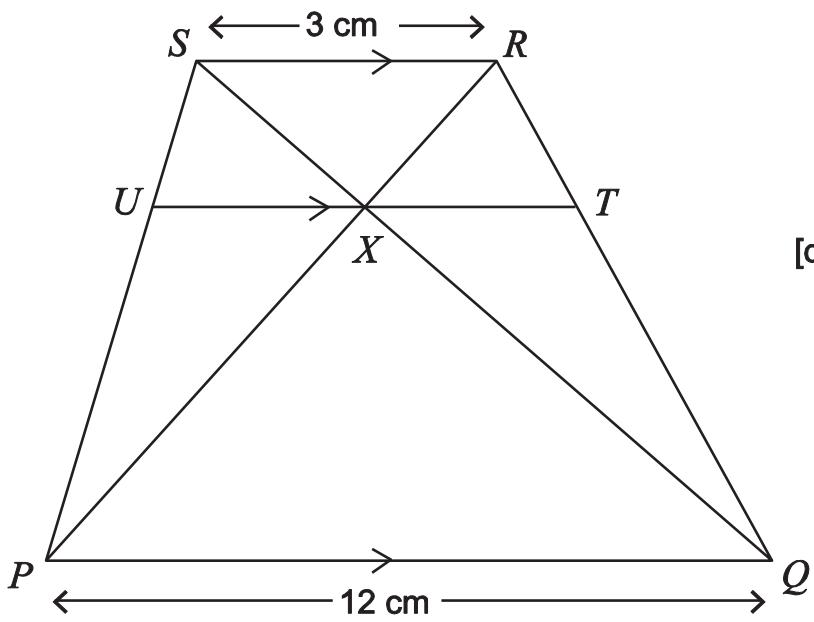
1 markThe diagonals of the trapezium meet at .
lies on and lies on such that is a line segment through parallel to .
The length of is 12 cm and the length of is 3 cm.
What, in centimetres, is the length of ?
- A.4.2
- B.4.5
- C.4.8
- D.5.25
- E.6
Answer: C
Worked solution
We note that and are similar, and are similar, and and are similar.
The last pair is the most helpful to start with, as we know the lengths of two corresponding sides: and , so the scale factor is . Thus the height of (from ) is 4 times the height of (again from ).
It follows that , and so . Since is similar to , and , we must have , so . Likewise, , so and the correct answer is C.
We could alternatively have used the similarity of triangles and , and of triangles and ; we would reach the same result.
Question 17
1 markWhich of the following statements is/are true?
1 For some value of : there is exactly one solution with and there is at least one solution with .
2 For some value of : there is exactly one solution with and there are no solutions with .
3 For some value of : there is exactly one solution with and there are no solutions with .
- A.none
- B.1 only
- C.2 only
- D.3 only
- E.1 and 2 only
- F.1 and 3 only
- G.2 and 3 only
- H.1, 2 and 3
Answer: H
Worked solution
has gradient 1 and -intercept .
We sketch the graph of to help us:
We now consider the statements in turn:
1 To have exactly one solution with and at least one solution with , we could take to be just less than 2. So this statement is true.
2 We want to choose to be negative for this case; if is such that intersects the sine curve at , there will be exactly one solution with . This value of must satisfy , so , so there are no solutions with . So this statement is true.
3 The same value of as in statement 2 will work here: . At , , so there cannot be any solutions with . As the sine graph is below 2 for , there are no solutions there either. So this statement is true.
The correct option is therefore H.
Question 18
1 mark(*) If for all then
Which one of the following functions provides a counterexample to (*)?
- A.
- B.
- C.
- D.
- E.
- F.
Answer: D
Worked solution
So we first check whether these functions satisfy the condition for all :
A This function goes from to as goes from to . So when , . So this function does not satisfy the antecedent.
B Similarly to A, when , , so and this function also does not satisfy the antecedent.
C When , so and this function does not satisfy the antecedent.
D This function looks as though it might satisfy the antecedent, as it does not obviously fail to do so: , so the cubic graph has two stationary points in the interval . We can locate these by differentiating:
so when . As
and ,
we see that the function lies between and when , so in this interval, and the antecedent is satisfied.
E As in C, when , so and this function does not satisfy the antecedent.
F As with D, , so we look for stationary points of the function. We have
so when or . We have and , so the function lies between and when , so the antecedent is satisfied.
We therefore only need to consider the consequent condition for D and F.
For the function in D, the integral on the right, , is zero, since both and are odd functions: the area between 0 and 1 and the area between -1 and 0 are equal, but the first is above the -axis and the second below it, so they cancel each other out. We could also see this by calculating the integral explicitly. The integral on the left, , is the integral of a square, which is never negative, so the integral must be greater than 0. (We could likewise find this exactly by explicit integration.) Thus and the consequent is false. Hence D provides a counterexample.
For the sake of completeness, we will show that F is not a counterexample. Note that for all . This means that for all , and so . Thus F is not a counterexample. (We could, of course, find these integrals by explicitly integrating.)
The correct answer is therefore D.
Question 19
1 markSketches of this object are made by looking at it from the right-hand side, from the front and from above. These sketches are called the side elevation, the front elevation, and the plan view respectively.
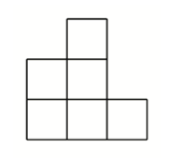
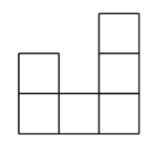
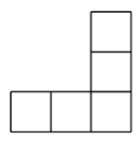
How many cubes were used to construct the object?
- A.exactly 6
- B.either 6 or 7
- C.exactly 7
- D.either 7 or 8
- E.exactly 8
- F.either 8 or 9
- G.exactly 9
Answer: F
Worked solution
Let us show the three layers:
We have used '?' to indicate that we do not yet know where there are cubes. We do, however, know that there must be a cube in at least one of the three layers for each of the five positions.
Next, let us look at the front elevation. This tells us that in the left hand column, we can see two cubes. Since there is only one possible location for the cubes in this column, the first two layers must have a cube and the third not. Likewise, for the middle column, there is only a cube in the bottom layer. In the right hand column, there must be at least one cube in each layer, but it is not yet clear where these would be, as there are three possible positions in each layer.
We now know the following:
Next, let us consider the side elevation. The left hand column, which corresponds to the bottom row of the plan view layers, has height 2, which means that the bottom right corner of the top layer cannot have a cube. The middle column, which corresponds to the middle row of the plan view layers, has height three, so all three of these cubes must be present (as there is only one possible position in the middle row). Finally, the right column, corresponding to the top row of the plan view layers, has height one, so only the bottom layer has a cube in this position.
We thus reach this position:
One of the '?' cubes must be present, to give the required plan view, and the other one may or may not be – it makes no difference to any of the views. So there are either 8 or 9 cubes, and the answer is option F. (Note that we would need the corner of the bottom layer to be 'Y' if it is a single object.)
Question 20
1 markHow many pairs of positive integers and are there for which this statement is true?
- A.none
- B.1
- C.2
- D.3
- E.4
- F.5
- G.6
- H.infinitely many
Answer: E
Worked solution
We start by dividing by for simplicity, giving
Now multiplying both sides by and expanding the brackets gives
which rearranges to
We will look at two methods of solving this equation, starting with a case-based approach.
We know that and must each be at least . If , then , and so this cannot give a solution to (*). So we need only consider and . For each of these, we can solve the equation to find ; if is an integer greater than , we have a solution.
| | | | |
|---|---------------|-------|-----|
| | | | (not integer) |
| | | | |
| | | | |
| | | | |
| | | | |
There are four pairs of and , and the answer is E.
A second approach to solving (*) is to multiply both sides by to eliminate the fractions; this gives
.
We can rearrange this to give , and we can factorise the left hand side by adding or subtracting a constant to get
.
So we need to find two integers which multiply to . Since and are both positive, we must have and (as ), so the possibilities are:
| | | | |
|-------|-------|---|---|
| | | | |
| | | | |
| | | | |
| | | | |
as before.