TMUA Challenge Paper 2 Tmua-p2-challenge-2
20 questions20 marks75Updated August 2026
The TMUA Challenge Paper 2 Tmua-p2-challenge-2 paper in full: all 20 questions, each with its answer. TMUA is the Test of Mathematics for University Admission. Sit it cold under exam timing, mark it, then work back through anything you missed using the solutions below.
Questions and answers are free. Full step-by-step worked solutions unlock with a free account. Start practising.
Question 1
1 markWhich of the following is a counterexample to the claim that is prime for every positive integer ?
- A.
- B.
- C.
- D.
- E.
- F.
- G.
- H.there is none
Answer: E
Question 2
1 markConsider the statement: if and are both rational then is rational. Which of the following is its contrapositive?
- A.If is rational then and are both rational.
- B.If and are not both rational then is irrational.
- C.If is irrational then at least one of and is irrational.
- D.If is irrational then neither nor is rational.
- E.If or is irrational then is irrational.
- F.If and are both irrational then is irrational.
- G.If is rational then at least one of and is rational.
- H.If at least one of and is irrational then is not rational.
Answer: C
Question 3
1 markFor the quadratic with and , , real, the condition is
- A.necessary but not sufficient for two distinct real roots.
- B.necessary and sufficient for two distinct real roots.
- C.neither necessary nor sufficient for two distinct real roots.
- D.sufficient for two distinct real roots only when .
- E.necessary but not sufficient for two distinct real roots of opposite sign.
- F.sufficient but not necessary for two distinct real roots.
- G.equivalent to the discriminant being positive.
- H.necessary and sufficient for two distinct real roots of the same sign.
Answer: F
Question 4
1 markConsider these three statements about real numbers.

Which are true?
Which are true?
- A.none of them
- B. only
- C. only
- D. only
- E. and
- F. and
- G. and
- H., and
Answer: G
Question 5
1 markThe numbers are written on a board. Repeatedly, two of the numbers, and , are rubbed out and is written in their place. After such steps a single number is left. Which of the following must be true of it?
- A.It is .
- B.It is .
- C.It is odd.
- D.It is even.
- E.It is a multiple of .
- F.It is at least .
- G.It is prime.
- H.None of these must be true.
Answer: C
Question 6
1 markThe following argument is offered, where and are non-zero real numbers.
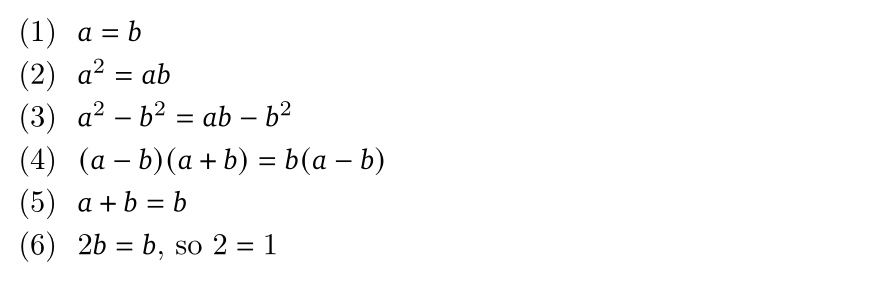
At which step does the argument first fail?
At which step does the argument first fail?
- A.step (2)
- B.step (3)
- C.step (4)
- D.step (5)
- E.step (6)
- F.step (1)
- G.more than one step fails
- H.it does not fail
Answer: D
Question 7
1 markWhich statement best justifies the claim that is divisible by for every integer ?
- A. and always have the same parity.
- B. divides for every integer .
- C., and is always even.
- D.The result holds for and therefore for all .
- E. because has no repeated prime factor.
- F., and a product of three integers is always divisible by .
- G. is even, and every even number is divisible by .
- H. is a product of three consecutive integers, so one of them is a multiple of and at least one is even.
Answer: H
Question 8
1 markConsider the claim: if divides then divides and divides , where and are integers. Which of the following is correct?
- A.True: a square is congruent to or modulo , so a sum of two squares is divisible by only when both squares are.
- B.True, but only when and are both positive.
- C.False, as , shows.
- D.False, as , shows.
- E.True, and it follows at once from the fact that is prime, with no further argument needed.
- F.False, as , shows.
- G.True, because and must therefore divide .
- H.False, as , shows.
Answer: A
Question 9
1 markA sequence and a number are given. Consider the statement

Which of the following is its negation?
Which of the following is its negation?
- A.For every there exists such that for all .
- B.There exists such that for every there exists with .
- C.There exist and such that for all .
- D.For every and every there exists with .
- E.There exists such that for every .
- F.For every there exist and with .
- G.There exists such that for every there exists with .
- H.For every there exists such that for some .
Answer: B
Question 10
1 markWhich of the following establishes that a board cannot be tiled by pieces, each of which covers four squares in a row or in a column?
- A. is not divisible by , so no tiling exists.
- B.Colour the board like a chessboard. Each piece covers two squares of each colour, and the two colours occur unequally often.
- C.No piece can be placed in a corner of the board.
- D.The board has an even number of squares, so any tiling would use an odd number of pieces.
- E.Nothing establishes it: a tiling does exist.
- F.Colour the square in row and column with modulo . Each piece covers all four colours once, so a tiling would need squares of each colour; in fact they occur , , and times.
- G.Colour the columns in the repeating pattern Each piece covers all four colours, and the colours occur , , and times.
- H.A tiling would use pieces, and is odd.
Answer: F
Question 11
1 markThe diagram shows a sketch of , the derivative of a function defined for all real . The curve meets the -axis at and , and touches it at .
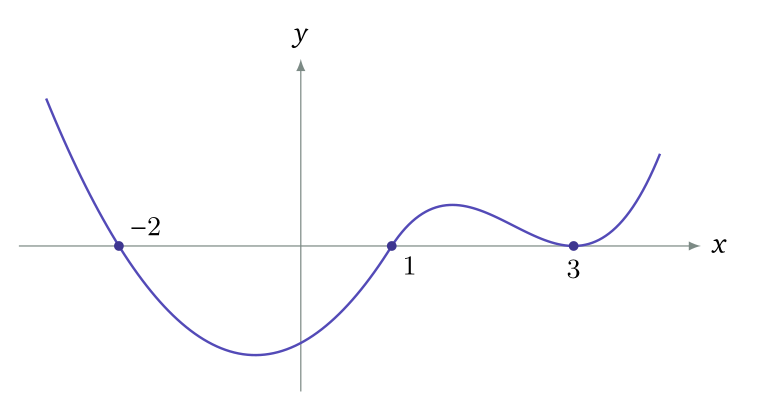
Which statement about is true?
Which statement about is true?
- A. has a local minimum at and a local maximum at .
- B. has exactly two stationary points.
- C. has a local maximum at and a local minimum at .
- D. has a local maximum at , a local minimum at , and a stationary point of inflection at .
- E. is decreasing for .
- F. has a local maximum at .
- G. has a local minimum at .
- H. is increasing for .
Answer: D
Question 12
1 markFive points are placed inside a square of side . Which argument shows that some two of them are a distance at most apart?
- A.Divide the square into four squares of side ; two of the points lie in the same one, and its diagonal is .
- B.The five points cannot all lie at corners of the square.
- C.The average of the ten distances between the points is less than .
- D.Divide the square into five regions; each point lies in one of them.
- E.No argument works: the four corners together with the centre is a counterexample.
- F.The square has diagonal , and half of is .
- G.Divide the square into two rectangles; three of the points lie in the same one.
- H.Any five points in the plane include two at distance at most .
Answer: A
Question 13
1 markOn an island there are red, green and blue chameleons. Whenever two chameleons of different colours meet, both change to the third colour; nothing else changes a chameleon's colour. Which of the following states can be reached?
- A.All red.
- B.All green.
- C.All blue.
- D. of each colour.
- E. red, green and blue.
- F.Any one of "all red", "all green" and "all blue".
- G."All green", but neither of the other two single-colour states.
- H.None of the states listed above.
Answer: H
Question 14
1 markThe inequality holds for every real if and only if
- A.
- B.
- C.
- D.
- E. and
- F. and
- G. or
- H.
Answer: B
Question 15
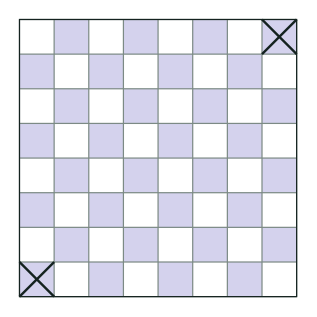
1 markTwo squares at opposite ends of a diagonal are removed from an board, as shown. Can the remaining squares be covered exactly by dominoes, each covering two squares that share an edge?
- A.Yes, and an explicit covering can be written down.
- B.Yes, because is even.
- C.No, because is not divisible by .
- D.No, because no domino can be placed in a corner.
- E.Yes, because .
- F.No, because an odd number of rows is left uncovered.
- G.No: the two removed squares are the same colour, so squares of one colour and of the other remain, while every domino covers one of each.
- H.It depends on which pair of opposite corners is removed.
Answer: G
Question 16
1 markLet be a set of ten distinct positive integers, each less than . Which of the following must be true?
- A. contains two elements whose sum is .
- B. contains three elements in arithmetic progression.
- C. contains two elements whose difference is .
- D.The elements of have sum at least .
- E. has two disjoint non-empty subsets with the same sum.
- F. contains two elements, one of which divides the other.
- G. contains a multiple of .
- H.The largest element of is at least .
Answer: E
Question 17
1 markConsider the statement for all real , if then . Which of the following is correct?
- A.The statement and its converse are both true.
- B.The statement is false, as shows.
- C.The converse is true and the contrapositive is false.
- D.The statement and its contrapositive are true, but the converse is false, as shows.
- E.The statement, its converse and its contrapositive are all false.
- F.The converse and the contrapositive are both true.
- G.The statement is true and its contrapositive is false.
- H.The statement is true, and its converse is false, as shows.
Answer: D
Question 18
1 markHow many of the ten digits can occur as the final digit of a perfect square?
- A.
- B.
- C.
- D.
- E.
- F.
- G.
- H.
Answer: C
Question 19
1 markFor positive real and , which single fact is enough to prove that ?
- A.
- B.
- C.
- D.
- E. and
- F. and
- G.
- H.
Answer: A
Question 20
1 markConsider the statement: for every integer such that is odd, is a multiple of . Which of the following is correct?
- A.It is false, as shows.
- B.It is true, vacuously: is always even, so there is no such .
- C.It is false, as shows.
- D.It is true, and every such happens to be a multiple of .
- E.It is neither true nor false, because no such exists.
- F.It is false, as shows.
- G.It is true, but only because is prime.
- H.It cannot be decided without knowing which integers are allowed.
Answer: B