Solution of Linear and Quadratic Inequalities
Updated July 2026
Solution of linear and quadratic inequalities
The most important things to be aware of when dealing with inequalities is that they do NOT behave quite the same way as equations with equal signs. With inequalities you can add and subtract on both sides as much as you want, but you cannot multiply and divide both sides [or raise both sides to an even power, or apply certain functions to both sides] without first checking that what you are multiplying or dividing by is positive and/or preserves the inequality.
Here are a few examples:
- is true but multiply both sides by to get which is clearly false.
- is true but squaring both sides gives which is clearly false.
- is true and cubing both sides gives which is also true.
- is true but dividing both sides by gives which is clearly false.
- is true but is false while is true.
In general, when dealing with inequalities, it is important to make sure that the way you are manipulating them does not turn a true statement into a false one or generate extra [incorrect] solutions if you are dealing with algebra.
Let's have a look at several examples to illustrate the sorts of things you need to think about as you solve inequalities:
Example 1
Solve .
We can answer this by simple rearranging:
Example 2
Solve .
We will solve this using graph and some algebra.
First, we factorise the left-hand side:
Then we roughly sketch the quadratics and find out what values make the graph sit above the -axis [that is ]:
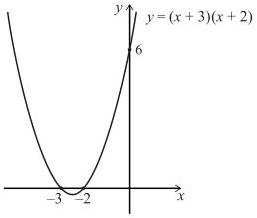
And from the diagram we can see the solution must be or .
Example 3
Solve:
It is very tempting [but not a good strategy] to multiply both side of this expression by . However, as is negative for some values of the inequality sign will then be the wrong way around for some values of and lead to a slight mess. Instead, we need to adjust our algebraic approach slightly and the best thing to do is to multiply both sides by which we know is always positive for all real values and so it will not affect the inequality sign:
Giving [note we rearrange rather than multiply out as we have a common factor we can extract]:
And on simplifying
Which is solved as in example 2 above.
Make sure you are familiar with various techniques for solving inequalities – there are lots of ways of approaching things and you might have learnt some that we have not mentioned above – the main approaches tend to be via algebra and graphs or via using number lines.
As an aside, it is useful to know how to write ranges correctly, particularly as it is common to see incorrect expressions.
Let's look at a couple of howlers:
in this case, it is clear what is meant but we tend to read strings of inequalities as a single 'sentence' and this expression is really two separate statements scrunched together [it is presumably meant to be '1 < x or x < -5']. It is, of course, ok to write things like -3 < x < 5 as the whole expression makes sense, and it is true also that -3 < 5.
Here is another one:
this is [presumably] incorrect as there are no values that satisfy both -2 < and [look at how 'and' is used in the Notes on Logic and Proof that we have written for TMUA paper 2]. Here, it would have been better to write either: '-2 < or ' and perhaps even better ' or ' and sometimes just ', '. Our preference would be to use 'or'.
Let's now turn to look at inequalities involving the modulus sign. We will use some sketches in this section, but we will postpone a detailed look at modulus graph sketching until later.
We start by looking at a simple modulus function. We are going to look at:
Recall first that means 'the positive value of . So when then and when then .
We can sketch this:
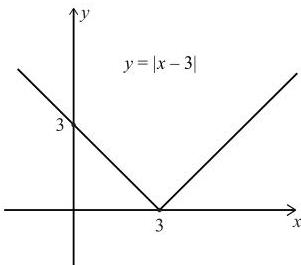
But the best way to think about the meaning of is as a measure of the [positive] distance of from 3 on the number line. Keep this idea in mind as we look at some inequalities involving the modulus.
Let's start by solving the inequality:
We can solve this graphically by sketching both and and working out for which values the graph of is below [or the values are less than] the graph of :
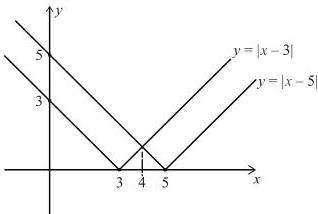
And from the diagram, we see that the values that make the inequality correct [or true] are .
Another way of thinking of the inequality is asking what are the values that are closer to 3 than they are to 5. And a little thought leads rapidly to the solution .
How might we use these ideas to solve slightly more complicated inequalities? For instance, what about the inequality which we can rewrite as . We can solve this with a sketch.
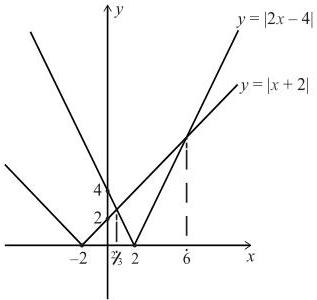
The inequality asks for the values for which the graph of sits 'below' [less than] the graph of and this gives .
It is worth spending a moment to look at how we found the values and 6 from the graphs. If you are not sure of how we get some of the equations here, you should read the section on modulus graph sketching later in these notes.
To find the value we use the sketch to guide us as it tells us we need to solve where the minus sign arises because we are looking at the 'flipped' part of . And to find the value 6 we solve .
Or we can think about it as before as asking when is twice the distance of from 2 less than the distance of from . A little thought [more than before] gives us the answer: .
Comment
There is a wide range of inequalities we could look at in the TMUA/ESAT. What is important is that you understand what inequalities are, and that you have a set of techniques to solve them – relying just on algorithms for solving without understanding is dangerous and limiting. We have looked at a few inequalities above and also looked at some [but not all] techniques for solving them.