Simultaneous Equations Substitution
Updated July 2026
Simultaneous equations
Simultaneous equations: analytical solution by substitution, e.g. of one linear and one quadratic equation.
In this section, we will look at simultaneous equations. We will look at what simultaneous equations are and then we will investigate how we can solve them. After that, we will look at how the solutions to simultaneous equations fit with the corresponding graphs of the equations.
Let's start by stepping back and exploring how we might think about equations and their graphs in general terms.
We start by considering the simple [linear] equation where is taken from the real numbers. This equation is really a quick way of writing out a [very large] set of number pairs: for instance, when , so the number pair is in the set; as is and and etc. In fact, the set of number pairs represented by the equation where is real is so large that we can never write out all the members of the set [it is 'uncountably infinite'; if you are interested, look up Cantor's infinities]. Nevertheless, it is just a very large set of number pairs that all obey the pattern .
In other words, we can think of an equation [once we are given all the possible values – e.g., is real, or is real and etc., etc.] as a quick way of summarising a very large set of number pairs. We also know there is a very clever way of drawing all these number pairs on a diagram – that is we draw the line and each point on the line we draw represents one of the number pairs from the set. This may all seem trivial to you but when the idea of drawing pictures [i.e. graphs] of equations was first introduced it was a major change for the way people could do and understand mathematics – this move from algebra and sets of number pairs to geometry is something we take for granted now but it was not always that way [the plane, also known as the Cartesian plane, was introduced to mathematics in 1637 by Rene Descartes. He first thought of the idea, so we are told, thanks to his watching a fly on a ceiling]. It is very useful to get used to trying to understand how anything algebraic you meet can be interpreted geometrically and vice versa; sometimes this is not an easy task but when you see connections between algebra and geometry as you progress as a mathematician, you will find your understanding is greatly enhanced.
Now let's turn to look at simultaneous equations and to learn what is meant by solving them and how to interpret their solutions.
Here are two equations:
We are going to find what and values make both of these equations true at the same time [i.e., simultaneously] – that is what we mean by "solving" the equations simultaneously. In other words, we are looking for the number pairs that appear in both the set of number pairs for and the set of number pairs for . And, if we think geometrically, that must be where the graphs of the equations [which are, recall, pictures of all the number pairs] cross – because the point where they cross must be in both sets.
We will look at three ways of solving these: by substitution; by elimination; and graphically.
By substitution
We make the subject of the equation to get and then we replace in the second equation by : so, becomes . Then simplifying: so and because we find that . So, the solution to the simultaneous equations is and .
By elimination
[This is really like technique 1 but written a little differently]:
We make the number of 's in each equation the same [we could have chosen to do this for instead]:
Then we have:
And subtracting the bottom equation from the top one, we get:
Which gives and then as before.
Graphically
We draw the graph of each equation and look at the point where they cross:
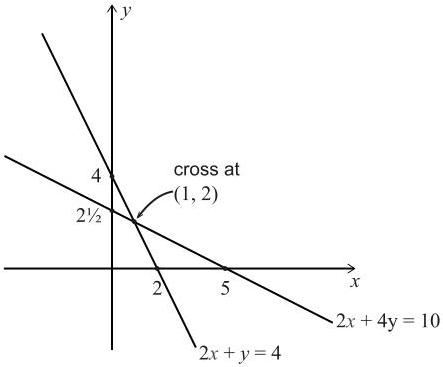
Let's look now at simultaneous [linear] equations in more general terms. And recall, linear equations are ones that have graphs which are straight lines. We are going to ask how many solutions there are for a pair of simultaneous linear equations. And we are going to answer the question by looking at the different ways we can draw two straight lines on the plane.
We can draw two straight lines on the plane in three different ways:
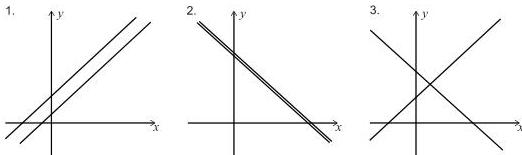
-
Two lines that are parallel and distinct. These lines will not cross and so have no solutions. Let's have a quick look at the equations of two such lines: because they are parallel, they must have the same gradient so the ratio of to in each equation must be the same. For example, and . We can see that these lines cannot have any common values as there can't be values such that adds to both 4 and to 8.
-
Two lines are parallel and the same. In this case every pair is a solution as we are really only writing the equation of one line twice. For instance: and .
-
Two lines that are not parallel. Here the lines will have to cross exactly once [convince yourself this is obvious; remember, we are in two dimensions. The situation gets a little more complicated in three dimensions. But we do not ask you to deal with three dimensions in the TMUA. Nevertheless, do think about all the possible cases for two lines in three dimensions] and so these sorts of simultaneous equations will always have one solution.
So far, we have explored linear simultaneous equations. What about looking at simultaneous equations where one is linear, and one is a quadratic?
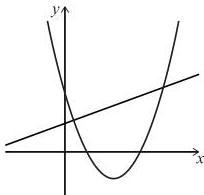
We can start to get a picture of the possibilities by considering sketches of lines and quadratics. There are three possibilities:
- Line crosses quadratic giving two distinct solutions.
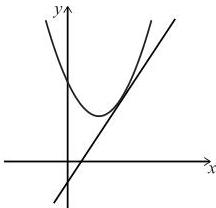
- Line is tangent to quadratic giving one [repeated] solution.
- Line never crosses quadratic giving no [real; there will be, in this case, complex solutions but this is outside the scope of the TMUA/ESAT] solutions.
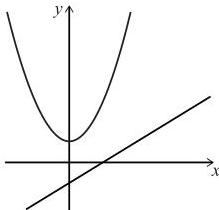
Solving simultaneous equations where one is linear and one is quadratic is simple: we eliminate the values [or values if easier] and solve the resulting quadratic equation using one of the techniques we met earlier in these notes. Factorizing or the discriminant conditions on the resulting quadratic [resulting from the elimination process] will tell you quickly which of the three cases for quadratic plus linear you are dealing with.
Here is an example:
Example
Solve and .
To solve these, we eliminate to give
And rearranging
Which factorises to
so there is a single solution of and and this must be when the line is tangent to the quadratic.
Exercise
Finally, some things to think about:
What are the possible solutions for a quadratic and a cubic simultaneous equation. Is it possible to have a situation with no real solutions [justify your answer both algebraically and using graphs [hint [stop reading if you don't want a hint]: which graphs generally get steeper faster, quadratics or cubics? Why?]]?
Find a condition on , and for to be tangent to .