Quadratic Functions and Graphs
Updated July 2026
Quadratic functions and their graphs
Quadratic functions and their graphs; the discriminant of a quadratic function; completing the square; solution of quadratic equations.
Quadratics are essentially functions that are written in the form where . The term "quadratic" can mean the function, or the graph, or the expression etc. – it is generally a loose term for all things related to the function.
In this section we will look at the quadratics both algebraically and graphically. It will help if you read this section in conjunction with the one on "graph shifting" below and also have some graphing software to hand [e.g., DESMOS GRAPHING].
Why is there so much talk about quadratics in GCSE and A level mathematics? The simple answer is that they are both simple to deal with and have lots of interesting properties that can be clearly illustrated without adding unnecessary complications. They are the perfect "toy" function to play with to help you start to understand more complicated concepts and graphs as your mathematical knowledge develops.
Before we start exploring some aspect of quadratics, let's list many of the sorts of things you are expected to be able to do with quadratics:
- Factorise them when appropriate.
- Solve quadratic equations using "the formula".
- Complete the square for a given quadratic [and it is useful to know how this process relates to the quadratic formula].
- Understand the relationship between the roots of a quadratic and its graph.
- Understand the relationship between a quadratic written in completed-square form and its graph.
- Sketch quadratic curves given the equation [marking x-intercepts (i.e., roots) y-intercept and min /max coordinates].
- Understand how to use the discriminant of a quadratic to tell you about the quadratic's roots.
- Know how to find the coordinates of the min/max by completing the square, or by differentiating.
Generally, if you are asked to solve a quadratic equation, it is usually better to see if you can factorise it before launching into other methods [such as using the quadratic formula or completing the square].
The main topic we shall look at here is the interplay between the algebra of quadratics and their graphs.
Let's start by looking at a simple quadratic and write it in "completed square" form [as always, make sure you understand how the "completed square" form works]:
We can see from this that the graph of is the same shape as the graph of but it is in a different place on the plane. In fact, if we start with the graph of and "shift" [or translate] it to the left by and then "up" by then we get the graph of . We have merely started with the graph of and moved it to a new position on the plane; we have not squashed or stretched it. So, all graphs of the form are really just the graph but translated to another part of the plane.
If you look at the "graph shifting" section of these notes, you will see that if then on shifting becomes which is the translation we described.
What happens to the minimum of [which is at ] when it is shifted by the translation? Its -coordinate moves to and its -coordinate moves to . This is not surprising, and we can get the same result in other ways. For instance, we can find the coordinate of the minimum by differentiating and setting equal to 0: so the minimum occurs at and the -coordinate of the minimum is [by substituting into ] which is exactly what we expect from our discussion of graph shifting as the point would be shifted to .
We can investigate the minimum coordinates of a third way: first, recall that we have and we want to find what value gives us the least -value. We notice that is always positive or zero, to make the value the least possible, we need to make equal to zero; and this means we need just like before.
What does our discussion about graph shifting for tell us about the roots of the quadratic? First we recall that the roots of the quadratic are the solutions to and so they are the -values when the -value is zero, and so they are the -values when the graph crosses the -axis [because the -axis has the equation ]. How do we know if the shifted graph has roots, in other words, how do we know if the shifted graph crosses the -axis? The answer is straightforward and leads us to the discriminant condition for roots: we start by recalling on is shifted to on . The only way that the new graph can cross the -axis is if the -coordinate of its minimum point is "under" the -axis [notice we have also used the fact that the coefficient of is positive so the quadratic is a U shape]; in other words, we require for the graph to cross the -axis [we will deal with touching the -axis in a moment]. Rearranging this, we get that the quadratic has [two real] roots when which is the discriminant of the quadratic [see our discussion below if you are not familiar with this]. And if the graph just touches the -axis then we know the quadratic has one [repeated; we say a root is repeated if it occurs more than once – e.g. ] root and also we must have which leads to .
Exercise
How does changing the values of and in affect the position of the graph?
You can use a graph sketching package [e.g., DESMOS GRAPHING] and play around with different and values [positive and negative] to see what happens and then make sure you can justify your findings by referring to the discussion above and completing the square.
So far, we have looked at and related it to but what about the more general quadratic of the form [where to make sure it is a quadratic]?
We can start by completing the square on this [the algebra is a little unpleasant but worth doing all the same; there are several equivalent but slightly different approaches to completing the square when the coefficient is not just 1. We have picked one approach, but you might have seen others in your maths classes. You should be comfortable with a range of approaches here].
And rewriting this a bit [we have jumped steps but make sure you can fill them in!]:
We can then use this expression to derive the quadratic formula and to explore the relationship between the formula and aspects of the graph of .
Let's start with deriving the quadratic formula:
For this, we want to solve and when we replace the quadratic by its completed-square form this becomes:
which gives
and hence
[noticing here we need both the positive and the negative square roots] which rearranges to
We can relate this to the sketch of :
The line of symmetry for the graph is at [make sure you can argue why this is true] and the distance from this line of symmetry to each of the roots is and so the distance between the roots must be . See the picture on the next page.
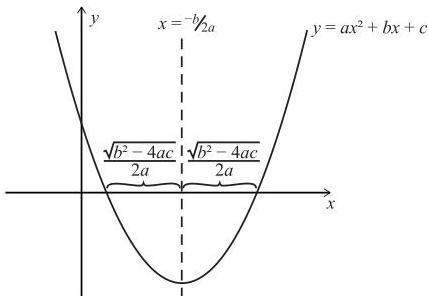
Finally for this section let's remind ourselves of the discriminant condition and how it tells us if the graph cuts the -axis [and recall that the discriminant is the in the formula]. Here are the three possible conditions and what they tell us:
- quadratic has two real distinct roots [cuts -axis at two distinct points]
- quadratic has one repeated root [touches -axis]
- quadratic has no real roots [never cuts or touches the -axis; this means the quadratic never crosses the -axis. When you learn about complex numbers, you will discover that the quadratic does have roots, i.e. values that make the quadratic zero; but it turns out that these roots don't exist in the real numbers, and we have to go to a 'larger' number system to find them. There are all sorts of interesting 'number systems' [we are deliberately vague here as to what we mean by a 'number system' as it can get quite technical and many 'number systems' are not really like the numbers you are used to when counting on your fingers and toes] in maths and some of them have turned out to be essential for dealing with higher level physics too: e.g. complex numbers in elementary quantum theory]
You should also be able to explain clearly why the discriminant condition works – you should be able to explain algebraically using the formula and also using graph sketching and graph shifting. Spend some time now checking all these different approaches to dealing with quadratic roots fit clearly together in your mind.
Exercise
Start with .
Divide the expression through by . You now have a quadratic in .
Use the quadratic formula to show:
And hence that
Then show this is the same result as that given by the standard quadratic formula. Are there any conditions on the equivalence of the two formulae [e.g., can we have for the alternative; and, if not, why not?]?