Equation of a Circle
Updated July 2026
Coordinate geometry of the circle
Using the equation of a circle in the forms
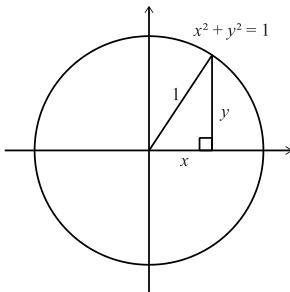
Imagine drawing a circle of radius 1 on the -plane with its centre at the origin and a radius of 1. What can we say about all the points that sit on this circle? They must all be a distance of 1 from the origin. We can use Pythagoras' theorem to express this idea in algebra [see the diagram] and when we do so we get the equation of a basic circle: . Any satisfying this equation is on the circle and any not satisfying this equation is not on the circle. (As an aside, all points inside the circle satisfy , and all points outside the circle satisfy .)
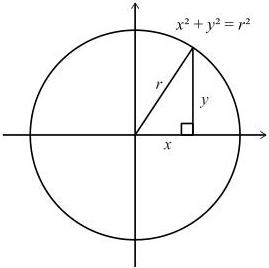
What about taking the same circle and making the radius bigger? If the radius is then we see from Pythagoras' Theorem [and the diagram below] that the equation of this circle must be
What if we want the centre of the circle to be somewhere else on the -plane? We will find the equation of the circle in that case in one of two ways: we either using Pythagoras' or using graph shifting.
Let's find the general equation of a circle of radius with its centre at the point :
Pythagoras' tells us that all the values that are a distance from will sit on the circle. So, we can use some geometry to work out the equation of the circle [see the diagram too] and we get
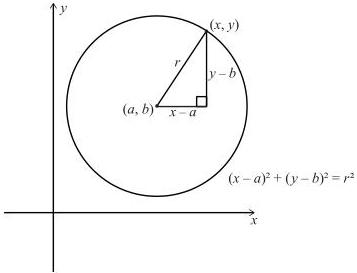
Or we can start with the circle of radius centred at the origin which has equation and shift it horizontally by and vertically by [so it moves to have a centre at the point and using standard graph shifting. Doing this, we get the equation:
You should be able to identify [very quickly] the radius and the centre of any circle equation you are given. For example, the circle with equation has its centre at and its radius is 5 [because , and be very careful not to say its radius is 25 !!]. The circle has its centre at and a radius of
There are other ways of writing the equation of a circle and you should learn to recognise them and be able to work out both the radius and centre of a circle given its equation. The most common alternative form of a circle is . We will look at a few examples and use "completing the square" to find the centre and radius:
Example 1
Find the centre and radius of
We collect the terms together and the terms together:
And then complete the square for the terms and also for the terms:
And rearranging gives us our standard equation:
So, the centre is at and the radius is
Example 2
Find the centre and radius of
We go through the same process as above – collect terms and complete the square to give:
Which rearranges to give
OH NO !!!!!
A moment's thought shows something has gone wrong. The left-hand side is the sum of squares so must always be but the right-hand side is negative. Well, it turns out that there are no real and values that make this equation true and so it is not the equation of a circle. The lesson to learn here is that not every equation of the form is the equation of a circle. You should be able to work out what extra condition we need to place on and to ensure that the equation is a circle.
Example 3
Find the centre and radius of
Well initially this doesn't look exactly like . But we can easily divide by 2 to get and then proceed as before to get:
Which has centre at and a radius of
Exercise
Why are the following not equations of circles?
Given the equation what conditions on and will make it an equation of a circle? [this is slightly tricker than it appears – be careful and think of what different cases there might be ...]
Finally, we will look at a couple of scenarios involving circles that you should be able to deal with. We will do this by working through a couple of examples.
Example 1: When is a line tangent to a circle?
Find the values of for which is tangent to the circle with equation
This can be solved algebraically [or geometrically with some careful work] but it is good to sketch a picture to start with to get an idea of why the question asks for values [not just value] and to get a very rough idea of what these values might be. Here is a sketch:
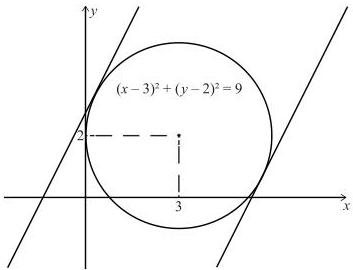
Now we can start to think about how we should approach this. In simple terms, if a line is tangent to a circle, then it intersects it at only one point. So, if we try to solve the equation of the line and the circle simultaneously, we will need to look for the case that has only one solution. If you think about it for a moment, the number of ways a line can intersect a circle can be twice, or once, or not at all. And when you try to solve the equation of a line simultaneously with the equation of a circle, you will get a quadratic in [or in ]. So, putting all this together suggests we try to solve simultaneously and then use the discriminant condition to work out the values of that gives one [repeated] root of the quadratic we obtain [think why we expect the discriminant to be 0 for two different values of ].
Let's do that for this question: substitute into to give and multiplying out we get
Rearranging
And we want this to have one repeated root, so the discriminant condition requires
Which then gives
And from this you can work out the two values – you can see we have two lines in the diagram above, one for reach of the values we found.
Example 2: What is the closest distance between a line and a circle?
Find the closest distance between the line and the circle
There are lots of ways to approach this question. We are going to use a mix of algebra and geometry. The first thing we are going to do [which is not necessary but just makes things easier to deal with] is to translate the circle so its centre is at the origin and then translate the line the same way [convince yourself that this does not change the answer]. We are going to replace by and by in both equations to give
Which simplify to
We can sketch these and then use some [simple] geometry to find the shortest distance between the line and the circle:
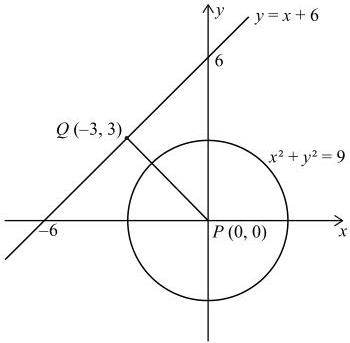
From this diagram we can see that the line between and will help us find the length that we seek. The length of the line between and is [it is ] and the length of the radius we know is 3. So, the distance from the line to the circle [which is the value we seek] must be
Exercise
For example 2, can you find other ways of finding the length required? (For instance: there is a formula for the shortest length of a point from a line. You could find the distance of the centre of the circle from the line and then subtract the radius length from the result. If you choose to take this approach, make sure you can prove and fully understand the equation that gives the shortest length between a point and a line. We do NOT expect you to know this formula in the TMUA/ESAT. You could also alter the problem in other ways using algebra: for instance, you could ask what value makes a tangent to the circle and then the answer to the question would be . Can you see why this would work?)
How would you solve the problem if the equation of the line had a different gradient – e.g., find the shortest length between the line and the circle . Try to solve it using a number of different methods. Which method do you think is best?