Coordinate Geometry Straight Lines
Updated July 2026
The Straight Line
Equation of a straight line, including
Conditions for two straight lines to be parallel or perpendicular to each other. Finding equations of straight lines given information in various forms.
The specification here is self-explanatory as to what you need to know about straight lines. You should be comfortable dealing both algebraically and geometrically [i.e., graphically] with straight lines. In this section we will briefly explore most of the main ideas we expect you to know and add a few things to think about.
Let's start with the classic and remind ourselves of what the and the represent for a diagram of a line whilst we explore things in a little more detail.
The in represents the gradient of the straight line. [You should be able to calculate the gradient of a straight line if you are given two points that it passes through.] But what does the gradient tell us about the line? The usual way of thinking about the is as a measure of 'steepness': the greater the value of then the steeper the line; and if is positive the line slopes from bottom left to top right, and if the is negative is slopes from top left to bottom right.
But what do we really mean by steepness? We can think of steepness in a couple of interrelated ways: we can think of the gradient as telling us how much we have to go vertically to get back on the line for every 1 unit we move horizontally from a point on the line. So, if the gradient is 2 then we need to move vertically up by 2 for every 1 unit we move horizontally from the line; and if the gradient is minus 3 then we need to move down by 3 for every 1 unit we move horizontally from the line [see diagrams below].
Another way of thinking about this [which is more useful when we encounter straight lines as tangents to curves] is that, for instance, a gradient of 2 tells us that the values are changing twice as fast as the values – so as increases by 1 the values must increase by 2, and if increase by 5 then must increase by 10 and so on. Negative gradients, for instance , just tell us that as increases by 1 then the values decrease [the minus sign signals the decrease] by 3. So gradient is a 'rate of change' telling us the rate at which changes relative to .
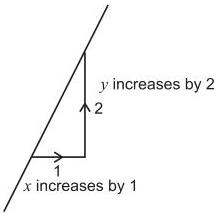
gradient of 2
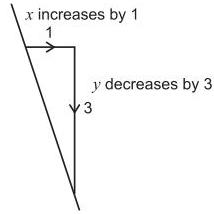
gradient of -3
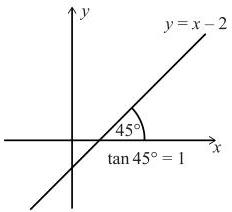
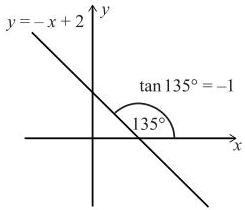
There is yet another way to think about the gradient which can be useful, that is to consider the gradient as the tan [that is the trigonometric tan] of the angle that the line makes with the positive axis [see diagrams] and of this we assume the scales on the -axis and the -axis are the same. You should be able to see why this is the case if you consider how the gradient is calculated. So, the gradient of a line at 45 degrees should be and that is exactly what we expect with a line such as . If the angle is 135 then we would expect the gradient to be and that is exactly what we expect with a line such as .
There are a couple of special cases for gradients: horizontal lines [which have a gradient of zero] and vertical lines which don't strictly have a gradient but often it is said they have an infinite gradient or negative infinite gradient [this is all a bit of a fudge]. It is best to think of vertical lines [and perhaps horizontal lines] as special cases - vertical lines always have the equation and horizontal lines always have the equation . You should also be aware that the -axis has equation and the -axis has equation .
What can you say about the gradients of two parallel lines [we exclude horizontal and vertical lines for this discussion, but you should be able to spot when they come up as special cases]? They have the same steepness so they must have the same gradients. So we can say that lines and are parallel if and only if [check you know why we write "if and only if" you might need to look at our Notes on Logic and Proof for TMUA paper 2].
What about lines that are perpendicular to each other? Here you need to know [and understand] that the lines and are perpendicular if and only if . You should be able to see this easily by looking at the two similar triangles in the diagram below – convince yourself why using this diagram.
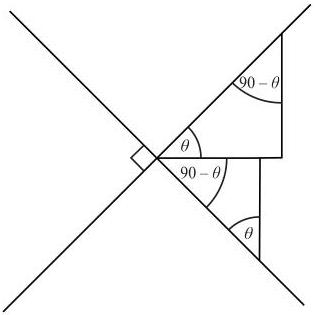
Exercise
[This exercise is a little outside of the TMUA/ESAT specification.] Use the idea that the gradient of a straight line is equal to the tangent of the angle it makes with the horizontal -axis to explain why if and only if the lines are perpendicular [exclude cases that involve vertical lines]. You can then ask yourself a general question – is there a condition on and when the lines meet at some other angles [60 or 45 degrees, for instance] and can you justify your answer?
We have spent some time discussing the gradient of a straight line so now we can turn to ask what the represents in the . The answer is simple, and you should know it: the is the value of where the graph crosses the -axis; this is often called "the -intercept".
It is also useful to think about straight line graphs using graph-transformations [see later in these notes]:
Exercise
As an exercise, think about what each of the following transformations does to the graph of [ and are constants; we could have called them something like and but we chose to vary the notation a little as you will need to get used to all sorts of notation as you learn more mathematics – text books and teachers are not always consistent in how they use notation. If you introduce notation into your maths that isn't given in a problem, make sure you make it VERY clear what your notation represents!]
Then combinations of these:
Finally, you should be able to work out the equation of a line given two bits of information. What two bits of information do you think you will need to uniquely specify the equation of a line? The answer is you will need:
Case 1
The coordinate of one point on the line and the gradient of the line – i.e., point (x1, y1) lies on the line with gradient m.
To work out the equation you need to notice that the gradient of the line joining any point (x, y) on the line with (x1, y1) must be constant:
And then rearranging.
Or you can use y = mx + c and substitute the point (x1, y1) into the equation to find c. (With line questions it is very easy to make sign errors when putting coordinates into equations. Make sure you are careful!)
Exercise
Use both the above approaches to find the equation of the line with the following gradients and points:
Case 2
The coordinates of two distinct points that sit on the line (x1, y1) and (x2, y2).
To work out the equation of the line, take a general point (x, y) on the line and calculate the gradient of the line [which is fixed no matter what] in two different ways:
and then rearrange this equation.
Or you can work out the gradient first using [make sure you get the order of the and the on the top and the bottom the same way around – otherwise you will get the wrong sign for your gradient; and also make sure to put on the top and on the bottom ] and then using and finding by substituting in one of the points or into the equation.
Exercise
Use both the above approaches to find the equation of the line with the following gradients and points:
- (0, 0) and (2, 3) [is there a shortcut here?]
- (-2, 5) and (-4, -7)
- (3, -7) and (8, -7)
Final thoughts
In this section we have used the equation of a line in the from . However, it is also common to see the equation of a line written in the form [It is unfortunate that appears in both as its role is different in each equation – do not assume that the in is the -intercept!]. You should be able to move from one form to the other easily using algebra. Both forms are useful in different contexts and different education systems might put more emphasis on one form rather than the other.