Binomial Expansion Integer Powers
Updated July 2026
The Binomial Expansion
Binomial expansion of for positive integer , and for expressions of the form for positive integer and simple . The notations and .
The binomial theorem is quite rich mathematically and there are lots of different ways we can approach it. For examinations, the best way is usually just to know the formulae and their quirks; but we do not recommend that you ever learn your mathematics in a way that sidesteps understanding. Here we will start by telling you what you need to know about the binomial expansion for the TMUA/ESAT and give you a few tips; then we will look in more detail at how the binomial expansion works.
What we expect you to know: in simple terms, we expect you to be able to do two things: one, calculate values of ; and two, work out any term in expressions such as and, more generally, in expressions of the from .
For instance, we might ask you to find the constant term in the expansion of
All we have really done here so far is reiterate what the specification says. But let's look at what this entails in a little more detail:
For simple cases such as the expansion of for smallish , you will probably have learnt how to use Pascal's triangle. You might even have used Pascal's triangle when tackling slightly more complicated expressions such as . This approach will always work, but sometimes can be very slow and time consuming; for instance, what if you were asked for the first five terms [in increasing powers of ] of the expansion of ? In that case, finding the 17th row in Pascals triangle and writing out the correct expression will take some time. Is there a quicker and slicker method? Yes! : using the Binomial expansion directly. Using the Binomial expansion is easier than it looks once you understand the patterns in the expansion.
Let's start by writing out the Binomial expansion in full and then take it to pieces so we can see how easy it is to use:
(Or we could write this as ; check you understand why both forms give the same result.)
Whilst this looks a little daunting to start with, it is actually very easy to use once you know the patterns you need to think about. Let's work a couple of examples to see how we can use this in practice to find any term in any expansion quickly and effortlessly:
Example 1
Find the term with in the expansion .
We build the answer in stages so you can see how the binomial expansion works in practice.
First as we need we know we must be looking for the term that has in it so we write that down:
Note that both the 2 and the are raised to the power of 7. That is important. (A common error is to write without the bracket and so forget that the 2 must also be raised to the power of 7.)
Then we need to work out what power of 3 goes with and we use the fact that the sum of the powers of the individual terms always add to the overall power which is 8 here. So, we must have together with because . So, we write
And finally, we need to work out what applies to this. That is easy to do. The value is always the power of the bracket so here , and the can be either the power of the 3, which is 1, or the power of the which is 7. That might seem odd that we can use either or but it is ok as both have the same value [think, for the moment, of the symmetry of Pascal's triangle; or you can prove it using the definition of — try to prove ]. So, we can write the answer as
You can then work out the numerical value of the coefficient easily.
So, in summary, the patterns you need to recall are:
- The powers of the terms always add to the power that the bracket is raised to.
- The number in the top of the is the power that the bracket is raised to.
- The value in can be either of the powers appearing in the expression.
Let's look at a second example that illustrates a mistake that students often make when dealing with the Binomial expansion [and you, of course, will not make this mistake!]:
Example 2
Find the coefficient of in .
Following our rules above it is very tempting [but wrong!] to write the answer as .
This is wrong for two reasons – one serious and one less serious. The less serious reason is that this is not a coefficient as it still has in it, but that is a forgivable error. The major issue is the way we have written the power-of-5 bit in the expression. What we should have realised is that we need to look at all raised to the power of 5: that is, both the minus sign and the 3 need to be raised to the power of 5 as well. So, the correct expression [that will give us our coefficient] is . We will leave you to work out the answer from there.
How the binomial expansion works
This section is not something we expect you to know for the TMUA/ESAT so you can skip it if you want. We are going to set out a brief explanation of how the binomial theorem works.
We start by looking at what means and we shall do this using a simple example:
Example
Imagine you have five letters A B C D E. From these five letters you want to find how many different collections of 3 letters you can get but you don't want the order of the letters to be important. So, for instance, ABC is a collection and so is ACB and they count as the SAME collection as they contain the same three letters [think of a collection here as a bag of three letters all jumbled rather than the three letters neatly laid one after the other on a table].
How can we work out how many different collections of 3 letters we can get from the 5 letters A B C D E ? [that is how many ways we can chose 3 things from 5 things]. Let's work out how we might go about it. We could start with three boxes and see how many ways we can fill them with three different letters from A B C D E:
| Box 1 | Box 2 | Box 3 |
|---|
We have 5 choices of letter for box 1; and then once we have chosen box 1, we have 4 letters left for box 2; and once we have chosen box 2's letter, we have 3 choices left for box 3. So, it appears that we have choices overall for filling the three boxes. Does that mean we can get different collections of 3 letters chosen from A B C D E? The answer is no, as we will have chosen the same three letters a number of times: for instance, one of choices must be A B C but another choice will be A C B and another choice will be B A C and so on. In other words, we will have multiple copies of each collection of letters amongst our 60 different choices we made. How do we deal with this?
Let's work out how many times we must have picked out a collection of three letters. We will work this out for the collection A B C. How many ways can we choose the letters A B C in order? In other words, how many ways can we order the letters A B C? We can think of this in a similar way to above: we have 3 choices of the first letter we choose [ A or B or C ] and then we have 2 choices for the second letter we choose, and 1 choice for the final letter. So, we have ways of choosing the letters A B C is . We can list these:
ABC ACB BAC BCA CAB CBA
So, let's stop and take a look at what we have worked out. We wanted to see how many ways we can select 3 letters from 5 letters without worrying about the order. We discovered we could select 3 letters in 60 different ways, but we also noticed that the same 3 letters could be chosen 6 different ways as we chose them in order. So, every 6 of the 60 we chose will be the same collection, so we only really have 60 divided by 6 [that is, 10] different collections of 3 letters we can choose [can you list them?].
Let's write the whole calculation out in one go: .
We notice that the top is almost 5! And the bottom is 3! We can use this to write the expression another way as and this is just .
Often is spoken as '5 choose 3' for obvious reasons – and sometimes it is written at which can also be read as '5 choose 3' even though the C actually stands for 'combination'.
We can now look at the general case and work out how many ways we can choose a collection of things from a collection of different things. This takes a little time to grasp but the effort is worth it. If you don't like the brief explanation we have given here, you can look elsewhere at the topic of 'permutations and combinations' to find an explanation that suits you.
We do exactly the same as above in stages. First, we note that if we have boxes than we have choices for the first box, choices for the second box and choices for the third box and so on. If we draw out boxes, we need to fill the first of them and leave the remaining boxes empty. There will be empty boxes and filled boxes.
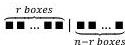
How many choices does this give us in this case: the answer must be
This is like the above.
And we can write this as follows:
And this is just like above where we used
But we recall that each of these choices contains repeats. We have objects chosen lots of times but each in a different order – just like above where we had ABC and ACB etc. How many ways have we chosen the same objects? The answer is just as above - it must be different ways. So, in the choices we have counted each set of objects times so to work out how many different collections we have, we need to divide by [just like we had 60 divided by 6 above].
This gives us the number of ways of choosing r objects from n objects:
We can see how each bit of the equation works. The divided by is the number of ways we can fill the first boxes out of a set of boxes; and the is the number of ways we can pick the same collection of objects in order in those first boxes.
At this stage it is useful to revisit something we mentioned in an example above. We mentioned that the symbol has some symmetry – so for instance is the same as . We can now explore why this is the case using the ideas we have set out here. If you are asked how many ways you can choose 2 objects from 7 objects you have two ways you can work out the answer. You can choose all the different sets of two objects you can find and count them [that will give you ]; or you can think about how many ways you can choose 5 objects and throw them away to leave two objects behind [that is ]. A little thought shows you these must be the same. Count how many ways you can choose objects from objects and keep them, or how many ways you can choose objects from object and throw them away. In both cases you are left with all different collections of objects chosen from objects.
Now how does this lengthy digression about choosing 3 objects from 9 objects or 2 objects from 7 objects etc. help us understand how the binomial expansion works? Let's look at an example to understand how they are related.
Consider . We will write this out in full as
Let's work out roughly how we might go about multiplying out these brackets:
If we multiply out term by term, we need to choose either 2 or from each bracket and make sure we have got all the different combination [doing this long-hand will take ages – you can try if you want].
When we multiply out term by term, we will have things like:
and we can also have
and also
and so on...
In other words, the term comes from all sorts of different combinations – we need to pick three brackets to give us the 2's or two brackets to give us the 's.
How many different ways can we pick three 2's from 5 brackets? We know the answer from above – it is how many ways can we choose 3 from 5 and that is [or we could look at the number of ways of choosing two lots of from five brackets and use ].
So, the term in the expansion of must be .
Now we can see how the general term works in the binomial expansion:
Let's look at one term on the right hand side . This term is, in essence, made up from choosing from of the brackets and then using the from the remaining brackets [hence the powers must sum to ] and then seeing that we get lots of from brackets in exactly different ways so there must be lots of the term in the expansion.