Definite Integration Area Between Curve Axis
Updated July 2026
Definite integration and the area between a curve and an axis
Definite integration as related to the 'area between a curve and an axis'. The difference between finding a definite integral and finding the area between a curve and an axis is expected to be understood.
In this section, we will assume you know how to integrate and deal with limits in an integral!
When we talk about areas and integration, we need to be very careful. The term "area" is usually taken to be a positive value and that can lead to some confusion when we talk about definite integration and the area between a curve and an axis. Definite integration is almost a sum of areas but instead it subtracts "areas" that are underneath the -axis. So, a definite integral calculates all the areas that sit above the -axis and sums them up and then subtracts all the areas that sit below the axis; and it does this whole calculation in one go.
As an aside: There is a good reason for this – we do not expect you to know the details for TMUA/ESAT but you might have met some diagrams in class where integration is presented as sums of very thin rectangles between the curve and the -axis. The contribution of each of these rectangles to the integral is the value of the rectangle height [and the value can be positive or negative] times the teeny width along the -axis [the bit, which is always taken to be positive]. As rectangles that sit under the -axis have negative values, their contributions to the integral are negative – and hence the negative "areas" for those bits of the integral.
Let's look at a few examples to help us understand how this works:
Example 1
Calculate and draw a picture to illustrate the meaning of the answer.
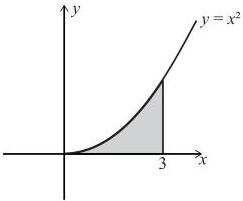
Example 2
Calculate and draw a picture to illustrate the meaning of the answer.
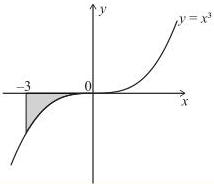
Example 3
Calculate and draw a picture to illustrate the meaning of the answer.
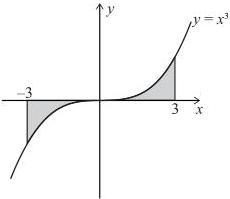
Can you work out why the answer is zero?
Definite integral versus total area
We mentioned above that there can be a subtle difference between being asked to find the area between a curve and an axis and finding a definite integral. We will explore this in more detail.
We have already discussed that a definite integral can be interpreted as the sum of the areas above the -axis minus the sum of the areas below the -axis. So, if you are asked to find the area between a curve and the -axis between two values, the definite integral might give you the wrong answer. The answer will be wrong because to find the total area between a curve and the axis when you are given two values, you must find the areas that sit above the axis and ADD them to the positive areas that sit below the -axis; and we know that definite integration will subtract areas that sit underneath the -axis. How can we calculate the area required? The simple answer is that we calculate each area separately – the areas above the -axis and the areas below the -axis – using the definite integral. And then we take the positive values of all these areas and add them together. Here is an example to illustrate what we mean here:
Example
Find the area between the -axis, the lines and and the curve .
Let's start by sketching the area so we can understand what we are being asked to do:
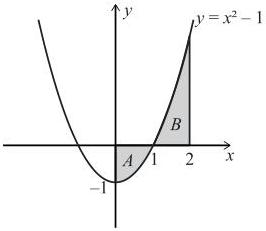
From the diagram you can see that we need to split our calculations into two pieces because we want positive areas – the question asks for areas rather than just asking for an integral. We need to find and . We expect the first integral to be negative and the second to be positive. Let's calculate the two integrals and then we can see how to combine them to get the answer:
We note that the definite integral for A is negative as expected and the definite integral for B is positive. This tells us that area A is and area B is so the total area required is .
It is useful to contrast this answer with the definite integral from to . You should calculate this to see what you get – your answer should be .
Integration with dy
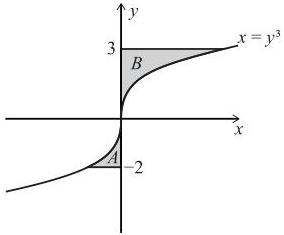
Although there is no requirement for you to deal with integrals with dy in them, it is useful to know about them all the same: for instance, . We call these integrals with respect to [w.r.t] and we need to make sure that what is being integrated is expressed in terms of .
These integrals are calculated exactly the same way as those with in them:
And we can draw a picture to illustrate the region that this integral applies to [note the integral corresponding to A is negative, and to B is positive]:
Integration 'tricks'
Finally, there are a few 'tricks' you should be aware of that can sometimes make integration easier. The ones we will look at here [albeit briefly] are ones that involve using the symmetry or asymmetry of graphs to simplify definite integrals.
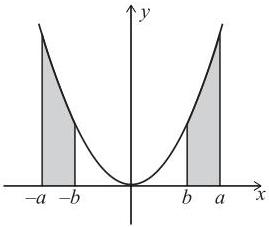
If a graph of a function is symmetric about the axis [when the graph is reflected in the axis it looks the same] the following must be true:
And we can see why using a diagram:
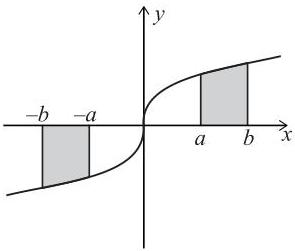
If a graph of a function is antisymmetric [when the graph is reflected in the axis and then in the -axis, it looks the same] the following must be true:
And we can see why using a diagram:
Exercise
Using these symmetry ideas and your knowledge of integration, you should be able to explain why the following are true [although trigonometric integration and differentiation is not on the TMUA/ESAT specification, all these examples are expressions we could expect you to deduce within the TMUA/ESAT specification]: