Trapezium Rule Approximation
Updated July 2026
The Trapezium Rule
Approximation of the area under a curve using the trapezium rule; determination of whether this constitutes an overestimate or an underestimate.
We expect you to be able to use the Trapezium rule to estimate areas under curves [and recall we take area to be positive] or to estimate the values of definite integrals [remember definite integrals take "areas" under the x-axis as negative]. We will make sure that any question we ask in the TMUA/ESAT is very clear about whether it is asking for an estimate of areas between a curve and an axis or whether it is asking for an estimate of a definite integral.
You should either learn the Trapezium rule formula [but make sure you understand it] or you should be able to calculate the result from scratch using your knowledge of the area of a trapezium. We ALWAYS assume that the trapezium rule finds an estimate of an area using equal width strips.
Let's briefly look at the Trapezium rule and how it works.
The area of a trapezium with two right angles in it – as shown – is
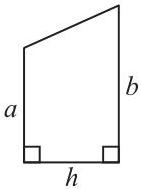
Using this formula, we can see how we could estimate the area under a curve using a set of equal width trapezia. We will use n trapezia each of width h and the heights of each trapezium can be calculated from the function y = f(x) whose area we are approximating:
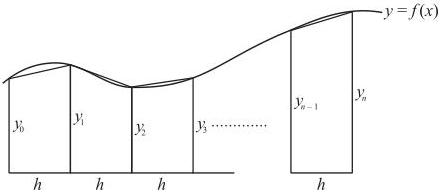
And this simplifies to
And this is one form of the Trapezium rule. Notice that every appears twice except the first one and the last one ; this is not surprising as every [except and ] is the shared side for two trapezia.
We will not ask you questions that involve complicated calculations as we are interested in checking your understanding of mathematics in the TMUA/ESAT rather than your ability to add lots of numbers together correctly!
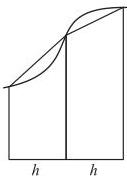
You should be able to tell whether the result of the trapezium rule is an overestimate or an underestimate using your understanding of the shapes of curves [some of which we meet in the next section].
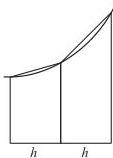
overestimate
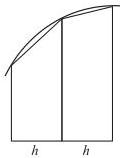
underestimate
Sometimes, it is not possible to tell if the trapezium rule gives an overestimate or underestimate without further work: