Trigonometry Sine Cosine Rules
Updated July 2026
The sine and cosine rules
The sine and cosine rules, and the area of a triangle in the form . The sine rule includes an understanding of the 'ambiguous' case (angle-side-side). Problems might be set in 2 or 3 dimensions.
We will start this section by looking at the area of a triangle and then explore the sine rule and the cosine rule.
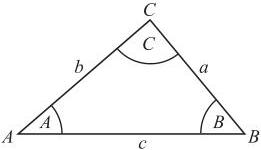
A quick note on labelling. We tend to label polygons anticlockwise [not always though – and in this section we have varied the labels we have used on triangles in each diagram to keep you on your toes!]. For triangles we label corners [and usually angles in the respective corners] with capital letters, and the sides opposite corners with corresponding lower-case letters:
Area of a triangle
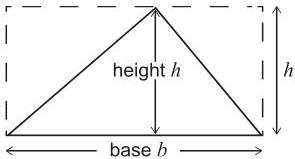
We start with the most basic formula for the area of a triangle. From the diagram below, you can see that the area of a triangle is exactly half that of the rectangle so the area of the triangle must be:
What about for a triangle where the top corner is not above the base?
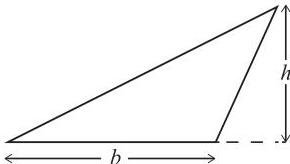
The area is the same, but you must be careful to use vertical height [as shown] above the horizontal base and not any part of slanted height. Can you convince yourself using geometry that the area is still base vertical height even when the triangle does not fit neatly inside a rectangle? [Hint: you can add an identical triangle to make a parallelogram then chop up and rearrange the parallelogram slightly. What other ways can you use?]
Let's now calculate the area of triangle another way using a little bit of trigonometry.
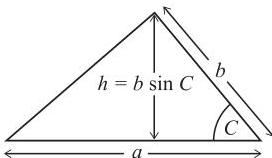
From the diagram you can see that the base of the triangle is length and the height [using trigonometry] is . The area of the triangle must be:
This gives us another formula for the area of a triangle using the length of two sides and the angle between the two sides.
The sine rule
From this equation we can easily derive the sine rule [which is essentially, as we shall see, a way of saying that the area of a triangle is the same no matter how you choose to calculate it].
Above we showed that the area of a triangle with base was . If we rotate the triangle to make the base , then the area can be written as and if we rotate it again to make the base, then we can see that the area can be written as . These areas must all be the same, and so:
Which is essentially the sine rule in disguise. If we multiply by 2 and divide by we get:
Which is the more usual form of the sine rule; it also appears the other way up:
When do we use the sine rule?
| Given | Find with one use of the sine rule |
|---|---|
| Two angles and one side | Any other side [note, once given two angles, you can calculate the third as angles in a triangle add to 180] |
| Two sides and one angle [not between given sides] | Another angle [see below] |
In some cases, there is more than one triangle that will fit a given set of data – the sine rule then gives us an "ambiguous" result. The ambiguity arises in some cases when finding another angle using the sine rule. This is because there are always two angles between 0 and 180 that have the same sine value.
Here is an example of this "ambiguity":
Example
In triangle , angle , and . Find angle
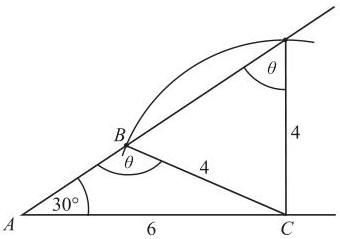
Using the sine rule we can write [note we tend to put the unknown on the top]:
So, we get
We obtain two values for : 48.6 or 180 – 48.6. Both angles are plausible as when added to 30 they do not exceed 180.
Exercise
Explore when this ambiguity arises – what are the conditions for there to be one answer, two answers, and no answers to a question giving two sides and one angle and asking for the third angle as above?
Exercise: Proof of sine rule using circle theorems
The diagram below shows a triangle with a circle drawn around it [you can always draw a circle around a given triangle – the centre of the circle will be where the perpendicular bisectors of the sides intersect – can you explain why there is always a circle and why its centre is where we suggest?]. The radius of the circle is .
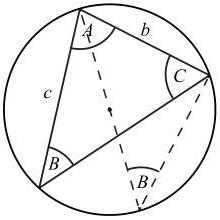
Prove using the construction shown as dotted lines [and the appropriate circle theorems] that
And hence
Use a similar approach to show that
The cosine rule
Now we will turn to look at the cosine rule. The cosine rule is really a more general from of Pythagoras' theorem for non-right-angled triangles [actually, it works for right-angled triangles too!]
Here is a right-angled triangle
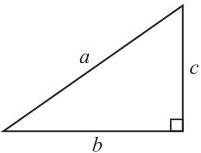
And we know that Pythagoras' theorem tells us that
If we distort the triangle just a little bit and keep and the same length, then won't be the same as anymore. We will need a correction term:
And we expect the correction term to change as the angles in the triangle change.
We can work out an exact relationship between the three sides and the angle changes:
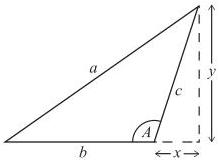
From the diagram [and Pythagoras] we can write:
And
Combining these gives:
But [make sure you can see why the minus sign is there]
And so:
Which is Pythagoras' theorem with a correction term.
Let's explore this equation, which is known as 'the cosine rule' a little:
First, we note that the equation applies to any set of three sides and an appropriate angle in the triangle:
Make sure you note how , and and , and appear in these equations [look up cyclic permutations]. And also, how the cosine function takes care of whether the correction term needs to be positive or negative [think about how this works and make sure you understand – think about how the cosine function can be thought of as a 'projection' – see the trigonometry section below]
Sometimes the cosine formula is written with the cosine as the subject [we recommend you learn just the first formula above and then manipulate it for each scenario as you need]:
And we can also see that the cosine rule becomes Pythagoras' theorem if we set the angle to 90 [but recall we used Pythagoras' theorem to prove the cosine rule!]
When do we use the cosine formula?
[note, it is almost always better to use Pythagoras' and trigonometry if you have a right-angled triangle]:
| Given | Find with one use of the cosine rule |
|---|---|
| Three sides | Any angle |
| Two sides and one angle [between given sides] | The third side |