Radian Measure Arc Length Area Sector
Updated July 2026
Radian measure
Radian measure, including use for arc length and area of sector and segment.
Usually, the first method for measuring angles that you will encounter is to use degrees. And, as you know, one revolution is 360 degrees. There is nothing special about the number 360 [some say it is used as it is roughly the number of days in a year] but any other number would also work. We could have 400 units in a complete revolution [so 100 units in a right angle]. In fact, there is a measure of angles that uses 100 to be a right angle – it is called "Gradians" [you will see a "grad" setting on your calculator]. All these angle measures are a bit arbitrary but there is one measure for angles that is more natural than all the others, and that is "radians".
By "more natural" we mean that it is the most likely measure any alien civilization would use. There is more to it than that, though. All the differentials and integrals involving trigonometry you will [or already have] learned in calculus are only true if the angle is in radians. So for in radians. We do not require you to know about calculus with trigonometry in the TMUA/ESAT but it is worth your exploring why we need to use radians to make the rules work, and thinking about what differentiating and integrating would look like if were in degrees instead of radians. You should assume angles are given in radians unless told otherwise when doing calculus.
So how big is one radian? We take a sector of a circle of radius 1 and arc length also 1 and we define 1 radian to be the angle that is subtended by this arc.
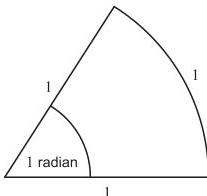
Or, if you prefer, equivalently we can say that one revolution is equal to radians [because the length of the circumference of a circle of radius 1 is ]. So, 1 radian is [often we write "rad" for radians but there is a symbol for radians, like there is a symbol for degrees, but it tends not to be used that much. The symbol is a superscript "c": 1 rad = 1c].
We can convert from degrees to radians and vice-versa very easily by recalling one revolution is either 360 degrees or 2π rad.
θ degrees to radians
θ degrees is θ/360 fraction of one full revolution and one revolution is 2π radians, so the conversion must be
α radians to degrees
By the same argument as above, we can convert α radians to degrees
You ought to know some standard conversions [learn them!]
| Degrees | Radians |
|---|---|
| 30 | π/6 |
| 45 | π/4 |
| 60 | π/3 |
| 90 | π/2 |
| 180 | π |
| 360 | 2π |
Areas and arc lengths
You need to know [and understand] the formulae for arc length and area for a sector with an angle radians:
Make sure you can prove both these formulae [and understand how the proofs work] and that you know how to use both formulae. We will set out the proofs below but think about it before taking a peek.
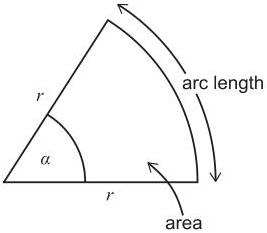
To prove the formulae in each case we start by recalling that radians is fraction of a whole circle.
So, the arc length in the picture must be
which gives
And the area of the sector must be:
which gives