Operations on Integers Decimals and Fractions
Updated August 2025
Applying the four operations to integers, decimals, and fractions is a core requirement for the TMUA. This page teaches how to use place value to perform accurate arithmetic with positive and negative numbers. It covers formal algorithms for multiplication and division and methods for combining proper and mixed fractions.
Mathematical operations must respect place value for decimals and integers, or be standardised using common denominators for fractions, to ensure that digits or values of the same weight are combined correctly.
Place Value
Understanding place value is essential for performing arithmetic with integers and decimals. Every digit in a number has a value determined by its position relative to the decimal point. Each place value is ten times larger than the place to its right and one tenth the size of the place to its left.
The standard place values are:
- Millions:
- Hundred Thousands:
- Ten Thousands:
- Thousands:
- Hundreds:
- Tens:
- Units:
- Decimal Point:
- Tenths:
- Hundredths:
- Thousandths:
For example, consider the digit in the following numbers:
- In , the represents hundreds.
- In , the represents hundredths.
- In , the represents thousandths.
Addition and Subtraction of Integers and Decimals
To add or subtract, numbers must be aligned according to their place value. This is achieved by lining up the decimal points. Any empty positions should be filled with zeros, which is especially vital for subtraction.
Example: Addition
Calculate .
Align the decimal points and fill the thousandths column with a zero:
Starting from the right, . In the hundredths column, : write and carry to the tenths. The final result is .
Example: Subtraction
Calculate .
Align the points and use zeros: .
We cannot take from , so we convert one hundredth into thousandths. Then . Next, in the hundredths column. In the units, we cannot take from , so we borrow from the tens: . The final result is .
Addition and Subtraction of Fractions
To add or subtract fractions, you must find a common denominator. For mixed numbers, you can either handle the integer and fractional parts separately or convert the entire number into an improper fraction first.
Example: Addition of Fractions
Find .
The lowest common multiple (LCM) of and is . Convert both fractions:
and
Example: Subtraction of Fractions
Find .
Convert to the improper fraction . Using a common denominator of :
Multiplication of Integers and Decimals
Method 1: Formal Column Multiplication
Calculate .
- Multiply by units to get .
- Multiply by (put a in the units column then multiply by ) to get .
- Add .
Method 2: Partitioning (Box Method)
Split into and into . Multiply each part and sum the results:
Summing .
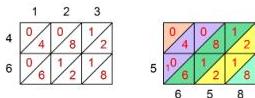
Method 3: Bones (Lattice Multiplication)
This method uses a grid where each box is split diagonally. Digits are multiplied and placed in the boxes, then diagonal sums are calculated.
Multiplying Decimals
Calculate .
First, multiply as integers: . Count the total decimal places in the original numbers: has one and has two. The answer must have decimal places. Thus, .
Division of Integers and Decimals
The number being divided is the dividend, the number dividing is the divisor, and the result is the quotient.
Example: Integer Division
Calculate .
Using the bus stop method:
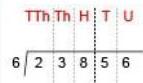
- remainder . Carry the to make .
- remainder . Carry the to make .
- remainder . Carry the to make .
- remainder . Carry the to make .
- .
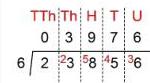
The answer is .
Example: Decimal Division
Calculate .
Multiply both the dividend and divisor by a power of to make the divisor an integer. Multiplying both by gives .
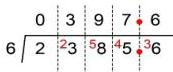
Performing the division gives .
Multiplication and Division of Fractions
Multiplying Fractions
Convert mixed numbers to improper fractions. Multiply numerators together and denominators together. Simplify before or after multiplying.
Example: .
Simplifying: and . The calculation becomes .
Dividing Fractions
Invert the divisor (the second fraction) and then multiply.
Example: .
Key takeaways
- Always align decimal points for addition and subtraction to ensure digits of the same place value are combined correctly.
- When multiplying decimals, perform the calculation as if they were integers first, then adjust the decimal point based on the total decimal places in the original values.
- For fraction division, invert the divisor and multiply: 'Keep, Change, Flip'.
- Mixed numbers should usually be converted to improper fractions before performing multiplication or division.
- To divide by a decimal, multiply both the dividend and divisor by the same power of ten to create an integer divisor.
In the TMUA, you do not have a calculator. Use estimation to check the magnitude of your answers. For example, if you calculate , a rough estimate of will help you place the decimal point correctly in your result of .
When dividing fractions, only invert the divisor (the second number). A common error is inverting the dividend or both fractions.
The 'Bones' or lattice method of multiplication is mathematically identical to the column method but separates the multiplication phase from the addition phase, which can help reduce cognitive load and prevent carrying errors during complex calculations.
Worked Examples
Practice Questions
Frequently asked questions
What is the most common mistake when subtracting decimals?
The most common mistake is failing to use placeholder zeros. For example, in , students often incorrectly subtract the from nothing or treat it as , whereas it must be via regrouping from the tenths column ().
How do you handle negative numbers with these operations?
The same rules apply. For subtraction, . For multiplication and division, if the signs are the same, the result is positive; if the signs are different, the result is negative.
Do I have to simplify fractions before multiplying them?
You do not have to, but simplifying first keeps the numbers smaller and reduces the risk of arithmetic errors. For example, in , cancelling the and to and , and the and to and , makes the result immediately obvious.
How do you find the mid-point of a class interval for mean estimates?
Add the lower boundary and the upper boundary of the interval together and divide by two. For example, the mid-point of is .