Prime Factorisation Factors and Multiples for the TMUA
Updated August 2025
This section covers essential number theory concepts including prime factorisation, Highest Common Factor (HCF), and Lowest Common Multiple (LCM). Understanding these properties is vital for the TMUA, as they underpin complex algebraic manipulations and proofs. A concrete fact is that every integer greater than 1 has a unique prime factorisation.
The Unique Factorisation Theorem states that every integer greater than 1 can be expressed as a unique product of prime numbers. This representation allows for the systematic determination of all factors and multiples of a number.
Multiples and Common Multiples
A multiple of a number is a value found in the times table of that specific number. A common multiple for two or more numbers is a value that is a multiple of all of those numbers. The Lowest Common Multiple (LCM) is the smallest positive number that is divisible by all the numbers in a given set.
Example: Finding common multiples
Find the first three common multiples of and .
- Multiples of :
- Multiples of :
- Common multiples:
Factors and Common Factors
A factor (also known as a divisor) of a number is a value that divides into that number exactly, leaving no remainder. A common factor is a number that divides exactly into all the numbers in a set. The Highest Common Factor (HCF) is the largest number that divides exactly into all the numbers provided.
Example: Finding common factors of two or more numbers
Find all the common factors of and .
- Factors of :
- Factors of :
- Common factors:
Prime Numbers and Factorisation
Prime numbers are integers that possess exactly two factors: and the number itself. Prime factorisation is the process of writing a number as a product of its prime factors. The Unique Factorisation Theorem (Fundamental Theorem of Arithmetic) guarantees that every integer greater than has a unique prime factorisation, regardless of the order of the factors.
Divisibility Tests
Divisibility tests are useful for identifying factors quickly:
- 2: The last digit is even.
- 3: The sum of the digits is divisible by .
- 4: The last two digits form a number divisible by .
- 5: The last digit is or .
- 6: The number is divisible by both and .
- 7: Subtract two times the last digit from the rest of the number: if the result is divisible by , the original is too. For example, for , calculate . Since is a multiple of , is also a multiple of .
- 8: The last three digits form a number divisible by .
- 9: The sum of the digits is divisible by .
Example: Deciding if a number is prime
Is a prime number? Sum of digits: . Since is divisible by , is divisible by . It has more than two factors (at least ), so it is not prime.
Important Prime Facts
- There are 10 primes less than 30: .
- The number is not prime as it only has one factor.
- The number is the only even prime.
- Apart from and , all primes end in or .
Prime Factorisation Methods
Example: Writing prime factorisation in index form
Write as a product of prime factors using index notation.
Method 1: Repeated Division (Ladder)
Divide by the smallest prime to get . Divide by to get . Divide by to get . Divide by to get . Stop as is prime. .
Method 2: Factor Tree
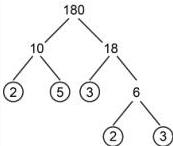
As shown in the diagram, circle prime numbers at the end of each branch. The product of the circled numbers is .
Finding HCF and LCM Using Prime Factorisation
Example: Finding the HCF and LCM of 180 and 420
-
Prime factorisations:
-
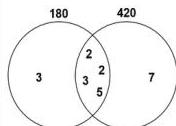
Use a Venn diagram to find the overlap:
-
HCF: Multiply the numbers in the overlap: .
-
LCM: Multiply all numbers in the diagram: .
Check: . Also . The results match.
Example: HCF and LCM of three numbers (180, 168, and 72)
HCF: Find prime factors common to all: . LCM: Include the maximum occurrence of each prime factor. The max number of s is three (), s is two (), and one and one . .
Solving Problems and Finding Square Roots
Example: Factor verification
Show that is a factor of . . . Since all prime factors of are present in the factorisation of , it is a factor.
Example: Solving logic problems with primes
Sarah reverses the digits of a 2 digit number and subtracts it from the original. Can the answer be prime? Let the original number be . The reversed is . The difference is . Since this is a multiple of , it cannot be prime (unless it is , but is not prime).
Example: Finding square roots
Given , find . Halve the indices: .
Key takeaways
- The Highest Common Factor (HCF) is the product of the lowest powers of all common prime factors.
- The Lowest Common Multiple (LCM) is the product of the highest powers of all prime factors present in any of the numbers.
- HCF multiplied by LCM of two numbers always equals the product of the two numbers themselves.
- A number is prime if and only if it has exactly two factors: 1 and itself.
- Divisibility tests are vital for efficient prime factorisation in non-calculator exams.
For TMUA questions involving large squares, always perform prime factorisation first. If every prime factor has an even index, the number is a perfect square. To find the square root, simply divide all indices by 2.
Be careful when identifying the LCM of three numbers. It is not always the product of the numbers divided by the HCF. Use the maximum-power method or a 3-ring Venn diagram to ensure accuracy.
The relationship between HCF and LCM () is a fundamental property in number theory that often provides a shortcut in problems involving ratios or gear-tooth rotations.
Worked Examples
Practice Questions
Frequently asked questions
Is 1 a prime number?
No, 1 is not a prime number. By definition, a prime number must have exactly two distinct factors. 1 only has one factor (itself), so it is not prime.
How can I find the LCM of three numbers without a Venn diagram?
Find the prime factorisation of each number. For every prime that appears in any of the factorisations, take the highest power of that prime. Multiply these highest powers together to get the LCM.
Can the HCF of two numbers be larger than the numbers themselves?
No, the Highest Common Factor must be less than or equal to the smallest number in the set, as it must divide into them exactly.
Does the Unique Factorisation Theorem apply to negative integers?
The theorem usually refers to positive integers greater than 1. However, negative integers can be treated as multiplied by the unique prime factorisation of their absolute value.