Relationships Between Operations and Priority for the TMUA
Updated August 2025
Mastering the relationships between operations and the hierarchy of calculations is vital for accuracy in the TMUA. This guide explains multiplication as repeated addition, the role of inverse operations in solving equations, and the BIDMAS convention for handling complex expressions involving powers, roots, and reciprocals.
Mathematical operations are connected through repetition and inversion: multiplication is repeated addition, and division is its inverse. The priority of operations (BIDMAS) provides a universal set of rules to evaluate expressions containing brackets, indices, roots, and reciprocals in the correct sequence.
Basic Relationships Between Operations
To perform calculations effectively, you must understand how different operations relate to one another.
Multiplication
Multiplication can be conceptualised as repeated addition of the same value. For example, if there are 10 identical boxes, each with a mass of kg, the total mass is found by adding ten times. Mathematically, this is simplified through multiplication:
Division
Division represents repeated subtraction of the same value until zero is reached, or a remainder is left. This is useful for determining how many times one quantity fits into another.
Example: Filling glasses
A container holding 20 litres of lemonade is used to fill glasses that hold 250 ml each. Since 20 litres is equivalent to ml, we calculate how many times 250 can be subtracted from :
Thus, 80 glasses can be filled.
Indices
Indices, or powers, represent repeated multiplication or division by the same number.
Example: Index form
Consider the calculation . By reordering the terms, we group the common values:
Inverse Operations
Inverse operations are those that reverse the effect of another operation. Multiplication is the inverse of division, and addition is the inverse of subtraction.
Example: Solving for an unknown using addition/subtraction
If 34 is added to an unknown number and the result is 78, we use the inverse of addition (subtraction) to find the original value:
Algebraically, leads to .
Example: Solving for an unknown using multiplication/division
If a number is divided by 8 and the result is 104, we use the inverse of division (multiplication):
Algebraically, leads to .
Simplification Through Cancelling
Expressions can be simplified by cancelling, which involves dividing both the numerator and the denominator of a fraction by the same common factor. You should always aim to simplify calculations before fully evaluating them to keep numbers manageable.
Example: Fraction cancellation
To find a calculation equivalent to , we look for common factors:
-
Divide 21 and 63 by 21:
-
Divide 55 and 85 by 5:
This results in the simplified form .
Order of Operations (BIDMAS)
The convention for the priority of operations ensures that every mathematical expression has only one correct value. The hierarchy is as follows:
- Brackets: Evaluate the contents of brackets first. If brackets are nested, start with the innermost set.
- Indices: Evaluate powers, roots, and reciprocals. Note that the reciprocal of is .
- Division and Multiplication: These operations have equal priority. Evaluate them from left to right.
- Addition and Subtraction: These operations have equal priority. Evaluate them from left to right.
Worked Examples: Order of Operations
Example 1: Basic priority
Calculate
Multiplication takes priority over addition: .
Example 2: Negative results in brackets
Calculate
Evaluate the bracket first: . Since subtracting a negative is equivalent to adding: .
Example 3: Multiplying over brackets
Calculate
Evaluate the bracket: . Multiply the coefficient by the result: .
Example 4: Indices and coefficients
Calculate
-
Brackets:
-
Indices: (The power applies only to the bracket)
-
Multiplication:
-
Subtraction: .
Key takeaways
- Multiplication is repeated addition, and division is repeated subtraction.
- Inverse operations allow you to solve for unknowns by reversing the calculation steps.
- Cancelling common factors in fractions should be done before multiplying out to simplify the arithmetic.
- The BIDMAS hierarchy must be followed strictly: Brackets, Indices (including roots and reciprocals), Multiplication and Division, then Addition and Subtraction.
- Division and multiplication (or addition and subtraction) have equal priority and should be calculated from left to right.
In the TMUA, you often deal with large fractions. Always look to cancel common factors between the numerator and denominator immediately. This prevents you from having to multiply large numbers, which saves time and reduces the risk of calculation errors.
A common mistake is applying a power to a coefficient outside a bracket. In the expression , you must square the 4 first to get 16, then multiply by 3 to get 48. Do not multiply 3 by 4 first to get 12 and then square it.
The concept of inverse operations is the foundational building block of algebra. Rearranging a formula to change the subject is essentially a sequence of applying inverse operations in the reverse order of BIDMAS to 'undo' the expression and isolate the variable.
Worked Examples
Practice Questions
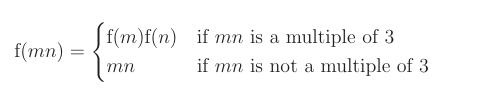
for all positive integers and
Given that , what is the value of ?
Frequently asked questions
What is the priority order between division and multiplication?
Division and multiplication have equal priority. They should be evaluated in the order they appear from left to right in the expression.
Where do roots and reciprocals fit into the order of operations?
Roots (like ) and reciprocals (like ) fall under the 'Indices' category in BIDMAS, meaning they are evaluated after brackets but before multiplication, division, addition, or subtraction.
If an expression is , why is the answer 11 and not 5?
Addition and subtraction have equal priority and are evaluated from left to right. Thus, is performed first to get 8, then 3 is added to get 11. Treating addition as having higher priority than subtraction is a common misconception.
How do you handle multiple sets of brackets?
You should always evaluate the innermost set of brackets first, then work outwards towards the outer brackets.
Does a negative number squared always become positive?
Yes, if the negative number is inside a bracket, such as . However, be careful with notation: without brackets usually implies following the order of operations (Indices before the implicit multiplication by ).