Algebraic Manipulation and Expanding Brackets for the TMUA
Updated July 2025
This section covers fundamental algebraic skills including collecting like terms, distributing single terms, and factorising expressions. Mastering these techniques is essential for the TMUA, as they form the basis for simplifying complex equations and expanding products of multiple binomials accurately under timed conditions.
Algebraic manipulation allows the rewriting of expressions into equivalent forms through the distributive law and the systematic collection of terms with identical variables and powers.
Understanding and Identifying Like Terms
Like terms in algebra are terms that are identical in their variable parts, including their indices, though they may have different numerical coefficients. For instance, and are considered like terms because the variables and are raised to the same powers in both. Conversely, and are not like terms because the power of is different. Similarly, and are not like terms.
Collecting Like Terms
Like terms can be collected and combined by adding or subtracting their coefficients. This simplifies the expression without changing its mathematical value.
Worked Example: Collecting Like Terms
Question: Simplify the expression by collecting like terms.
Step 1: Identify and group the terms. , which we write as .
Step 2: Identify and group the terms. .
Step 3: Identify terms with no counterparts. The terms , , and are unique and cannot be combined with others.
Result: The simplified expression is . This is often rearranged in descending order of indices: .
Multiplying a Single Term Over a Bracket
To multiply a single term over a bracket, you must multiply every term inside the bracket by the term outside the bracket. This follows the distributive law: .
Worked Example: Distributing a Single Term
Question: Multiply out .
Method 1: Direct Multiplication
- Multiply by to get .
- Multiply by to get (remembering that two negatives make a positive).
- Multiply by to get .
Method 2: Grid Representation Create a grid to ensure every term is accounted for:
Result: .
Taking Out Common Factors
Factorisation is the inverse of expanding brackets. Common factors are values (numbers or variables) that appear in every term of the expression. To factorise, identify the highest common factor (HCF) and divide every term by it.
Worked Example: Factorising an Expression
Question: Factorise .
Step 1: Find the HCF of the numerical coefficients. The HCF of 6, 15, and 21 is 3.
Step 2: Find the HCF of the variables. For , the powers are . The highest power common to all is . For , the powers are . The HCF is . The variable does not appear in the final term, so it is not a common factor.
Step 3: Combine and divide. The common factor is . Divide each original term by :
Result: .
Expanding Products of Two Binomials
When multiplying two brackets that each contain two terms (binomials), every term in the first bracket must be multiplied by every term in the second.
Worked Example: Expanding Two Binomials
Question: Expand and simplify .
Method 1: Visual Distribution Multiply the Firsts (), Outers (), Inners (), and Lasts ().
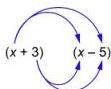
This gives: .
Method 2: Splitting the Multiplication .
Method 3: The Grid Method
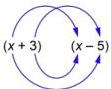
Result: .
Expanding Products of More Than Two Binomials
To expand three or more binomials, multiply the first two together, simplify the result, and then multiply that new expression by the next binomial.
Worked Example: Expanding Three Binomials
Question: Multiply .
Step 1: Expand the first two brackets. From the previous example: .
Step 2: Multiply by the third bracket. Use the grid method for accuracy:
Step 3: Combine like terms. .
Result: .
Key takeaways
- Like terms must have exactly the same variables and the same powers to be combined.
- When expanding brackets, ensure the sign of the outside term (especially if negative) is applied to every term inside.
- Factorisation requires identifying the highest common factor for both numerical coefficients and variable powers.
- Expanding multiple binomials is a staged process: multiply two first, simplify, then multiply by the next.
In the TMUA, speed and accuracy are vital. Use the grid method for expanding complex or multiple brackets to avoid missing terms or making sign errors, which are the most frequent causes of lost marks in algebra questions.
Be extremely careful with negative signs when taking out common factors or expanding brackets. A common mistake is factorising as instead of the correct .
Algebraic expansion and factorisation are inverse operations. You can always check your factorisation by expanding the result: if you do not return to the original expression, an error occurred in your HCF identification or division.
Worked Examples
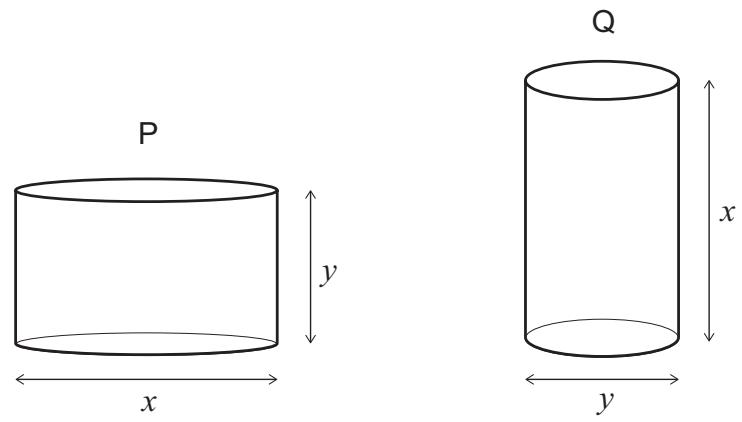
Cylinder P has diameter x and height y.
Cylinder Q has diameter y and height x.
What is the positive difference between the total surface areas of P and Q?
Practice Questions
Frequently asked questions
Can I combine and if they have the same coefficient?
No. Terms can only be combined if they are 'like terms'. While they have the same variable , the powers are different, so they must remain separate in the final expression.
What is the most common mistake when expanding brackets like ?
The most common error is forgetting to multiply the negative sign by the second term. results in , so the expanded form is .
How do I know if an expression is fully factorised?
An expression is fully factorised when there are no more common factors remaining inside the bracket. If you can still divide all terms inside the bracket by a number or a letter, you have not taken out the highest common factor.