Trigonometric Ratios and Exact Values
Updated September 2025
Trigonometric ratios are fundamental tools for calculating lengths and angles in geometric figures. This guide explains how to use sine, cosine, and tangent in right-angled triangles, details the exact values for key angles, and provides a geometric interpretation of trigonometry essential for TMUA success.
The trigonometric ratios relate the angles of a right-angled triangle to the ratios of its side lengths: , , and .
The Fundamental Trigonometric Ratios
Trigonometry in its most basic form is the study of right-angled triangles. For any acute angle in a right-angled triangle, we identify three sides relative to that angle: the hypotenuse (the longest side, opposite the right angle), the opposite (the side across from ), and the adjacent (the side next to that is not the hypotenuse).
The three primary ratios are defined as follows:
These ratios allow us to find an unknown side length if we know one side and one angle, or to find an unknown angle if we know two side lengths. It is sufficient for the TMUA to understand these from the standard definitions of trigonometric functions.
Exact Values for Key Angles
You are expected to know the exact values of the trigonometric functions for specific angles. While these can be memorised, they are easily derived from two standard triangles.
The Triangle
For an angle of , we use an isosceles right-angled triangle with two sides of length 1. By Pythagoras' theorem, the hypotenuse is .
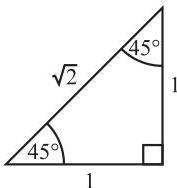
From this triangle, we can see:
The and Triangle
For angles of and , we consider half of an equilateral triangle with sides of length 2. This creates a right-angled triangle with a hypotenuse of 2 and a base of 1. The vertical height, by Pythagoras, is .
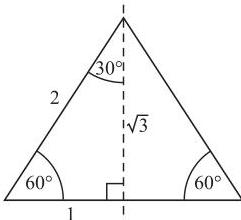
From this triangle, we find:
- and
- and
- and
For and , the values are:
- is undefined.
Trigonometric Identities
Two essential identities link these ratios. First, the relationship between tangent, sine, and cosine:
Second, the Pythagorean identity. In a right-angled triangle with hypotenuse 1, the opposite side is and the adjacent side is . Applying Pythagoras' theorem gives:
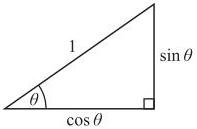
While we have derived this for acute angles, this formula applies to any angle .
Trigonometry as Projection
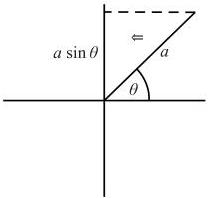
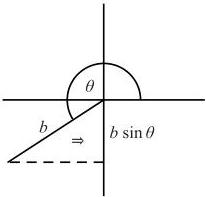
A useful way to conceptualise sine and cosine is as projection operators. They project a line of length onto the horizontal axis or the vertical axis. In this interpretation, the line segment being projected always has a positive length. The cosine function projects the line onto the axis, and the sine function projects it onto the axis.
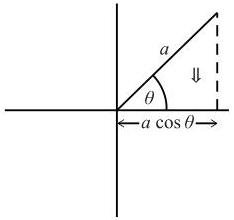
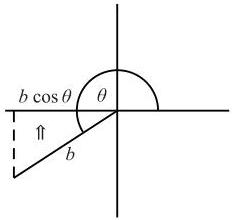
In the diagrams above, if the angle is obtuse, the projection becomes negative because it points in the negative direction. Similarly, the sine projection becomes negative when the angle points below the axis.
Application to General and 3D Figures
While you are not required to recall the sine or cosine rules for this specific topic, you must be able to apply trigonometric ratios to general triangles in 2D and 3D by constructing right-angled triangles. This often involves dropping a perpendicular from a vertex to an opposite side (an altitude). In 3D figures, such as pyramids or cuboids, you must identify 2D right-angled triangles within the 3D space, often using the base or the diagonal of a face as one of the sides.
Key takeaways
- The ratios , , and only apply directly to right-angled triangles.
- Exact values for , , and can be derived from an isosceles right triangle and an equilateral triangle cut in half.
- is always equal to , and is always 1.
- Complex 2D or 3D problems can usually be solved by breaking the figure down into multiple right-angled triangles.
When dealing with exact values like or , rationalising the denominator to or can help you spot cancellations in more complex algebraic expressions.
A common error is confusing the 'opposite' and 'adjacent' sides. Always label your sides starting from the angle you are currently using, as the labels change if you switch to the other acute angle in the triangle.
The Pythagorean identity is actually the equation of a unit circle . Every point on the circumference of a circle with radius 1 has coordinates .
Frequently asked questions
What should I do if a triangle is not right-angled?
Since you are not expected to use the sine or cosine rules for this topic, you should look for ways to split the general triangle into two right-angled triangles by drawing a perpendicular line from one vertex to the opposite side.
Why is undefined?
Using the identity , at we have and . Since division by zero is undefined, has no value.
How do I apply these ratios to 3D problems?
In 3D, identify a right-angled triangle that contains the side or angle you need. This often requires using Pythagoras' theorem first to find a length on the base of the shape, which then becomes the 'adjacent' side for a vertical triangle.