Converting Decimals Percentages and Fractions
Updated August 2025
This study guide explains how to convert between terminating decimals, percentages, and fractions, as well as techniques for translating recurring decimals into fractional form. Mastering these conversions allows for faster mental estimation and comparison in the TMUA. A fundamental rule is that simplified fractions only terminate if their denominators contain prime factors of 2 and 5.
Fractions, decimals, and percentages all describe proportions of a whole. Conversions between them are performed through division, multiplication by powers of 10, or algebraic manipulation to eliminate repeating digits in the case of recurring decimals.
Definitions and Overview
Fractions, decimals, and percentages are different ways to describe a proportion of a group, number, or whole. Understanding their relationships is essential for solving problems in the TMUA. There are two main types of decimals that we must be able to manipulate:
- A terminating decimal is a decimal which has a finite number of digits.
- A recurring decimal is a decimal which has repeating digits or a repeating pattern of digits that continue infinitely.
Standard Conversion Methods
To move between these different forms, follow these standard procedures:
- Mixed Number to Improper Fraction: Convert the integer part into a fraction with the same denominator as the fractional part, then add it to the fractional part.
- Improper Fraction to Mixed Number: Divide the numerator by the denominator. The quotient is the whole number part and the remainder is written over the original denominator.
- Cancelling a Fraction: Divide both the numerator and the denominator by their highest common factor (HCF) to reach the lowest terms.
- Equivalent Fractions: These are found by multiplying or dividing both the numerator and the denominator by the same non-zero value.
- Fraction to Decimal: Divide the numerator by the denominator. Alternatively, use equivalent fractions to write the fraction over a denominator that is a power of 10, then use place value.
- Decimal to Percentage: Multiply the decimal by 100.
- Percentage to Decimal: Divide the percentage by 100.
- Terminating Decimal to Fraction: Use the smallest place value to identify the denominator and write the digits of the decimal as the numerator. For example, because the 7 is in the ten thousandths place.
The Prime Factor Rule for Decimals
A simplified fraction will result in a terminating decimal if and only if the only prime factors in the denominator are 2, 5, or both. If any other prime factors (such as 3, 7, or 11) exist in the simplified denominator, the decimal will be recurring.
Worked Examples: Basic Conversions
Converting Mixed Numbers and Improper Fractions
Write as an improper fraction.
Write as a mixed number.
Divide the numerator by the denominator: remainder 2. This gives .
Cancelling to Lowest Terms
Cancel to its lowest terms.
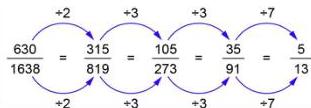
We can use two methods to simplify this. Method 1 involves prime factorisation:
Method 2 involves repeated cancelling:
Finding Equivalent Fractions
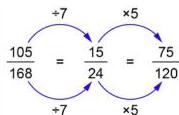
Find the value of where .
We can use cross multiplication: . Rearranging gives .
Worked Examples: Decimals and Percentages
Fraction to Decimal
Convert and to decimals.
For , we use equivalent fractions: .
For , use short division: .
Decimals and Percentages
Convert to a decimal.
.
Convert 5.5 to a percentage.
.
Terminating Decimal to Fraction
Convert 0.725 to a fraction in its lowest terms.
The 5 is in the thousandths column. .
Recurring Decimals
Fraction to Recurring Decimal
Convert to a recurring decimal.
. The dots show that the digits 2 and 7 repeat indefinitely:
Convert to a recurring decimal.
Divide 4.7 by 9. The division results in , which is . Only the 2 is recurring because each step in the division results in a remainder of 2.
Recurring Decimal to Fraction
To convert a recurring decimal to a fraction, we define the decimal as and multiply by a power of 10 to shift the decimal point past the recurring digits, then subtract to eliminate them.
Convert to a fraction.
Let . Since two digits recur, multiply by :
Subtracting gives , so .
Convert to a fraction.
Let . Multiply by 10 to get . Subtracting from gives . Thus .
Ordering Mixed Types
To order numbers in different formats, convert them all to a single form, usually decimals.
Write in ascending order: .
Ascending order: .
Key takeaways
- A simplified fraction terminates if its denominator's only prime factors are 2 and 5.
- Multiply recurring decimals by (where is the number of repeating digits) to set up an equation for fractional conversion.
- When comparing mixed formats (fractions, decimals, and percentages), convert all values into decimals for the most reliable comparison.
- A percentage is simply a part per hundred: divide by 100 to find the equivalent decimal.
In the TMUA, you should memorise common conversions such as eighths () and sixteenths () to save time. If a denominator ends in a 9, 99, or 999, it is almost certainly a recurring decimal.
Be careful when subtracting recurring decimals with non-repeating parts (like ). Ensure you shift the decimal correctly so that the recurring digits align perfectly before you subtract.
The conversion between recurring decimals and fractions proves that all recurring decimals are rational numbers. The algebraic method essentially treats the infinite tail of the decimal as a geometric series that can be summed exactly.
Worked Examples
Frequently asked questions
What is the fastest way to convert a fraction like 7/20 into a decimal?
The most efficient way is to find an equivalent fraction with a denominator of 100. Multiply both numerator and denominator by 5 to get , which is .
Does every fraction eventually terminate or recur?
Yes. Every rational number (a number that can be expressed as a fraction of two integers) will either result in a terminating decimal or a recurring decimal. Non-terminating, non-recurring decimals are irrational numbers like or .
Why does the prime factor rule only work on simplified fractions?
If the fraction is not simplified, the denominator might contain prime factors that are also in the numerator. For example, in , the denominator 15 contains the factor 3, but since it cancels with the numerator to give , the decimal terminates ().