Function Mappings and Properties for the TMUA
Updated August 2025
A function is a mathematical mapping that assigns exactly one output to every input within its domain. This topic covers the distinction between one-to-one and many-to-one mappings, the vertical line test, and the specific properties of the square root and modulus functions. Candidates must understand that the square root symbol denotes the positive root exclusively.
A function is a rule that maps each input value from a domain to exactly one output value . A function is one-to-one if every output corresponds to a unique input, and many-to-one if multiple inputs share an output.
The definition of a function
In simple terms, a function is a rule, or mapping, that connects a set of input values to a set of output values. However, not every algebraic expression or mapping qualifies as a function. To define a function properly, three specific criteria must be met:
- There must be a rule, usually an algebraic expression, that maps input values to output values.
- There must be a clear list of permitted input values, which is known as the Domain of the function.
- For every single input value in the domain, the rule must produce exactly one output value.
To illustrate this, consider the expression . This is a function because every number you square results in a single, unique value. In contrast, the expression is not a function because a single input, such as , leads to two different output values, and . The only exception to this in the example is when , but a function must provide a single output for every value in its domain.
Domain and notation
While a function is strictly denoted by a letter like and its value as , it is common in the TMUA to see the notation simplified to . The Domain is the set of all values for which the function is defined. Usually, the domain is assumed to be the set of all real numbers unless stated otherwise. Some functions have inherent restrictions: for instance, the square root function is only defined for , and logarithmic functions are only defined for positive values. Occasionally, a domain is restricted manually for a specific problem, such as defining for .
One-to-one and many-to-one mappings
While every input must have only one output, it is possible for multiple different inputs to result in the same output. This leads to two categories of functions:
- One-to-one functions: Each unique input produces a unique output, and no two inputs share an output. For example, is one-to-one because every real number has a unique cube.
- Many-to-one functions: Different input values can lead to the same output value. For example, is many-to-one because both and .
Graphical tests for functions
You can identify a function and its mapping type by inspecting its graph using two simple geometric tests:
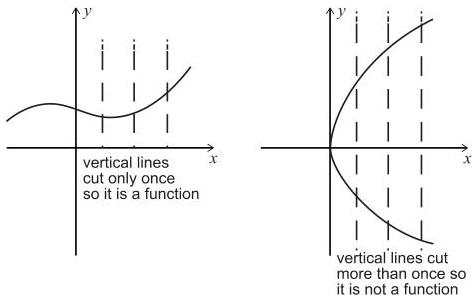
- The Vertical Line Test: This test determines if a mapping is a function. If any vertical line drawn on the graph crosses the curve more than once, it is not a function because that value has multiple values.
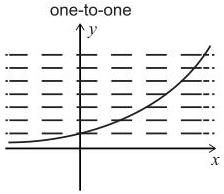
- The Horizontal Line Test: Once you know a graph represents a function, this test determines the mapping type. if every horizontal line crosses the function at most once, it is a one-to-one function.
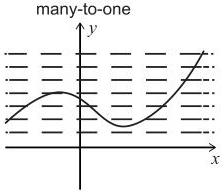
If a horizontal line can be drawn that crosses the function in more than one place, then the function is many-to-one.
Properties of common functions
There are two common functions whose properties you must know by heart for the TMUA:
The Square Root Function
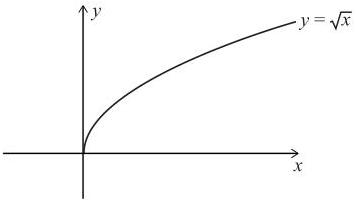
By mathematical convention, the symbol always refers to the positive square root. This convention is adopted without comment in TMUA questions: is 8, and not . The domain is restricted to . As seen in its graph, it is a one-to-one function.
The Modulus Function
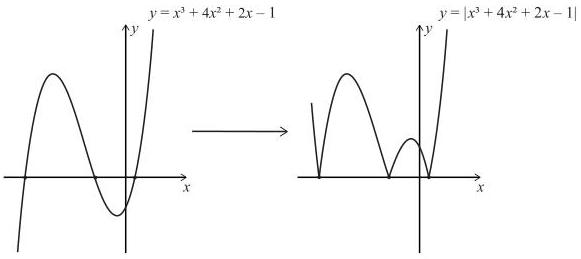
The modulus function, or absolute value, takes the positive value of whatever is inside the vertical lines. Thus, and . To sketch the graph of , you first sketch the original function and then reflect any part of the graph that lies below the -axis in the -axis, while leaving the parts above the -axis unchanged.
Key takeaways
- A mapping is only a function if every input in its domain has exactly one corresponding output.
- The vertical line test confirms if a graph is a function, while the horizontal line test distinguishes between one-to-one and many-to-one mappings.
- In the TMUA, the square root symbol always denotes the positive (non-negative) root only.
- The domain of is , and the function is one-to-one.
- The modulus function is many-to-one over the real numbers and its graph can be constructed via reflection.
When asked to solve equations involving , it is often helpful to sketch the graph to see how many solutions exist. Remember that the reflected 'flipped' parts of the modulus graph have the equation .
A very common mistake is assuming can be negative. In the context of functions and the TMUA, is never negative. If a question requires both roots, it will explicitly use the symbol.
Only one-to-one functions (known as injections) possess an inverse function. Many-to-one functions like do not have a true inverse unless their domain is restricted to a region where they are one-to-one, such as .
Worked Examples
Practice Questions
Frequently asked questions
Is a function?
No. If we treat as the input, a single value of (like ) corresponds to two different values of ( and ). It fails the vertical line test.
Why is considered a function if two inputs give the same output?
A function is allowed to have multiple inputs for the same output; this is called a 'many-to-one' function. The strict requirement is that every single input must have only ONE output.
What is the difference between and solving ?
The function is defined as the positive root. However, when solving an equation like , you are looking for all numbers that square to 25, which are , giving and .
Does a function always have to be defined for all real numbers?
No. The domain is the set of permitted inputs. Some functions, like or , have domains that exclude certain portions of the real number line.