Linear and Quadratic Inequalities for the TMUA
Updated August 2025
Mastering inequalities is essential for TMUA Paper 1, as they require stricter logic than standard equations. This topic covers linear, quadratic, rational, and modulus inequalities. You will learn to use graphical sketches and distance interpretations to determine valid solution ranges while avoiding common algebraic pitfalls.
An inequality defines a set of values for which a statement remains true. Crucially, while adding or subtracting terms preserves an inequality, multiplying or dividing by a negative number reverses the direction of the inequality sign.
The Fundamental Behaviour of Inequalities
When dealing with inequalities, it is vital to remember that they do not behave exactly like equations. While you can add and subtract terms on both sides freely, you cannot multiply or divide both sides, raise both sides to an even power, or apply certain functions without first checking if the operation preserves the inequality.
Consider these examples where standard algebraic moves fail if applied carelessly:
- The statement is true, but multiplying both sides by yields , which is clearly false.
- The statement is true, but squaring both sides yields , which is false.
- The statement is true, but dividing both sides by yields , which is false.
In general, you must ensure your manipulations do not turn a true statement into a false one or generate incorrect solution sets.
Solving Linear Inequalities
Linear inequalities can often be solved by simple rearrangement, provided you remember to flip the sign if you multiply or divide by a negative number.
Example 1 Solve
Subtract from both sides: Subtract 2 from both sides: Divide by 2:
Solving Quadratic Inequalities
Quadratic inequalities are best solved using a combination of factorisation and graphical sketching. Simply finding the roots is not enough: you must determine which regions of the axis satisfy the inequality.
Example 2 Solve
First, factorise the expression:
Next, produce a rough sketch of the quadratic . The roots (x-intercepts) are at and .
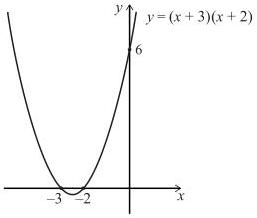
From the diagram, we identify the values where the graph sits on or above the axis (where ). The solution is or .
Rational Inequalities and the Square Method
A common mistake when solving rational inequalities is multiplying by a denominator that could be negative, which would flip the sign in ways the algebraist might not account for.
Example 3 Solve
It is tempting to multiply by , but since is negative for , this is a poor strategy. Instead, multiply both sides by , which is guaranteed to be positive for all in the domain.
Rearrange the terms into a single side to find a common factor:
Extract the common factor :
By sketching this quadratic, we see it is positive outside of the roots. Thus, the solution is or .
Writing Ranges and Correct Notation
Correct logical notation is essential. Avoid 'howlers' such as , which is a logical impossibility. If a solution set consists of two disjoint regions, use the word 'or'. For example, if must be less than or greater than , write or .
Inequalities Involving the Modulus Sign
The modulus function makes the value of positive. The expression can be interpreted as the positive distance of from on a number line.
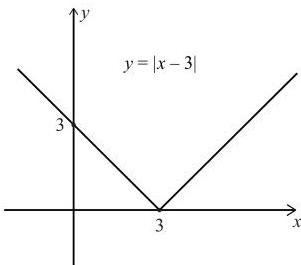
Consider the inequality . Graphically, we sketch and and see where the first graph sits below the second.
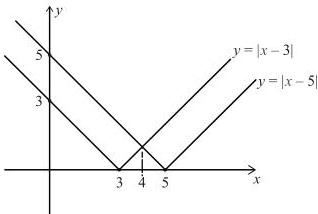
From the diagram, the solution is . Conceptually, this asks: which values are closer to 3 than they are to 5? The midpoint between 3 and 5 is 4, so everything to the left of 4 is closer to 3.
For more complex cases like , which is , we use a sketch:
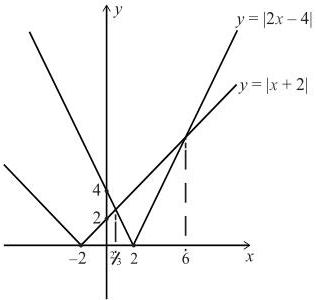
To find the intersection points and , we solve the equations where the lines meet. For , we solve , giving . For , we solve , giving . The range where the first graph is below the second is .
Key takeaways
- Always flip the inequality sign when multiplying or dividing by a negative number.
- For quadratic inequalities, factorise and sketch the graph to find the intervals above or below the x-axis.
- When solving rational inequalities, multiply by the square of the denominator to ensure you are multiplying by a positive value.
- Interpret modulus inequalities as the distance of from being less than .
- Use 'or' for disjoint solution sets and 'and' only when solution ranges overlap into a single interval.
In the TMUA, time is limited. For modulus inequalities, checking the 'midpoint' or interpreting the expression as distance on a number line is often much faster than full algebraic manipulation.
Be extremely careful with notation. Writing is a major logical error that suggests . Always check if your combined inequalities actually make sense numerically.
Solving inequalities is equivalent to finding the domain of a function defined by those constraints. For example, solving is the first step in finding the domain of the function .
Worked Examples
Practice Questions
Frequently asked questions
Why can I not just multiply both sides of a rational inequality by the denominator?
Because the denominator might be negative. If it is negative, the inequality sign must flip. If it is positive, it stays the same. Since the sign of a variable denominator changes depending on , multiplying by its square is safer because a square is always non-negative.
What happens if a quadratic has no real roots in an inequality?
If the discriminant , the quadratic graph never touches the -axis. It is therefore either always positive or always negative. You can check a single value to determine the sign for the entire range.
How do I solve without a graph?
You can split it into two linear cases: or . Solving these separately gives the two disjoint regions of the solution set.