Quadratic Functions and Equations for the TMUA
Updated August 2025
This lesson covers the properties of quadratic functions, their graphs, and the essential algebraic techniques required for the TMUA. You will learn to manipulate quadratics via factorisation, completing the square, and the quadratic formula, while understanding how the discriminant determines the nature of the roots.
A quadratic function is a polynomial of the form where , characterised by a parabolic graph and roots determined by the discriminant .
Defining Quadratic Functions
Quadratics are functions generally written in the form where . The term quadratic is often used loosely to refer to the function itself, its graph, or the algebraic expression. In university admissions tests like the TMUA, quadratics serve as the perfect toy function: they are simple enough to manipulate while possessing rich properties that illustrate deeper mathematical concepts such as symmetry and rates of change.
To master this topic, you are expected to be able to:
- Factorise quadratics when appropriate.
- Solve equations using the quadratic formula.
- Complete the square and understand its relationship to the quadratic formula.
- Understand the link between the roots and the graph.
- Relate the completed square form to transformations on the plane.
- Sketch curves, marking intercepts, intercepts, and vertex coordinates.
- Use the discriminant to determine the number of real roots.
- Find maximum or minimum coordinates via completing the square or differentiation.
Completing the Square and Graph Shifting
Consider the simplified quadratic . By completing the square, we can rewrite this as:
This form reveals that the graph is simply the basic parabola shifted, or translated, on the plane. Specifically, starting with , we shift it to the left by and up by . This transformation does not stretch or squash the shape, it merely moves it.
We can find the coordinates of the minimum point of using three distinct methods:
- Translation: The minimum of is . Shifting it as described gives the new minimum at .
- Differentiation: Setting yields . Substituting this back into the original equation gives the coordinate.
- Algebraic Inspection: Since is always greater than or equal to zero, the least possible value occurs when this squared term is exactly zero, which happens when .
The Discriminant and Roots
The roots of a quadratic are the values where , representing the points where the graph crosses the axis. For a graph with a positive coefficient, it only crosses the axis if its minimum point is below the axis. Algebraically, this requirement is , which rearranges to .
For the general quadratic , the nature of the roots is determined by the discriminant, :
- If , the quadratic has two real distinct roots and cuts the axis at two points.
- If , the quadratic has one repeated root and touches the axis at a single point.
- If , the quadratic has no real roots and never touches or crosses the axis.
The General Quadratic Formula
Completing the square on allows us to derive the quadratic formula. We start by dividing by :
Rearranging to isolate :
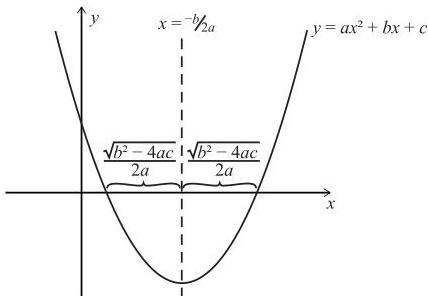
This formula provides the horizontal positions of the roots. The line of symmetry for the graph is at , and the distance from this line to each root is . Consequently, the total distance between the roots is .
Alternative Forms and Exercises
Sometimes, an alternative version of the quadratic formula is useful. If we divide the original equation by , we create a quadratic in terms of . Solving this leads to:
While this is equivalent to the standard formula, it requires . Thinking about such variations helps develop the flexibility needed for the TMUA.
Key takeaways
- The discriminant determines if there are two, one, or zero real roots based on its sign.
- The completed square form reveals the vertex of the parabola at .
- The quadratic formula is derived directly from the process of completing the square.
- The line of symmetry for any quadratic is always the vertical line .
Always check for a common factor across , , and before solving, as this simplifies the arithmetic significantly. When using the discriminant in inequalities, remember that a quadratic 'touching' the axis counts as having a repeated root ().
Be extremely careful with signs when calculating the discriminant, especially when is negative. A common error is writing as a subtraction when it should become an addition.
The relationship between the coefficients and the roots (Vieta's Formulas) is a powerful tool: the sum of the roots is and the product of the roots is . This often allows you to solve TMUA problems without ever finding the roots explicitly.
Worked Examples
Practice Questions
Frequently asked questions
What does a negative discriminant mean for the graph of a quadratic?
A negative discriminant () means the quadratic has no real roots. Geometrically, the entire parabola sits either strictly above the axis (if ) or strictly below the axis (if ).
How do I find the range of a quadratic function?
The range is determined by the coordinate of the vertex. For , the range is , and for , the range is , where is the value found after completing the square.
When should I factorise instead of using the formula?
Factorisation is generally faster if the roots are integers or simple fractions. If you cannot spot factors within a few seconds, it is usually more efficient to proceed with the quadratic formula or completing the square.