Understanding the Parameters of Linear Graphs
Updated September 2025
The linear function is the foundation of coordinate geometry. In this topic, we examine how the gradient and the intercept determine the line's orientation and position. Understanding these parameters as rates of change and vertical translations is essential for solving complex TMUA geometry problems.
The gradient represents the rate of change of with respect to , determining the steepness and direction of the line, while the constant identifies the intercept, marking where the graph crosses the vertical axis.
The Role of the Gradient
The in represents the gradient of the straight line. You can think of this as a measure of the line's steepness. If is positive, the line slopes upwards from bottom left to top right. If is negative, it slopes downwards from top left to bottom right.
We can quantify this steepness in two interrelated ways. First, the gradient tells us how much we must move vertically to get back on the line for every 1 unit we move horizontally. A gradient of 2 means for every 1 unit right, we move 2 units up. A gradient of means for every 1 unit right, we move 3 units down.
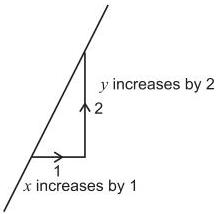
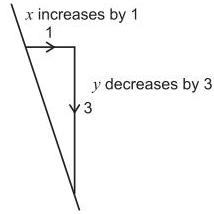
Secondly, the gradient is a rate of change. It tells us how fast is changing relative to . If , then values increase twice as fast as values. If , decreases by 3 units for every unit increase in .
Trigonometric Interpretation of
If the scales on the and axes are identical, the gradient is equal to the tangent of the angle that the line makes with the positive axis. For example, a line at has a gradient of .
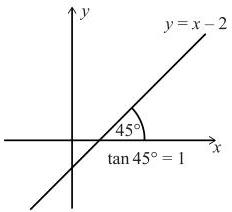
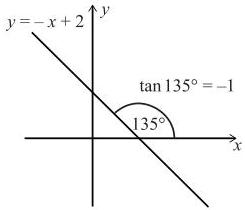
Horizontal lines have a gradient of and the equation . Vertical lines do not have a defined gradient in the same sense, but they have equations of the form .
The Role of the Intercept
The constant represents the intercept. This is the value of where the graph crosses the axis. This occurs when , so substituting into naturally yields .
Parallel and Perpendicular Lines
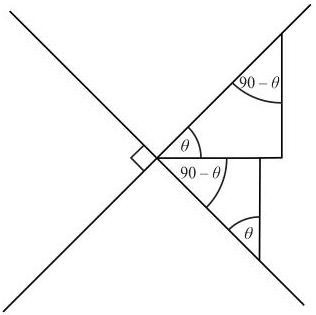
Two lines are parallel if and only if they have the same gradient (). Two lines are perpendicular if and only if the product of their gradients is (), assuming neither line is vertical. This relationship can be understood geometrically using similar triangles.
Transforming the Identity Graph
We can understand by viewing it as a sequence of transformations applied to the identity graph . There are two common paths to consider:
- Path A: . This involves a vertical stretch or horizontal squash followed by a horizontal translation by .
- Path B: . This involves a vertical translation by followed by a vertical stretch or horizontal squash.
In the case of , a vertical translation is identical to a horizontal translation , because . However, once the gradient is introduced, these transformations behave differently. For instance, in , the value shifts the graph horizontally and the value shifts it vertically.
Key takeaways
- The gradient is the rate of change of with respect to .
- The intercept is the value of the function when .
- Parallel lines share the same , while perpendicular lines satisfy .
- Changing translates the line vertically without changing its steepness.
- Changing rotates the line around the point .
When given a linear equation in the form , quickly rearrange it to to identify the gradient and intercept easily. Be extremely careful with signs when the gradient is negative.
A common error is confusing horizontal and vertical translations. For , is a vertical shift. If you write , the becomes a horizontal shift, which results in a different intercept of .
The gradient is the derivative of the function . Because the derivative is a constant , a straight line is the only type of function with a perfectly constant rate of change.
Frequently asked questions
What happens to the graph if ?
If , the equation becomes . This is a horizontal line where the value is constant regardless of .
Can be a negative value?
Yes. If is negative, the line crosses the axis below the origin ().
Is the in the same as the intercept?
No. In the form , the intercept is found by setting and solving for , which gives .
How do I find if I only have two points?
The gradient is calculated as the change in divided by the change in : .