Geometric Interpretation of Algebraic Solutions
Updated September 2025
Simultaneous equations represent the search for number pairs that satisfy multiple algebraic relationships at once. Geometrically, this translates to finding the intersection points of graphs on the Cartesian plane. Understanding this connection allows students to predict the number of solutions based on the orientation and intersection of lines and curves.
The algebraic solutions to a system of simultaneous equations are exactly represented by the coordinates of the points where the graphs of those equations intersect on the plane.
Algebra and Geometry: The Cartesian Connection
To understand the geometric interpretation of equations, we must first consider what an equation represents. An equation like is a concise way of summarising a set of number pairs. For instance, when , , so the pair is in the set. Other pairs include , , and . This set is uncountably infinite, meaning we can never list every member.
Historically, the introduction of the Cartesian plane by Rene Descartes in 1637 allowed mathematicians to draw these number pairs as a diagram. Every point on the line represents one pair from the algebraic set. This shift from pure algebra to geometry is a fundamental pillar of mathematics that allows us to interpret algebraic results through visual shapes.
Solving Simultaneous Equations
When we are given two equations, such as and , solving them simultaneously means finding the specific number pairs that make both equations true at the same time. Geometrically, this corresponds to the point where the two graphs cross. Because the point of intersection lies on both lines, it must be a member of both sets of number pairs.
There are three primary ways to solve such systems:
- Substitution: Rearranging one equation to make one variable the subject and substituting it into the other.
- Elimination: Multiplying equations to make coefficients match and then adding or subtracting to eliminate a variable.
- Graphical: Drawing both graphs and identifying the coordinates of the intersection point.
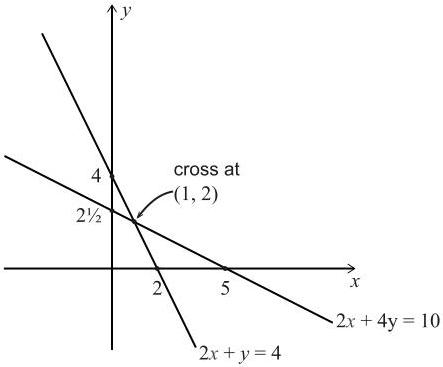
In the graphical example above, solving and algebraically leads to and . Visually, we see the lines intersect at the point .
Linear Simultaneous Equations
Linear equations are those whose graphs are straight lines. When considering two lines on a two dimensional plane, there are only three possible geometric relationships, which dictate the number of solutions:
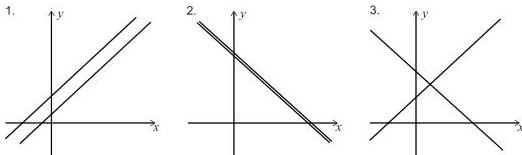
- Parallel and distinct lines: These lines have the same gradient but different intercepts. They never cross, so there are no solutions. For example, and . Since cannot equal 4 and 8 at the same time, no such pair exists.
- Parallel and identical lines: These are the same line written in different ways, such as and . Every point on the line is a solution, resulting in infinitely many solutions.
- Non-parallel lines: These lines have different gradients and must cross exactly once in a two dimensional plane. This results in exactly one solution.
Linear and Quadratic Intersections
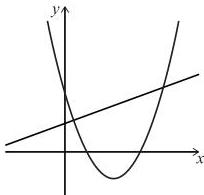
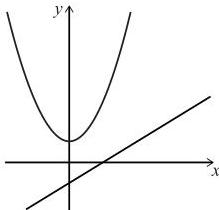
When one equation is linear and the other is quadratic, we can predict the number of solutions by visualizing the possible ways a straight line can interact with a parabola. There are three geometric cases:
- The line crosses the quadratic at two distinct points: This yields two distinct real solutions.
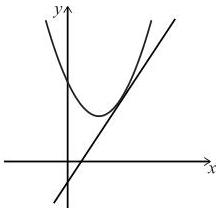
- The line is tangent to the quadratic: The line touches the curve at exactly one point. Algebraically, this results in one repeated solution.
- The line never crosses the quadratic: There are no real intersection points, meaning there are no real solutions to the simultaneous equations.
Worked Example: Line and Quadratic
Solve the simultaneous equations and .
To solve these, we eliminate by setting the expressions equal to each other:
Rearrange into a standard quadratic form:
Factorising the quadratic gives:
This yields a single solution, . Substituting back into the linear equation , we find . Because there is only one repeated solution, we can conclude geometrically that the line is tangent to the quadratic at the point .
Higher Order Systems
We can extend these principles to other functions, such as cubics. While a line and a quadratic might have no real solutions, a line and a cubic will always have at least one real solution because of the end behaviour of cubic functions. In TMUA questions, you should always be prepared to translate an algebraic problem into a sketch to determine if the solutions you have found make geometric sense.
Key takeaways
- A system of equations has as many solutions as the number of times their graphs intersect.
- Two parallel distinct lines have zero solutions because they never intersect.
- A single repeated solution in a linear and quadratic system indicates that the line is tangent to the curve.
- If a system has no real solutions, the graphs do not meet or touch on the Cartesian plane.
When solving simultaneous equations involving a quadratic, always check the discriminant of the resulting equation. It is the fastest way to determine the number of intersection points without needing to find the exact coordinates.
Be careful when assuming the number of solutions from a sketch alone. A line might look like it does not touch a curve, but it could intersect much further along the axes. Always verify your geometric intuition with algebra.
The relationship between equations and intersections is a specific case of the broader mathematical field of Analytic Geometry. This connection allows us to solve complex geometric problems, such as finding the distance between a point and a line, using purely algebraic methods.
Frequently asked questions
Can a system of two linear equations have exactly two solutions?
No. In a two dimensional plane, two straight lines can either be parallel and distinct (zero solutions), parallel and identical (infinitely many solutions), or non-parallel (exactly one solution).
What does a negative discriminant tell us about the graphs?
If you substitute a linear equation into a quadratic and find the resulting quadratic has a negative discriminant (), it means there are no real solutions. Geometrically, this confirms the line and the quadratic never intersect.
How do I know if a solution is a 'repeated root' from a graph?
A repeated root occurs geometrically when the graph of one function is tangent to the other. Instead of crossing through the curve, the line just touches it at that specific point.
Do cubic and quadratic systems always have solutions?
A cubic and a quadratic will always intersect at least once because as becomes very large or very small, the term dominates, ensuring the graphs must eventually cross.