Graphs of Functions and Differentiation
Updated September 2025
Learn how to use calculus to determine the shape of a graph for university admissions tests. This page covers finding and classifying stationary points using first and second derivatives, and identifying intervals where a function is strictly increasing or decreasing. A vital skill for sketching accurate polynomial curves.
The derivative represents the gradient of the tangent to the curve at any point. By identifying where , , or , we can determine the location of stationary points and the intervals of growth or decay for a function.
Differentiation is a powerful tool for determining the qualitative and quantitative features of a function's graph. While basic algebra tells us where a graph crosses the axes, calculus tells us about its turning points and general direction.
Stationary Points
A stationary point occurs when the tangent to a curve is horizontal. At such a point, the gradient is zero, meaning the rate of change of with respect to is null. Mathematically, we find stationary points by solving the equation:
Once we have identified the values that satisfy this equation, we must classify the points as local maxima or local minima. There are several techniques for this.
Worked Example: Classifying Points on a Cubic
Consider the cubic function . To find the stationary points, we first differentiate the expression:
Setting this equal to zero and factorising:
This gives us stationary points at and . Because this cubic has a positive coefficient for the term, we expect the maximum to be on the left and the minimum on the right. Thus, the maximum occurs at and the minimum at .
The Second Derivative Test
A more formal method for classification uses the second derivative, , which tells us how the gradient itself is changing.
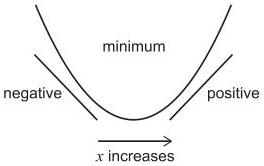
- If and , the point is a local minimum. This is because the gradient is increasing, turning from negative to positive.
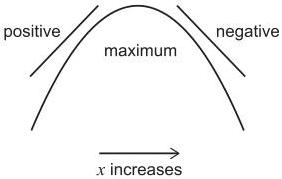
- If and , the point is a local maximum. The gradient is decreasing, turning from positive to negative.
In our cubic example , the second derivative is .
At : . Since , it is a minimum.
At : . Since , it is a maximum.
Logical Nuances
It is important to note that the conditions or are sufficient but not necessary. For example, at the minimum of , and . This shows that if the second derivative is zero, the test is inconclusive and the point could still be a maximum, minimum, or a point of inflexion.
Increasing and Decreasing Functions
Calculus allows us to define precisely when a function is always moving "upwards" or "downwards" on a graph.
Strictly Increasing Functions
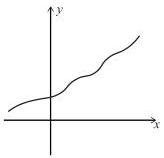
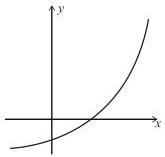
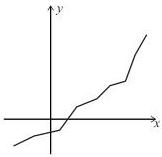
Intuitively, a strictly increasing function is one where the value always gets greater as the value gets greater. A sufficient condition for this using differentiation is:
If for all in an interval, then the function is strictly increasing on that interval.
Strictly Decreasing Functions
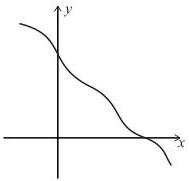
A strictly decreasing function is one where the value always gets less as the value gets greater. The sufficient condition is:
If for all in an interval, then the function is strictly decreasing on that interval.
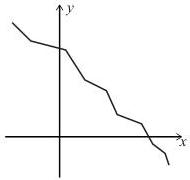
Note that we cannot say the reverse: if a function is strictly increasing, it does not mean for all . Some functions may have corners where the derivative is not defined, yet they are still strictly increasing. However, for the smooth polynomial functions typical of the TMUA, looking for or is the primary method.
Points of Inflexion
While detailed examination of inflexions is excluded, you should have a qualitative understanding that they represent a point where the curve changes concavity. In the graph of , the point at the origin is a horizontal point of inflexion because , but the graph does not turn back: it increases before and after the point.
Key takeaways
- Stationary points are located by solving .
- Use the second derivative to classify points: is a minimum, is a maximum.
- A function is strictly increasing on an interval where .
- A function is strictly decreasing on an interval where .
- Calculus conditions like are sufficient for classification, but not necessary, as shown by functions like .
In the exam, if you find stationary points for a cubic, you can often classify them just by looking at the coefficient of . A positive cubic goes from to , so the first stationary point encountered from the left must be a maximum and the second a minimum.
Be careful when differentiating fractional or negative powers of before finding stationary points. Always simplify the expression into a sum of powers first to avoid errors in the power rule .
The relationship between and the shape of is a local property. By finding where changes sign, you are effectively finding the 'boundaries' of the different regions of the graph's behaviour, allowing you to piece together the global shape of the function.
Frequently asked questions
What happens if both the first and second derivatives are zero?
If and , the second derivative test is inconclusive. The point could be a maximum (like ), a minimum (like ), or a point of inflexion (like ). You must check the gradient or values on either side of the point to classify it.
What is the difference between a stationary point and a turning point?
A turning point is a stationary point where the function changes direction (a maximum or a minimum). A stationary point is any point where , which includes horizontal points of inflexion where the function does not actually "turn".
Does mean a function is strictly increasing?
No. allows for intervals where the function is constant (flat). For a function to be strictly increasing, the value must strictly increase as increases. The sufficient condition we use is .