Trapezium Rule Approximation for the TMUA
Updated August 2025
Learn how to approximate the area under a curve using the trapezium rule for the TMUA. Understand the formula derivation using equal-width strips and how to determine if your estimate is an overestimate or underestimate based on the curve shape.
The trapezium rule estimates the area under a curve by dividing the region into strips of equal width and treating each as a trapezium. The approximate area is .
We expect you to be able to use the Trapezium rule to estimate areas under curves, where area is taken to be positive, or to estimate the values of definite integrals, where areas under the -axis are negative. We will ensure that any question asked in the TMUA is clear about whether it requires an estimate of areas between a curve and an axis or an estimate of a definite integral.
The Area of a Trapezium
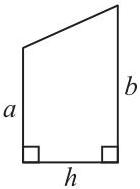
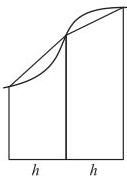
You should be able to calculate the result from scratch using your knowledge of the area of a trapezium. The area of a trapezium with two right angles, as shown in the diagram, is calculated by multiplying the width by the average of the two parallel heights.
The General Trapezium Rule
Using this basic formula, we can estimate the area under a curve by using a set of equal-width trapezia. We assume that the trapezium rule always finds an estimate using equal-width strips. We use trapezia, each of width . The heights of each trapezium, , are calculated from the function whose area we are approximating.
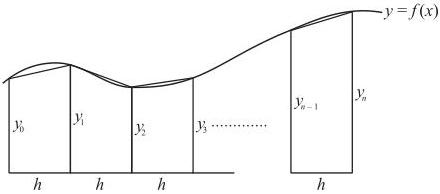
To find the approximate total area, we sum the areas of the individual trapezia:
This simplifies to the standard form of the Trapezium rule:
Note that every appears twice except the first one, , and the last one, . This is because every intermediate is a shared side for two adjacent trapezia.
Overestimates and Underestimates
You should be able to tell whether the result of the trapezium rule is an overestimate or an underestimate by understanding the shapes of curves. This depends on the way the curve bends relative to the straight top edge of the trapezia.
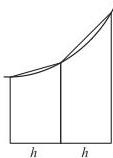
If the curve is convex (bending away from the -axis), the straight lines of the trapezia will lie above the curve, resulting in an overestimate.
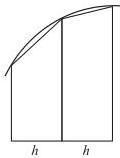
If the curve is concave (bending towards the -axis), the straight lines of the trapezia will lie below the curve, resulting in an underestimate.
Sometimes, it is not possible to tell if the trapezium rule gives an overestimate or underestimate without further work, such as when the curve contains a point of inflexion within the range of integration.
Key takeaways
- The width of each strip is found using where is the number of strips.
- The formula is .
- Convex curves result in an overestimate because the trapezia tops sit above the curve.
- Concave curves result in an underestimate because the trapezia tops sit below the curve.
Always draw a small table for your and values to avoid simple calculation errors. Ensure your calculator is in the correct mode (radians or degrees) when calculating values for trigonometric functions.
Be careful with the number of strips. If the question asks for 4 strips, you have 5 -values. A common mistake is to use the wrong value for when calculating .
The trapezium rule is a linear approximation. As the number of strips approaches infinity, the trapezium rule estimate approaches the exact value of the definite integral.
Worked Examples
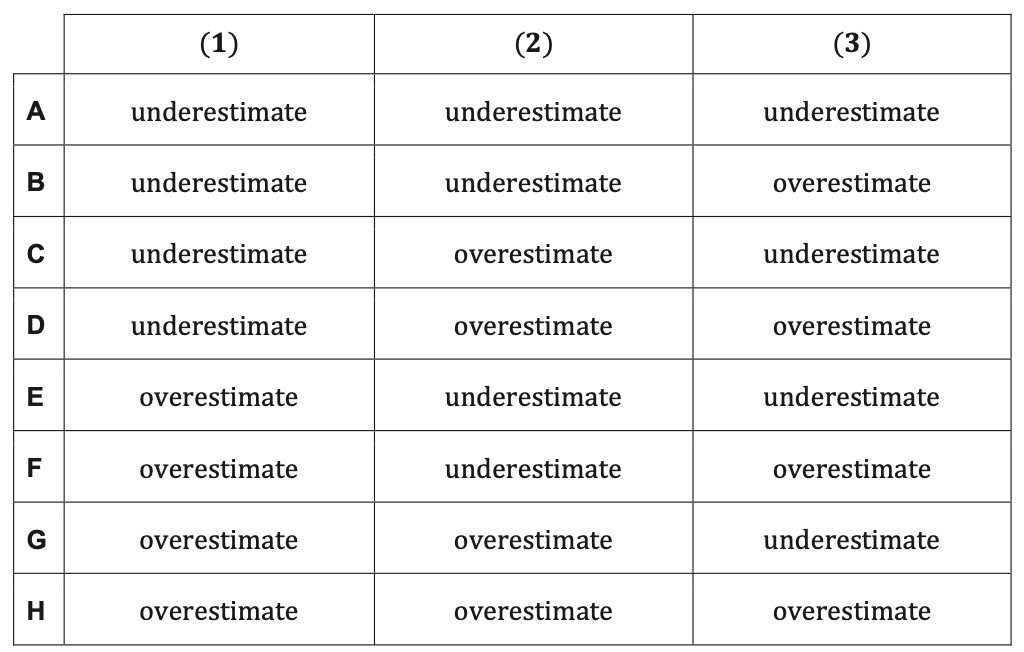
Consider the following three curves:
the curve reflected in the line
The trapezium rule is used to estimate the area under each of these three curves between
and .
State whether the trapezium rule gives an overestimate or underestimate for each of these areas.
Practice Questions
Frequently asked questions
What is the difference between strips and ordinates?
A calculation with strips uses -values (ordinates). For example, 4 strips require .
How do I determine if a curve is concave or convex without a graph?
You can use the second derivative. If , the curve is convex and the trapezium rule gives an overestimate. If , the curve is concave and it gives an underestimate.
Does the trapezium rule work for negative values?
Yes. It will estimate the definite integral. Trapezia below the -axis will have negative values, contributing negatively to the total sum.