Binomial Expansion for the TMUA
Updated August 2025
The binomial expansion is a vital tool for finding specific terms in the expansion of powers of brackets like or . For the TMUA, you must understand how to use combination notation and factorials to calculate coefficients efficiently without drawing Pascal's triangle. A core fact is that the powers of terms always sum to .
The binomial theorem provides a formula to expand as a sum of terms involving for positive integers . The coefficient represents the number of ways to choose terms from brackets, calculated as .
The binomial theorem is mathematically rich, and while there are many ways to approach it, for examinations like the TMUA, it is best to understand the underlying patterns rather than just memorising formulae. You are expected to be able to calculate the value of and expand expressions of the form or for positive integers .
Using the Binomial Expansion
For simple cases where is small, you may have used Pascal's triangle. However, for the TMUA, this is often too slow. If you need the first five terms of , calculating the 17th row of the triangle is inefficient. Instead, we use the general formula:
Note that this can also be written as . Both versions are identical because of the symmetry of the binomial coefficients. The pattern to remember is that the powers of the two components in any term must always sum to the total power .
Practical Application: Finding a Specific Term
To find a specific term quickly, you should build the expression in three distinct stages.
Example 1: Find the term involving in the expansion of .
- Identify the power of the component. Since we need , we must use . It is vital to wrap this in brackets, as both the 2 and the are raised to the power of 7.
- Identify the power of the constant. Because the total power is 8, and we have used a power of 7 for the term, the constant 3 must be raised to the power of . Thus, we have .
- Apply the combination coefficient. The top number is the total power of the bracket, which is 8. The bottom number can be the power of either component (either 1 or 7), because .
The final term is .
Example 2: Find the coefficient of in .
Following the same rules, we identify that we need . This leads to the term . A common error here is forgetting the minus sign or failing to raise to the power of 5. The coefficient is the numerical part of this term, so the final answer would not include .
How the Expansion Works: Combinatorics
The symbol represents 'n choose r', which is the number of ways to select a collection of objects from distinct objects without regard to order.
Consider five letters: A, B, C, D, E. If we want to choose 3 letters, we have 5 choices for the first, 4 for the second, and 3 for the third, giving permutations. However, since order does not matter, a set like {A, B, C} is the same as {B, A, C}. There are ways to order any 3 letters, so we divide our 60 choices by 6 to get 10 unique combinations. This is written as:
In general, the number of ways to fill boxes from a set of is shown conceptually here:
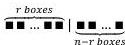
The formula for this is .
Symmetry and Brackets
One useful property is symmetry: . Choosing objects to keep is identical to choosing objects to throw away.
When we multiply out brackets like , we are effectively choosing either a 2 or a from each of the five brackets. To find the term for , we must choose from exactly two brackets and 2 from the remaining three. The number of ways to choose which two brackets provide the is , which explains why the coefficient appears in the expansion.
Key takeaways
- The sum of the powers of the two terms in any binomial expansion must always equal .
- Combination coefficients are symmetric, meaning .
- Always place negative terms or terms with coefficients in brackets (e.g., ) to ensure the power applies to everything inside.
- Factorial notation is used to calculate , where .
When finding a specific coefficient, do not expand the whole bracket. Instead, use the 'stages' method: write down the component with its required power, then determine the power of the constant, and finally add the coefficient.
The most common mistake is writing instead of . In the first case, you only multiply by 2; in the second, you multiply by . Always use brackets for terms involving coefficients or negative signs.
The binomial coefficient is a link between algebra and combinatorics. It represents the number of paths to a specific point in Pascal's triangle and the number of ways to choose terms when multiplying out identical brackets.
Worked Examples
Practice Questions
Frequently asked questions
What is the difference between a coefficient and a term?
A 'term' refers to the entire part of the expansion, including the power of , such as . The 'coefficient' is just the numerical multiplier of that power, which in this case is .
Can be a negative number or a fraction for this expansion?
For this specific part of the TMUA specification (MM2.4), is restricted to positive integers. Expansions for rational involve infinite series and are covered in different mathematical contexts.
How do I find the constant term in an expansion?
The constant term is the one where the total power of is 0. If the expansion is , you must find the combination of powers that allows the terms to cancel out.