Radian Measure and Sector Geometry
Updated August 2025
Radian measure provides a natural way to measure angles based on the properties of circles. For the TMUA, understanding radians is essential for calculating arc lengths and areas of sectors or segments using efficient, simplified formulae. One full revolution is exactly radians.
A radian is the angle subtended at the centre of a circle by an arc equal in length to the radius. For an angle in radians, the arc length is and the sector area is .
Introduction to Radian Measure
Usually, the first method for measuring angles you encounter is using degrees, where one full revolution is degrees. There is nothing inherently special about the number : some suggests it relates to the approximate number of days in a year, but other units exist, such as Gradians where a right angle is units. These measures are somewhat arbitrary. However, there is one measure for angles that is more natural than all others: radians.
We define one radian as the angle subtended by a sector of a circle of radius when the arc length is also exactly .
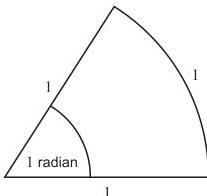
Equivalently, because the circumference of a circle of radius is , a full revolution is equal to radians. Therefore, radian is approximately equal to . While the symbol for radians is a superscript c (), it is common to simply write rad or use the number alone.
Converting Between Degrees and Radians
Conversion between degrees and radians is straightforward because degrees corresponds to radians.
To convert degrees to radians:
Since degrees is the fraction of a full revolution, the radian measure is:
To convert radians to degrees:
Similarly, radians is the fraction of a full revolution, so:
Students are expected to know these standard conversions by heart:
| Degrees | Radians |
|---|---|
Arc Length and Sector Area
You must understand and be able to use the formulae for arc length and sector area when the angle is measured in radians.
To prove these formulae, we recall that an angle in radians represents the fraction of a full circle.
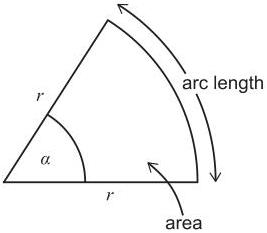
Proof of Arc Length:
The arc length is the circumference multiplied by the fraction of the circle corresponding to the arc:
Proof of Sector Area:
The area of the sector is the total area of the circle multiplied by the fraction of the circle that makes up the sector:
Area of a Segment
Although the guide focuses on sectors, the TMUA specification requires the use of radian measure for segments. A segment is the region bounded by a chord and an arc. To find the area of a segment, you subtract the area of the triangle formed by the two radii and the chord from the area of the full sector.
Using the formula for the area of a triangle where the sides are both the radius :
Key takeaways
- One radian is defined as the angle where arc length equals radius.
- Always convert degrees to radians using before using arc length or sector area formulae.
- The arc length and sector area only work when is in radians.
- The area of a segment is found by subtracting the triangle from the sector .
In the TMUA, always check your calculator is in the correct mode (Radians or Degrees). If a question involves or asks for arc lengths/areas of sectors, it is almost certainly a radian-based problem.
A common error is the 'fence post' error when calculating lengths related to sectors, or forgetting that the triangle area in a segment calculation () requires the calculator to be in radian mode for the sine function.
Radian measure is the only unit that makes the relationship between linear motion and angular motion direct. For a point moving around a circle, its linear velocity is related to its angular velocity by , which mirrors the arc length formula .
Worked Examples
Practice Questions
Frequently asked questions
Why use radians instead of degrees in advanced mathematics?
Radians are a natural measure because they relate angle directly to arc length. Furthermore, many calculus results, such as , are only valid when is measured in radians.
How do I find the perimeter of a sector?
The perimeter of a sector consists of the arc length plus the two radii. Thus, .
Can I use these formulas if the angle is in degrees?
No. The simplified forms and are derived specifically using the radian measure of a circle. If given degrees, you must convert to radians first or use the degree-based versions: and .