Fundamental Trigonometric Identities for the TMUA
Updated August 2025
Mastering the identities and is a requirement for the TMUA. These tools allow you to simplify trigonometric expressions and solve complex equations by reducing them to a single trigonometric function, particularly in quadratic contexts.
The fundamental identities and are relationships derived from the definitions of trigonometric ratios and Pythagoras' Theorem. They are valid for all real values of for which the functions are defined.
Defining Trigonometric Identities
There are many ways to define trigonometric functions. Usually, we first meet trigonometry in relation to right-angled triangles. If we use this approach, the identities we use in the TMUA can be derived directly from the basic ratios of opposite, adjacent, and hypotenuse.
The Relationship between Tangent, Sine, and Cosine
It is sufficient for the TMUA to realise that the relationship between these three functions comes from the standard definitions provided when you first learn trigonometry:
From these, it becomes obvious that can be expressed as a ratio of and :
This identity is particularly useful when you need to solve equations that contain both sine and cosine terms but no squared terms, as it allows you to convert the equation into one involving only tangent.
The Pythagorean Identity:
The second identity is fundamentally a version of Pythagoras' Theorem. Consider a right-angled triangle where the hypotenuse is 1 unit long. By the definitions of sine and cosine, the opposite side has length and the adjacent side has length .
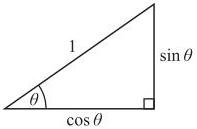
Applying Pythagoras' Theorem () to this triangle gives:
Which is written in standard notation as:
Universal Applicability and the CAST Diagram
While these identities are easily visualised using acute angles in a right-angled triangle, it is vital to notice that they apply to ANY angle , whether it is acute, obtuse, reflex, or negative.
You can justify why these identities apply universally by considering the 'CAST' style diagrams. In these diagrams, the hypotenuse is always taken as a positive value (often ). The signs of and change as the signs of the adjacent () and opposite () sides change across the four quadrants, but the relationships and remain consistent due to the algebraic properties of coordinates and the definition of a circle.
Practical Use in Solving Equations
In the TMUA, these identities are often used to reduce an equation to a single trigonometric function. For example, in equations involving and , you can substitute . This creates a quadratic equation in terms of , which can then be factorised and solved using standard quadratic techniques.
Key takeaways
- The identity is always true provided .
- The identity is a trigonometric form of Pythagoras' Theorem.
- Identities apply to all angles, not just those between 0 and 90 degrees.
- Rearranging allows you to substitute for and vice versa.
When you see a trigonometric equation with a squared term and a linear term of a different function (e.g., and ), always look to use to convert the squared term. This is the most common way to form a solvable quadratic.
Be careful when dividing by to create a term. You must ensure that . If is a potential solution to the original equation, dividing by it will cause you to lose that solution.
These identities are the bridge between geometry and algebra. While they originate in the geometry of triangles, they allow us to treat trigonometric functions as algebraic variables, which is why we can solve trigonometric equations using the same tools we use for polynomials.
Worked Examples
Practice Questions
Frequently asked questions
Can I use these identities for angles in both degrees and radians?
Yes. These identities are fundamental properties of the functions themselves and are independent of the unit used to measure the angle.
Is the same as ?
No. means , whereas means the sine of the squared angle. Brackets or the standard notation should be used to avoid ambiguity.
When should I use in an equation?
This is most useful when an equation has and terms of the same power. By dividing through by , you can often create a single term.
Does always equal exactly 1?
Yes, for any real number , this is an absolute identity. It is a mathematical constant derived from the geometry of the unit circle.