Roots Intercepts and Turning Points of Quadratic Functions
Updated August 2025
This lesson teaches how to identify and interpret the key features of quadratic functions for the TMUA. You will learn to find roots graphically and algebraically, determine intercepts, and locate turning points by completing the square. These skills are vital for sketching parabolas and solving optimisation problems under exam conditions.
A quadratic function produces a parabolic graph whose orientation depends on the coefficient . The roots are the intercepts where , the intercept is the point , and the turning point (the vertex) represents the extreme value of the function and its line of symmetry.
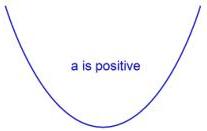
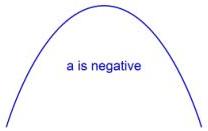
A quadratic function is a mathematical expression of the form , where , , and are constant values. When plotted on a coordinate plane, the resulting graph is a curve called a parabola. The orientation of this parabola is determined by the sign of :
- If , the parabola is U-shaped (concave up), opening upwards.
- If , the parabola is an upside down U-shape (concave down), opening downwards.
Graphical Interpretation of Roots and Intercepts
Roots of Quadratic Functions
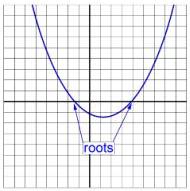
If you plot the graph of a quadratic function , the points where the curve crosses or touches the axis are the roots of the function. These roots are the solutions to the equation .
Intercepts
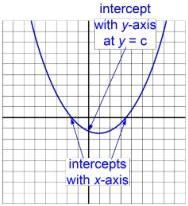
The intercept of a quadratic graph occurs when . Substituting zero into the equation yields . This is the point where the curve crosses the vertical axis.
The intercepts occur when . Depending on the specific function, there may be zero, one, or two intercepts with the axis. These points correspond directly to the real roots of the quadratic.
The Turning Point
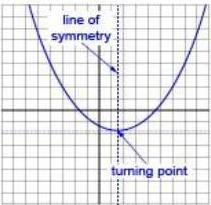
The turning point is the vertex of the parabola. It is the minimum point if and the maximum point if . Quadratic graphs are always symmetrical, and the line of symmetry is a vertical line that passes directly through this turning point.
Worked Example: Graphical Identification
The following diagram shows a section of the graph of .
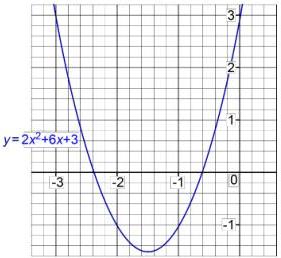
Finding Roots: To find the roots to 1 decimal place, we look at where the curve crosses the axis. Given that 5 small squares represent 1 unit, each small square is . From the graph, we can see the roots are approximately and .
Finding Intercepts: For , the intercept occurs when . Thus, .
Finding the Turning Point: Using the same graph of shown below, we look for the point where the curve is parallel to the axis.
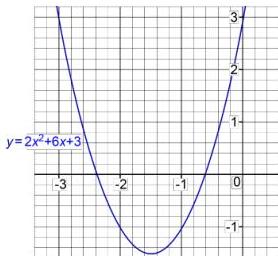
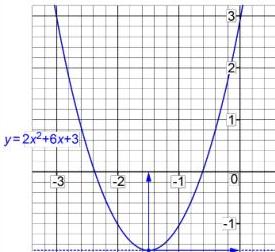
The coordinates of the turning point are approximately .
Deducing Roots Algebraically
To find the roots of algebraically, we solve the equation using methods such as factorisation, the quadratic formula, or completing the square.
Example: Find the roots of . We solve . Factoring the expression gives . Therefore, or , leading to roots at and .
Completing the Square
Completing the square is an algebraic process used to rewrite a quadratic expression of the form as a difference of two squares:
Worked Examples of Completing the Square:
- For : Halve the coefficient of to get . Then, .
- For : Half of is . Thus, .
- For : First, factor out the coefficient of so that the internal coefficient is 1: . Now complete the square inside the bracket: . Distributing the 2 gives .
Finding the Turning Point Algebraically
By completing the square, we can transform into the form . In this form, the turning point occurs when the squared term is at its minimum value, which is zero. This happens when , making the value equal to . Thus, the turning point is .
Worked Example 1: Find the turning point of . Completing the square: . The turning point occurs when , giving and . The turning point is .
Worked Example 2: Find the turning point of . First, factor out the 2: . Completing the square inside: . Simplifying: . The turning point occurs when , giving and . The turning point is .
Key takeaways
- The roots of a quadratic function are the coordinates where the graph crosses the axis.
- The intercept of is always the point .
- A quadratic graph is perfectly symmetrical about a vertical line passing through its turning point.
- Completing the square into the form reveals the turning point at .
- The sign of the coefficient determines if the turning point is a maximum () or a minimum ().
In the TMUA, if a question asks for the minimum or maximum value of a quadratic, immediately think about completing the square. The 'value' usually refers to the coordinate of the turning point.
When completing the square for where is not 1, always factor out of both the and terms first. A common mistake is to forget to distribute the back to the constant subtracted at the end.
The symmetry of the quadratic means that the coordinate of the turning point is always the arithmetic mean (the midpoint) of the two roots. This is a quick way to find the turning point if the roots are already known.
Worked Examples
Practice Questions
Frequently asked questions
How many roots can a quadratic function have?
A quadratic function can have zero, one, or two real roots. Graphically, this corresponds to the parabola not touching the axis, touching it at exactly one point (the vertex), or crossing it at two points.
Does every quadratic graph have a intercept?
Yes. Since the domain of a quadratic function is all real numbers, you can always substitute to find the intercept, which will always be .
Why do we halve the coefficient of when completing the square?
When you expand , you get . To match the term in , we must have , so .
Can the turning point be found without completing the square?
Yes, for , the coordinate of the turning point is always . You can then substitute this value back into the original equation to find the coordinate.