Solving Linear and Quadratic Simultaneous Equations
Updated August 2025
Simultaneous equations involve finding values for unknowns that satisfy multiple conditions at once. For the TMUA, you must solve linear and quadratic systems both algebraically and graphically. Mastering the translation of worded problems into algebraic expressions is essential for interpreting mathematical models and finding exact or approximate solutions.
A solution to a system of simultaneous equations is a set of values for the variables that makes every equation in the system true simultaneously. Graphically, these solutions correspond to the points where the graphs of the equations intersect.
Setting up Algebraic Equations
To solve a mathematical problem, you must often first translate a real world situation or a procedure into an algebraic expression or formula. In solving an equation, the goal is to isolate the unknown quantity to find its specific value. This is typically achieved by performing the same operation, such as adding, subtracting, multiplying, or dividing, to both sides of the equation to maintain balance while simplifying the terms.
Example: Setting up a linear equation
In a shop, the cost of one pen is 4 times the change received from after buying one pen. What is the cost of one pen?
- Identify the unknown: Let be the cost of one pen in pounds ().
- Express the change: The change from is .
- Form the equation: .
- Solve by multiplying out the bracket: .
- Add to both sides: .
- Divide both sides by 5: .
The cost of one pen is .
Graphical Solution of Simultaneous Linear Equations
Simultaneous equations can be solved graphically by plotting each equation as a line on a coordinate grid. The solution is the point (or points) where the lines intersect, as this coordinate satisfies both equations at once.
Example: Graphical solution of linear equations
Solve the following pair of equations graphically: and .
First, find coordinates for each line:
- For : When . When .
- For : When . When .
Plotting these points and drawing the lines shows they intersect at a single point.
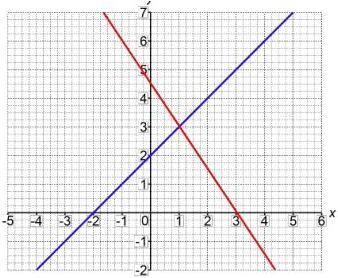
From the graph, the intersection point is , so the solution is and .
Algebraic Solution of Simultaneous Linear Equations
To solve linear simultaneous equations in two unknowns algebraically, you must eliminate one of the variables. This can be done through substitution or by creating a linear combination of the two equations.
Example: Algebraic solution by substitution
Solve: (Equation i) and (Equation ii).
- Rearrange (ii) to express in terms of : (Equation iii).
- Substitute (iii) into (i): .
- Expand the brackets: .
- Simplify: .
- Subtract 27 from both sides: .
- Divide by : .
- Substitute back into (iii) to find : .
Check by substituting both into (i): , which is correct. The solution is .
Algebraic Solution of One Linear and One Quadratic Equation
When one equation is linear and the other is quadratic, use the method of substitution. Rearrange the linear equation to isolate one variable, then substitute this into the quadratic equation. This usually results in a new quadratic equation in one variable, which typically yields two pairs of solutions.
Example: Solving a linear-quadratic system
Solve: (Equation i) and (Equation ii).
- Rearrange (i) to isolate : (Equation iii).
- Substitute (iii) into (ii): .
- Expand the terms: .
- Collect like terms: .
- Rearrange into standard quadratic form: .
- Divide by 2: .
- Factorise: , so or .
- Find corresponding values using (iii):
- If .
- If .
The solutions are and .
Graphical Solution of Non-Linear Systems
Approximate solutions for systems involving a quadratic equation can be found by plotting both the line and the curve. The coordinates of the intersection points provide the solutions.
Example: Graphical linear and quadratic solution
Find all approximate solutions for and in the range .
By plotting the points for both equations within the specified range:
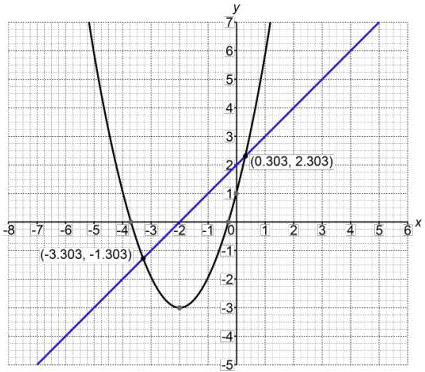
The intersections occur at approximately and .
Modelling Real Situations
Worded problems can be converted into simultaneous equations to determine unknown costs or quantities.
Example: Pricing paint shades
Two shades of purple are made of red and blue paint:
- 10 litres of Imperial Purple (7 litres blue, 3 litres red) costs .
- 10 litres of Royal Purple (5 litres blue, 5 litres red) costs . How much does 10 litres of red paint cost?
- Define variables: Let be the cost of 1 litre of blue and be the cost of 1 litre of red.
- Set up equations:
- (i)
- (ii)
- Multiply (ii) by to match the coefficient: (iii).
- Subtract (iii) from (i): , resulting in , so .
- Substitute into (iii): .
The cost of 10 litres of red paint is .
Key takeaways
- Simultaneous linear equations represent two straight lines, while quadratic systems involve a parabola and a line or another curve.
- The substitution method is the most robust algebraic technique for solving systems involving one linear and one quadratic equation.
- Graphical solutions provide intersection points that must be expressed as coordinate pairs .
- Worded problems must be translated into algebraic equations by identifying unknowns and establishing the relationships between them.
- Always check your algebraic solutions by substituting the values back into the original equations.
In the TMUA, time is critical. If a question involves choosing a solution from a list, it is sometimes faster to substitute the options into the equations to see which pair works rather than solving from scratch.
When solving linear-quadratic systems, a common mistake is finding only the values for one variable. Remember that solutions must be pairs of values. For every you find, calculate the corresponding .
Simultaneous equations are at the heart of coordinate geometry. Solving and is exactly the same as finding the points of intersection of the two functions and .
Worked Examples
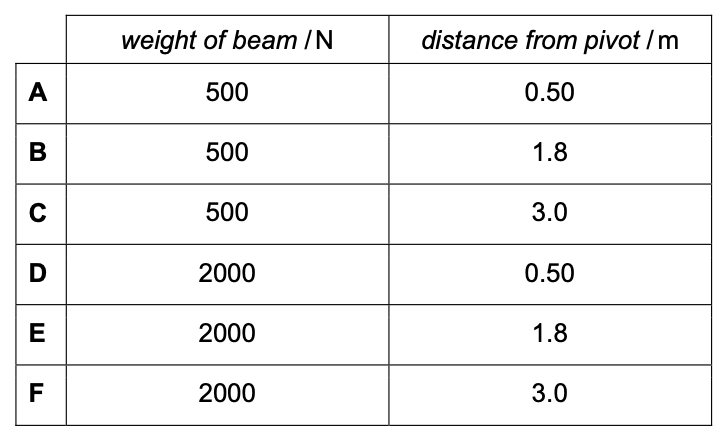
The normal contact force at the pivot is 800 N.
What is the weight of the beam and how far is the centre of gravity of the beam from the pivot?
Practice Questions
Frequently asked questions
How do I know if a system of equations has more than one solution?
A system of two linear equations usually has one solution (if the lines are not parallel). A system involving a quadratic and a linear equation can have zero, one (tangent), or two intersection points.
What should I do if the quadratic equation resulting from substitution does not factorise?
If a quadratic equation does not easily factorise, you should use the quadratic formula or complete the square to find the values of the variable.
Can I use the elimination method for linear and quadratic equations?
Elimination is generally difficult for non-linear systems unless the non-linear terms are identical. Substitution is the standard and more reliable method for linear-quadratic systems.
What is the difference between an exact and an approximate solution?
Algebraic methods provide exact solutions, often involving fractions or surds. Graphical methods involve reading values from a coordinate grid and provide approximate solutions due to the limits of visual precision.