Solving Quadratic Equations for University Admission
Updated August 2025
Solving quadratic equations is a cornerstone of TMUA preparation, requiring proficiency in algebraic and graphical techniques. This lesson teaches how to solve equations using factorisation, completing the square, and the quadratic formula. It also explores disguised quadratics and methods for estimating roots from graphs, ensuring you are equipped for any algebraic challenge.
A quadratic equation is a polynomial of the form . Solutions, or roots, are the values of that satisfy this equality and can be found algebraically or identified as the intercepts of the function .
Solving Quadratic Equations by Factorising
Factorisation involves expressing a quadratic expression in the form . Once in this form, the zero product property allows us to solve the equation by setting each linear factor to zero, specifically or . This method is most effective when and are rational numbers, often integers.
Worked Example: Solving by Factorising
Solve the equation:
To factorise this, we can use the method of splitting the middle term. We look for two numbers that multiply to give and add up to . These numbers are and .
- Split the middle term:
- Factorise in pairs:
- Take out the common bracket:
Now, solve the resulting linear equations:
If , then . If , then .
A quadratic equation may result in zero, one, or two real solutions.
Disguised Quadratics
In many exam problems, equations do not initially look like quadratics but can be transformed into them through rearrangement or substitution. These are often called disguised quadratics.
Worked Example: Rearrangement
Solve the equation:
First, multiply every term in the equation by to remove the denominators:
Now, rearrange the equation into the standard form :
This is the same quadratic solved in the previous example, giving or .
Worked Example: Substitution
Solve the equation: to find expressions for .
Observe that . We can substitute to create a quadratic equation:
Using our previous solutions for , we have: or
Finally, solve for by taking the cube root: or
Completing the Square
Completing the square is the process of writing a quadratic expression as the difference of two squares. For an expression , we can write:
Worked Example: Completing the Square
Express as a difference of two squares in the form .
Comparing with , we find , so .
Solving Equations by Completing the Square
Once a quadratic is expressed in the form , we can solve for by taking the square root of both sides.
Worked Example: Solving by Completing the Square
Solve by completing the square.
First, complete the square for :
Substitute this back into the original equation:
Take the square root of both sides:
If , then . If , then .
The Quadratic Formula
For any quadratic equation in the form , the solutions can be found using the quadratic formula. You must be able to recall this formula:
Worked Example: Using the Quadratic Formula
Solve the equation . Leave your answer in surd form.
First, set the equation to zero: . Here, , and .
Substitute these into the formula:
Simplify the surd :
Finding Approximate Solutions Graphically
Approximate solutions to can be identified by plotting the function . The roots are the values where the curve crosses the axis (where ).
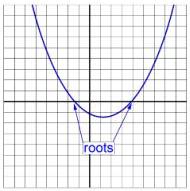
In more detail, you can use a grid to read these values to a specified degree of accuracy, such as 1 decimal place.
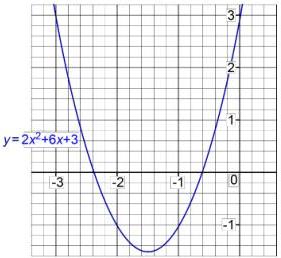
From a graph like the one above, we can identify the roots by looking at the points where the parabola intercepts the horizontal axis. In this specific case for , the roots are approximately and .
Key takeaways
- Rearrange all quadratic equations into the standard form before solving.
- The zero product property is the logical basis for solving by factorisation.
- The quadratic formula and completing the square are reliable methods when factorisation is difficult or impossible.
- Disguised quadratics can often be solved by identifying a substitution such as or .
- Graphical solutions provide estimates of roots where the curve crosses the axis.
In the TMUA, speed is vital. If a quadratic looks easy to factorise, try that first. If you spend more than 30 seconds struggling to find factors, immediately switch to the quadratic formula to avoid wasting time.
A common mistake when using the quadratic formula is forgetting that the division by applies to the entire numerator, , not just the square root part.
The quadratic formula is not a magical standalone tool; it is derived directly from the method of completing the square on the general quadratic equation . Mastering one provides a deeper structural understanding of the other.
Worked Examples
PQ = cm, RS = cm and the vertical height QR = x cm.
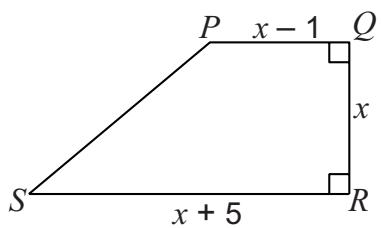
[diagram not to scale]
The area of the trapezium is 120 cm².
What is the length of RS?
Practice Questions
Frequently asked questions
When is it best to use the quadratic formula?
The quadratic formula should be used when the quadratic cannot be easily factorised or when you need the solutions in exact surd form and the numbers are too cumbersome for completing the square.
How do I know if an equation is a disguised quadratic?
Look for three terms where the power of the first variable is exactly twice the power of the second, such as and , or and .
What does a negative value under the square root in the formula mean?
If the discriminant is negative, the square root of a negative number is not a real number. This means the quadratic has no real roots and its graph does not cross the axis.
Does completing the square only work when the coefficient of is one?
It is easiest when . If is not 1, you should first factorise the out of the terms, such as , and then complete the square for the expression inside the bracket.