Solving Linear Inequalities in One and Two Variables
Updated August 2025
Mastering linear inequalities is vital for the TMUA, particularly for coordinate geometry and algebraic reasoning. This guide covers solving single-variable inequalities, representing solution sets on number lines, and identifying feasible regions on two-dimensional graphs. You will learn the critical rules for reversing inequality signs and how to combine multiple constraints.
An inequality describes the relative size of two expressions using symbols like . Solving them involves the same algebraic operations as equations, with the essential distinction that multiplying or dividing by a negative value reverses the direction of the inequality sign.
Symbols and Labelling Conventions
Inequalities are represented by four primary symbols. For a single variable , the representation on a number line follows specific conventions to indicate whether the boundary value is included in the solution set.
- (Less than): defines all values less than but not including 4. On a number line, this is shown with an open circle at 4.
- (Greater than): defines all values greater than but not including 4. This is also shown with an open circle at 4.
- (Less than or equal to): defines all values less than 4, including 4 itself. This is shown with a solid circle at 4.
- (Greater than or equal to): defines all values greater than 4, including 4. This is shown with a solid circle at 4.
Inequalities in Two Variables
When dealing with two variables, solution sets are represented as shaded regions on a coordinate graph. The boundary is defined by the equivalent linear equation.
- Dotted Lines: Used for strict inequalities ( or ). This indicates that the points on the line itself are not part of the solution.
- Solid Lines: Used for inclusive inequalities ( or ). This indicates that the points on the line are included.
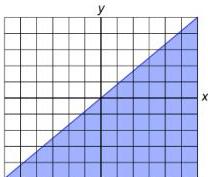
The shaded area above shows the region . Notice the dotted line for the boundary .
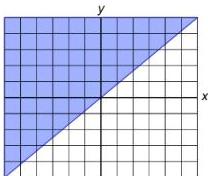
In this graph, the region is shown with a solid boundary line. When solving problems involving multiple inequalities, it is often clearer to shade the unwanted region and leave the required region unshaded. It is crucial to state clearly which method you are using.
Simplifying Inequalities
If , specific rules apply when manipulating the expression:
- Addition and Subtraction: Adding or subtracting a real number from both sides leaves the sign unchanged. For example: .
- Positive Multipliers: Multiplying or dividing by a positive real number leaves the sign unchanged. For example: .
- Inversion: If and are both positive or both negative, inverting both sides changes the direction of the sign. For example: .
- Negative Multipliers: Multiplying or dividing by a negative real number changes the direction of the sign. For example: .
Combining Inequalities
Combined inequalities take the form . Both symbols must point in the same direction. Notation such as is mathematically incorrect.
- The set and is written as .
- The set and simply reduces to .
- If inequalities do not overlap or define a continuous range, such as and , they cannot be combined into a single continuous statement.
- Statements like are incorrect because is not less than .
Worked Examples: Single Variable
Example 1: Simple Linear Inequality Solve and represent it on a number line.
- Add 4 to both sides: .
- Divide by 3: . This is represented by a number line with an open circle at 4 and an arrow pointing to the right.
Example 2: Two-sided Linear Inequality Solve .
- Add 4 to all three sections: .
- Divide all three sections by 3: . On a number line, place an unfilled circle at 4 and a filled circle at 8, joining them with a line.
Example 3: Complicated Variable Expression Solve .
- Multiply out the bracket: .
- Subtract from both sides: .
- Add 5 to both sides: .
- Multiply by and reverse the sign: .
- Divide by 3: .
Worked Examples: Finding Ranges
Overlapping Ranges: Find the range for and .
- From the first: .
- From the second: .
- Combined: .

Contained Ranges: Find the range for and .
- From the first: .
- From the second: .
- The valid range for both is simply .
Non-overlapping Ranges: Find the range for and .
- From the first: .
- From the second: .
- There is no range where both are valid.
Simultaneous Inequalities in Two Variables
To solve graphically:
- Draw the boundary line .
- Test a point, such as . Since is true, the region containing is the solution set.
- Use a solid line for the boundary.
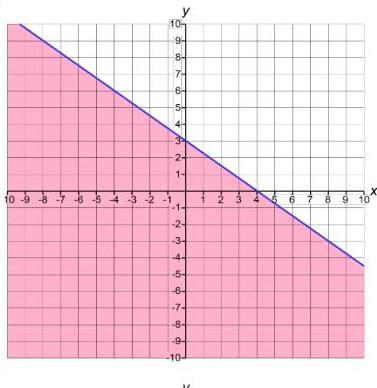
To solve multiple inequalities like , , and :
- Draw each boundary line.
- Shade out the unwanted regions for each constraint.
- The remaining unshaded region is the solution.
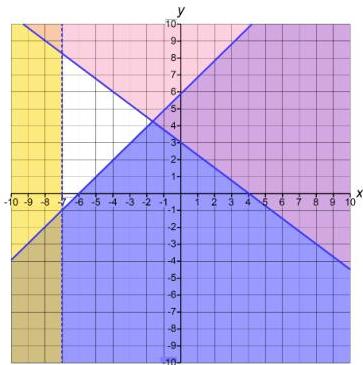
Key takeaways
- Always reverse the inequality sign when multiplying or dividing both sides by a negative number.
- Use open circles for strict inequalities ( and ) and solid circles for inclusive ones ( and ) on number lines.
- Strict inequalities in two variables are represented by dotted boundary lines, while inclusive ones use solid lines.
- To identify the correct region on a graph, test a simple point like in the inequality expression.
- Combined inequalities like must have signs pointing the same way and must be mathematically consistent.
For TMUA questions involving shading, always clearly label your axes and boundary lines. Testing the origin is the fastest way to determine which side of a line to shade, provided the line does not pass through the origin itself.
A very common error is forgetting to flip the inequality sign when multiplying by a negative. Always double check your final step, especially in algebraic rearrangements.
The solution to a linear inequality in two variables is a half plane. When multiple inequalities are applied, the intersection forms a convex feasible region, a concept fundamental to linear programming and optimization.
Worked Examples
Practice Questions
Frequently asked questions
When should I use a dotted line instead of a solid line on a graph?
A dotted line is used for strict inequalities, such as or . A solid line is used when the inequality is inclusive, such as or .
What happens if I divide an inequality by a negative number?
You must reverse the direction of the inequality sign. For example, becomes after dividing by .
Can I combine and into one statement?
No. These ranges do not overlap and do not form a single continuous interval. They must be written as two separate statements.
Is it possible for a set of simultaneous inequalities to have no solution?
Yes. If the shaded regions for the different inequalities do not overlap at any point on the graph, there is no set of coordinates that satisfies all conditions simultaneously.