Geometry: Area and Volume for the TMUA
Updated August 2025
Mastering the formulae for the area of triangles, parallelograms, and trapezia, along with the volume of right prisms, is essential for TMUA Paper 1. These foundational geometric concepts often appear in multi-stage problems requiring the calculation of surface areas or cross-sections in calculus and coordinate geometry contexts.
Geometric calculation relies on the relationship between linear dimensions: area for 2D shapes is the product of perpendicular dimensions, while the volume of a right prism is the area of its constant cross-section multiplied by its perpendicular length.
Area of Triangles
The most fundamental formula for the area of a triangle is derived from the fact that any triangle occupies exactly half the space of a rectangle with the same base and perpendicular height. As shown in the following diagram, the area is calculated as:
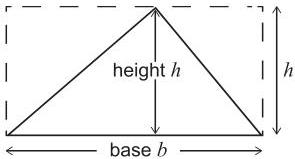
It is vital to distinguish between the vertical height (or perpendicular height) and the slanted height. If the top vertex is not directly above the base, the vertical height is measured as the perpendicular distance from the line containing the base to the vertex. Beyond basic geometry, the TMUA specification requires the use of trigonometry to find the area when the height is unknown but two sides and an included angle are provided:
Area of Parallelograms and Trapezia
A parallelogram is a quadrilateral with two pairs of parallel sides. Its area formula is a direct extension of the rectangle formula. By 'cutting' a right-angled triangle from one side and shifting it to the other, a parallelogram is transformed into a rectangle with the same base and perpendicular height. Therefore:
Note that the 'height' must always be the perpendicular distance between the parallel bases, never the length of the slanted side.
A trapezium (or trapezoid) is a quadrilateral with at least one pair of parallel sides. The area is found by taking the average of the two parallel lengths ( and ) and multiplying by the perpendicular height ().
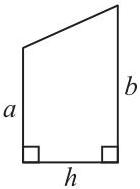
This formula is also the basis for the Trapezium Rule used in integration to approximate the area under a curve by dividing it into several such strips.
Volume of Cuboids and Right Prisms
A right prism is a three-dimensional solid with a constant cross-section throughout its length, where the edges connecting the two bases are perpendicular to the planes of the bases. The volume of any right prism is given by the product of the area of its cross-section and its length (or height):
A cuboid is a specific type of right prism where the cross-section is a rectangle. If a cuboid has length , width , and height , its volume is:
For other right prisms, you must first calculate the area of the 2D base using the formulae for triangles, parallelograms, or trapezia. For example, a triangular prism with a base triangle of area and a prism length has a volume of .
Worked Examples
Example 1: Triangle Area A triangle has sides of cm and cm, with an included angle of . Calculate its area. Using : Since : cm.
Example 2: Volume of a Trapezoidal Prism A right prism has a cross-section in the shape of a trapezium. The parallel sides of the trapezium are cm and cm, and the distance between them is cm. The prism has a length of cm. Find the volume. First, find the area of the trapezium cross-section: cm. Now, calculate the volume: cm.
Key takeaways
- The area of a triangle is or depending on available data.
- The height used in area and volume formulae must always be the perpendicular height, not a slanted length.
- A right prism has a constant cross-section, and its volume is simply the cross-sectional area multiplied by its perpendicular length.
- The area of a trapezium is the average of the parallel sides multiplied by the perpendicular height.
In TMUA questions, cross-sections are often hidden within coordinate geometry or calculus problems. If a question involves the 'area under a curve' between two points, recall the trapezium area formula, as it is the foundation of the trapezium rule.
The most frequent error is using a slanted side length as the 'height' in area or volume calculations. Always ensure the height dimension is perpendicular to the base.
The formula for the volume of a right prism () is an application of Cavalieri's Principle, which states that if two solids have the same cross-sectional area at every level and the same height, they have the same volume.
Worked Examples
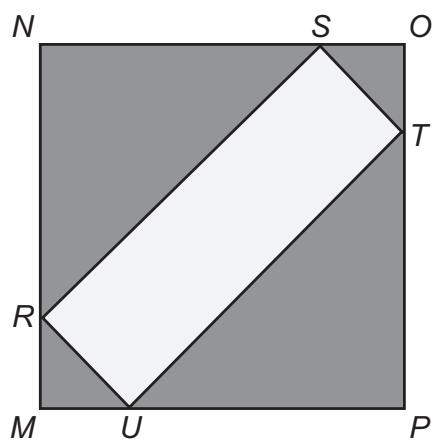
[diagram not to scale]
MNOP is a square of perimeter cm.
The vertices of rectangle lie on the edge of square .
has length cm.
What is the largest possible value of such that has area cm?
Practice Questions
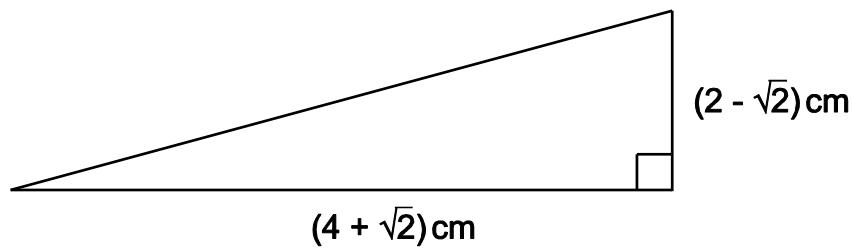
[diagram not to scale]
Calculate the area of the triangle.
Frequently asked questions
What defines a prism as a 'right' prism?
A prism is a 'right' prism if the side edges and faces are perpendicular to the base faces. If the sides are slanted, it is an oblique prism, which has the same volume but is generally not tested in this manner in the TMUA.
Can I use the triangle area formula for a non-right-angled triangle?
Yes, works for any triangle provided is the perpendicular height from the base to the opposite vertex. If you do not have the perpendicular height, use .
How do I find the volume if the cross-section is a complex polygon?
Divide the complex cross-section into simpler shapes, such as triangles and rectangles. Calculate the area of each part, sum them to find the total cross-sectional area, and then multiply by the length of the prism.