Geometry and Formulae for the TMUA
Updated August 2025
Mastery of the geometric formulae for circles and cylinders is a prerequisite for the TMUA. Candidates must apply these to calculate perimeters, areas, and volumes of complex composite shapes. Understanding how to decompose solids into spheres, pyramids, and cones is essential for solving 3-dimensional problems effectively.
The application of metric formulae for circles, cylinders, and standard 3D solids to determine the perimeter, area, surface area, and volume of both simple and composite geometric figures.
In the TMUA, you are expected to have a fluent command of the geometric properties of 2-dimensional and 3-dimensional shapes. While some advanced formulae are provided in the exam, the fundamental properties of circles and cylinders must be memorised and applied with precision.
Circle Formulae: Circumference and Area
The most fundamental geometric relationships involve the circle. You must know the following formulae by heart:
- Circumference of a circle: . This relationship defines the ratio of the circumference to the diameter as the constant .
- Area of a circle: .
When working with circular geometry, pay close attention to whether a question provides the radius () or the diameter (). Using the diameter in the area formula without first halving it is a frequent source of error.
Worked Example: Perimeter of a Semi-Circle
Find the perimeter of a semi-circle with a radius of units. Give your answer in terms of .
Step 1: Calculate the length of the curved arc. The circumference of a full circle is , so the arc of a semi-circle is . Here, .
Step 2: Calculate the length of the straight edge, which is the diameter of the circle. .
Step 3: Sum the components. units.
Right Circular Cylinders
A right circular cylinder is a 3-dimensional solid with two congruent circular bases that are parallel and connected by a curved surface. You must know the formula for its volume:
Volume of a right circular cylinder: .
This formula is derived by multiplying the area of the circular base () by the perpendicular height (). If you are asked to calculate the total surface area of a cylinder, remember to sum the areas of the two circular ends and the curved surface area:
.
Three-Dimensional Solids: Spheres, Pyramids, and Cones
For more complex solids such as spheres, pyramids, and cones, the TMUA specification notes that formulae will be provided if needed. However, being familiar with their structure is necessary for identifying how to use those formulae in composite problems.
- Spheres: Defined by a single radius . Metrics include volume and surface area.
- Pyramids: Defined by a base area and a perpendicular vertical height.
- Cones: A special type of pyramid with a circular base. Metrics involve the radius , the vertical height , and sometimes the slant height .
Perimeters and Areas of Composite Shapes
Composite shapes are formed by combining or subtracting standard 2-dimensional figures. To calculate their perimeters or areas, you should decompose the shape into its constituent parts.
Worked Example: Composite Area
A shape is formed by removing a semi-circle of diameter cm from one side of a square with side length cm. Calculate the area of the remaining shape.
Step 1: Find the area of the square. .
Step 2: Find the area of the semi-circle. The radius is cm (half the diameter). Area_{semi} = rac{1}{2} ext{\pi} (2^2) = 2 ext{\pi} .
Step 3: Subtract the semi-circle from the square. .
Surface Area and Volume of Composite Solids
Similar to 2D shapes, composite solids require breaking the object down into standard components such as cylinders, cones, and spheres.
Worked Example: Volume of a Capsule
A capsule is formed by joining two hemispheres of radius to the ends of a cylinder with radius and height . Find the volume of the capsule.
Step 1: The two hemispheres together form a single sphere of radius . The volume of a sphere is rac{4}{3} ext{\pi}r^3.
Step 2: The central cylinder has a volume of .
Step 3: Combine the volumes. V_{total} = ext{\pi}r^2H + rac{4}{3} ext{\pi}r^3 = ext{\pi}r^2(H + rac{4}{3}r).
Key takeaways
- The area of a circle is and the circumference is or .
- Volume for a right circular cylinder is found by multiplying base area by height: .
- Composite shapes must be decomposed into simpler, standard shapes before calculating total metrics.
- Pay close attention to boundary lines in composite perimeters: internal edges of joined shapes are not part of the external perimeter.
Always check your units. If a question gives some dimensions in centimetres and others in metres, convert everything to a single unit before applying geometric formulae.
The most common error is confusing radius and diameter. Always double-check which one is given or required, especially in the formula .
Linear scaling has a non-linear effect on area and volume. If all linear dimensions of a shape are doubled, the area increases by a factor of , and the volume increases by a factor of .
Worked Examples
Practice Questions
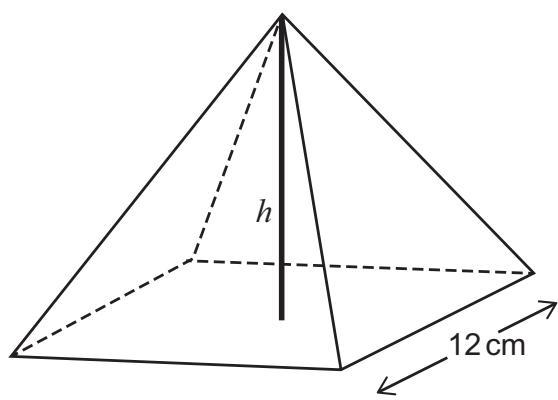
[diagram not to scale]
The volume of the pyramid, in , is equal to the total surface area of the pyramid, in .
What is the value of h?
(volume of pyramid =
Frequently asked questions
Which formulae are provided in the TMUA exam booklet?
Formulae for the volume and surface area of spheres, pyramids, and cones are usually provided. However, circle and cylinder formulae are expected knowledge and will not be given.
How do I calculate the height of a pyramid if only the slant edge is given?
You should use Pythagoras' Theorem. Construct a right-angled triangle using the vertical height, the distance from the centre of the base to a vertex, and the slant edge as the hypotenuse.
Does the curved surface area of a cylinder include the two ends?
No. The curved surface area is only the 'label' part of the cylinder, . If the question asks for 'total surface area', you must add the two circular ends, .