Arc Length and Sector Area for the TMUA
Updated September 2025
Learn to calculate arc lengths and sector areas using radian measure for the TMUA and ESAT. This topic covers the definition of the radian, conversion between degrees and radians, and the derivation of key geometric formulae for circles.
Radian measure defines angles by the ratio of arc length to radius. For a circle of radius and an angle of radians, the arc length is and the sector area is .
Introduction to Radian Measure
While degrees are a common method for measuring angles, where one full revolution is , the number 360 is somewhat arbitrary. Radians provide a more natural measure for angles, particularly for use in higher mathematics and calculus. A radian is defined as the angle subtended at the centre of a circle by an arc whose length is equal to the radius of the circle.
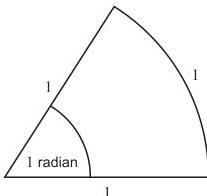
In a circle of radius 1, an angle of 1 radian corresponds to an arc length of exactly 1. Consequently, because the circumference of a circle with radius 1 is , a complete revolution is equal to radians. Therefore, 1 radian is approximately equal to .
Converting Between Degrees and Radians
To convert between these two systems, we use the fact that radians.
- To convert degrees to radians, calculate the fraction of a full revolution and multiply by : .
- To convert radians to degrees, calculate the fraction of a full revolution and multiply by 360: .
You should memorise the following standard conversions:
- radians.
- radians.
- radians.
- radians.
- radians.
- radians.
Arc Length and Sector Area Formulae
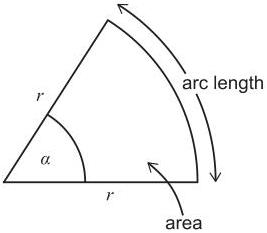
When using radians, the formulae for the geometry of a circle become remarkably simple. For a sector of a circle with radius and angle radians:
- Arc length
- Area of sector
Proof of the Arc Length Formula
We know that an angle of radians represents a specific fraction of a whole circle. Since a whole circle is radians, the fraction is . The arc length is therefore:
Proof of the Sector Area Formula
Similarly, the area of a sector is the area of the entire circle multiplied by the fraction of the circle that the sector occupies:
These proofs demonstrate why radians are the preferred measure: they eliminate the arbitrary constants associated with degrees and link linear and angular measures directly through the radius.
Key takeaways
- A full revolution of is equivalent to radians.
- The arc length of a sector with radius and angle in radians is .
- The area of a sector with radius and angle in radians is .
- Standard angles like , , and should be recognised instantly in their radian forms: , , and .
When solving circle geometry problems, immediately check if the angle is in radians or degrees. If you are asked for an exact value, leave your answer in terms of .
A common error is to use the degree value of an angle in the formula. Always convert to radians first. Also, remember that the area of a sector formula is , not .
Radian measure is crucial because it makes trigonometric functions 'natural' for calculus. For example, the derivative of is only if is in radians. In degrees, a messy scaling factor would be required.
Frequently asked questions
How do I calculate the area of a segment?
The area of a segment is found by taking the area of the sector and subtracting the area of the triangle formed by the two radii and the chord. Using radians, this is , which simplifies to .
Can I use these formulae if the angle is in degrees?
No. The formulae and are only valid when is measured in radians. If the angle is given in degrees, you must convert it to radians first.
What is the perimeter of a sector?
The perimeter of a sector consists of the arc length plus the two radii. Thus, the perimeter is , or , provided is in radians.