Circle Theorems and Geometry for the TMUA
Updated August 2025
Circle theorems describe the fundamental properties of angles and lines within circles, including tangents, chords, and cyclic quadrilaterals. This guide details the seven key theorems and the specific problem solving strategies recommended by the official examiners for the TMUA and ESAT assessments.
Circle theorems are a collection of invariant geometric rules, such as the principle that the angle subtended at the centre is twice the angle subtended at the circumference ( and ).
Overview of Circle Theorems
Circle theorems are included in both the M and MM sections of the university admissions specifications. This is intentional. While these theorems are typically covered early in secondary mathematics, they are frequently forgotten by the time students sit for the TMUA or ESAT. For these assessments, you must not only know the theorems but also understand their proofs and how to apply them to solve novel problems. You should make sure you can prove each theorem and that you have a deep understanding of the proof, considering what the assumptions are and what geometry is being used.
The Seven Core Theorems
The official guide specifies seven key properties that you must be comfortable using in geometric proofs and angle-chasing exercises.
1. Chords and Centres
The perpendicular from the centre of a circle to a chord always bisects that chord. This property is frequently used in coordinate geometry to find the centre of a circle when the coordinates of two points on a chord are known, as the centre must lie on the perpendicular bisector.
2. Tangents and Radii
The tangent at any point on a circle is perpendicular to the radius at that point. This creates a angle at the point of contact, providing a foundation for using Pythagoras' theorem or trigonometric ratios in circle problems.
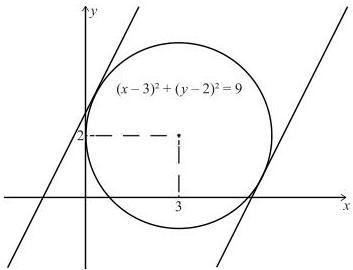
As shown in the diagram above, when a line acts as a tangent to a circle, it intersects at exactly one point. At this point, the gradient of the tangent and the gradient of the radius are related such that their product is , as they are perpendicular.
3. Angles at the Centre and Circumference
The angle subtended by an arc at the centre of a circle is exactly twice the angle subtended by the same arc at any point on the circumference. This leads to the special case where the angle in a semicircle is a right angle. Because a diameter subtends an angle of at the centre, any angle it subtends at the circumference must be .
4. Angles in Segments and Quadrilaterals
- Angles in the same segment are equal: Any two angles subtended by the same arc at the circumference, within the same segment, are equal in magnitude.
- Cyclic Quadrilaterals: For a four sided shape where all four vertices lie on the circumference of a circle, the opposite angles are supplementary, meaning they add to .
- Alternate Segment Theorem: The angle between a tangent and a chord at the point of contact is equal to the angle subtended by the chord in the alternate segment.
Problem Solving Techniques
The examiner guide suggests four specific techniques for tackling circle geometry questions:
- Angle chasing: Systematically fill in all known angles using the theorems above. Always look for isosceles triangles, which are frequently formed by two radii connecting the centre to points on the circumference.
- Rotating the diagram: Some geometric relationships become much clearer if you view the circle from a different orientation. Do not be afraid to rotate your paper or the diagram mentally.
- Adding lines: Sometimes adding a tangent, a diameter, or a chord helps you to find the solution. Connecting the centre to points of contact often reveals hidden right-angled or isosceles triangles.
- Dynamic methods: This involves learning to move points around on your diagram in a way that does not affect the solution but makes the question easier to solve. For example, moving a point along an arc while keeping the subtended angle constant according to the same segment theorem.
Proving Related Results
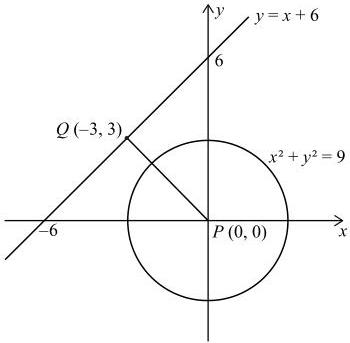
Many questions will require you to use these standard theorems to prove more complex results. For instance, you might be asked to find the shortest distance between a line and a circle, which requires understanding that the shortest path from the centre to the line must be perpendicular to that line. As seen in the coordinate geometry section, combining the algebraic equation of a circle with these geometric properties allows for the solution of sophisticated intersection problems.
Key takeaways
- Radii form isosceles triangles when connected to the ends of a chord.
- The angle at the centre is always double the angle at the circumference for the same arc.
- Opposite angles in a cyclic quadrilateral sum to .
- The tangent is perpendicular to the radius at the point of contact.
- Angles in the same segment subtended by the same arc are equal.
Always start by marking every radius on your diagram. This often reveals isosceles triangles that allow you to fill in missing angles through 'angle chasing'. If you are stuck, try drawing a line from the centre of the circle to any point of tangency.
A common error is to assume a quadrilateral is cyclic when its vertices do not all lie on the circumference. Only use the opposite angle rule if the shape is strictly a cyclic quadrilateral.
The fact that the angle in a semicircle is is actually a special case of the theorem that the angle at the centre is twice the angle at the circumference (). This demonstrates the internal consistency of circle geometry.
Worked Examples
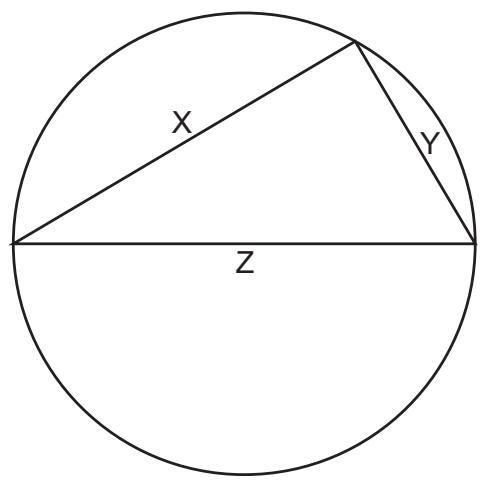
[diagram not to scale]
Wires X and Y each have twice the diameter of wire Z.
Wire X is 12 cm long. Wire Z is 15 cm long and is connected across a diameter of the ring.
A power supply is connected to the two corners of the triangle that lie on the diameter.
What is the value of the ratio ?
Practice Questions
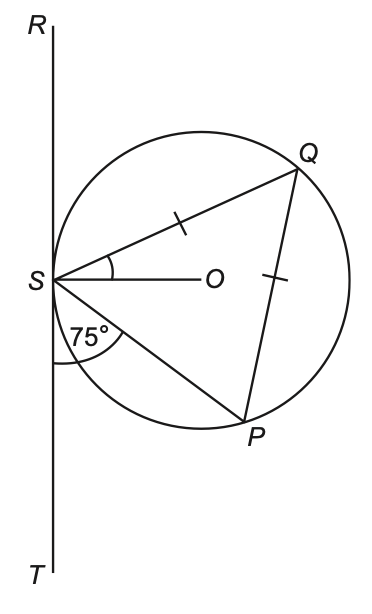
[diagram not to scale]
The line segment RT is a tangent at the point S to a circle with centre O
Q and P are points on the circumference of the circle such that QS = QP
Angle PST = 75°
What is the size of angle QSO?
Frequently asked questions
What is the alternate segment theorem?
The alternate segment theorem states that the angle between a tangent and a chord through the point of contact is equal to the angle in the alternate segment. For example, if a tangent meets a chord at point , the angle between them is equal to the angle subtended by that chord at any point on the circumference in the other part of the circle.
How can I identify an isosceles triangle in a circle?
In circle geometry, isosceles triangles are almost always formed by two radii. If you have a triangle where two vertices are on the circumference and the third vertex is the centre, the two sides representing the radii are equal, making the triangle isosceles.
Do I need to know the proofs for these theorems?
While the TMUA and ESAT may not explicitly ask you to reproduce a proof, the official guide states that you should understand the proofs deeply. Understanding how the theorems are derived helps you apply them to unfamiliar problems and proves you have a grasp of the underlying geometric logic.
What are dynamic methods?
Dynamic methods involve imagining points moving along the circumference. Since the angle in the same segment remains constant regardless of where the point is on the arc, you can sometimes 'move' a point to a more convenient location (like making a triangle right-angled) to simplify your calculations.