Circle Geometry Vocabulary and Properties for the TMUA
Updated August 2025
Mastering circle geometry requires both a precise vocabulary and an understanding of coordinate equations. This page defines essential terms like chord, tangent, and segment, while exploring the algebraic representation of circles. You will learn to identify centres, calculate radii, and apply core circle theorems essential for the TMUA.
A circle is defined as the set of all points that are a constant distance (the radius) from a fixed point (the centre), represented by the equation .
Basic Circle Vocabulary
To succeed in the TMUA, you must be fluent in conventional circle terminology. A circle consists of several distinct parts:
- Centre: The fixed point from which all points on the circumference are equidistant.
- Radius: The constant distance from the centre to any point on the circle.
- Diameter: A straight line passing through the centre, connecting two points on the circumference. It is exactly twice the length of the radius.
- Circumference: The perimeter or boundary of the circle.
- Chord: A straight line segment joining any two points on the circumference.
- Tangent: A straight line that touches the circumference at exactly one point and is perpendicular to the radius at that point.
- Arc: A portion of the circumference. An arc smaller than a semicircle is a minor arc, while one larger is a major arc.
- Sector: The region bounded by two radii and an arc (resembling a pizza slice). A minor sector has an angle less than 180 degrees, while a major sector is larger.
- Segment: The region bounded by a chord and an arc. A minor segment is the smaller part created by the chord, and the major segment is the larger part.
The Equation of a Circle
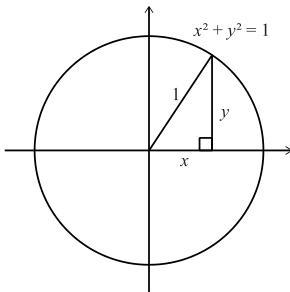
Imagine drawing a circle of radius 1 on the plane with its centre at the origin. All points on this circle are a distance of 1 from the origin. Using Pythagoras' theorem, we can express this as . Any satisfying this equation is on the circle.
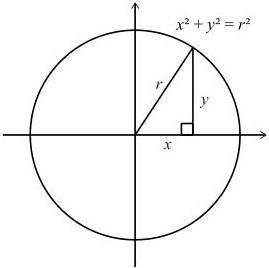
If we increase the radius to , the equation becomes .
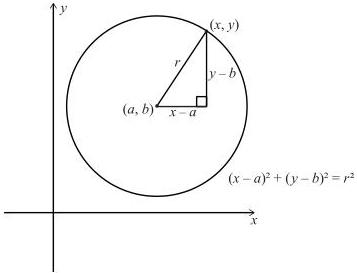
To move the centre to a different point , we use a translation. Pythagoras' theorem tells us that the distance between and is , leading to the standard form:
Identifying Centre and Radius
You must be able to identify the radius and centre quickly. For example, has a centre at and a radius of 5 (since ). Circles are often written in the expanded form . To find the centre and radius from this form, you must complete the square for both and .
Example: Finding the centre and radius
Find the centre and radius of .
- Collect and terms: .
- Complete the square: .
- Rearrange: .
The centre is and the radius is .
Caution on non-circles
Not every equation of the form is a circle. For instance, simplifies to . Since the sum of squares cannot be negative, no real values satisfy this, so it is not a circle.
Tangents and Intersections
A line can intersect a circle twice, once (tangent), or not at all.
Example: Finding a tangent
Find the values of for which is tangent to the circle .
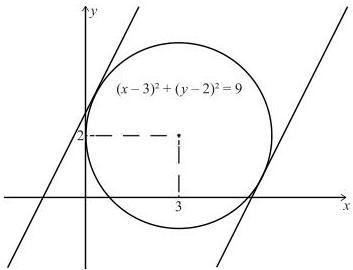
- Substitute the line into the circle: .
- Expand and rearrange into a quadratic in : .
- For a tangent, the discriminant must be zero (): .
- Solve for : . This gives two values for , representing the two possible tangent lines.
Circle Properties and Theorems
You are expected to know and apply the following geometric properties:
- Chords: The perpendicular from the centre to a chord bisects the chord.
- Tangents: The tangent at any point is perpendicular to the radius at that point.
- Angles at the Centre: The angle subtended by an arc at the centre is twice the angle subtended at the circumference.
- Semicircles: The angle in a semicircle is a right angle.
- Segments: Angles in the same segment are equal.
- Cyclic Quadrilaterals: Opposite angles in a cyclic quadrilateral add to 180 degrees.
- Alternate Segment Theorem: The angle between a tangent and a chord is equal to the angle in the alternate segment.
When solving problems, use angle chasing by looking for isosceles triangles formed by radii, or add auxiliary lines such as diameters or chords to reveal hidden relationships.
Key takeaways
- The standard equation of a circle with centre and radius is .
- To find the centre and radius from the general form , you must complete the square for both variables.
- A tangent to a circle intersects it at exactly one point, meaning the discriminant of the resulting simultaneous equation must be zero.
- Circle theorems, such as the angle at the centre being twice the angle at the circumference, are powerful tools for angle chasing in geometric problems.
When identifying a circle from an equation like , remember to divide the entire equation by the coefficient of (in this case, 2) before attempting to complete the square.
A common error is mistaking the constant in for the radius. The radius is actually . Always check that , otherwise the equation represents no real points.
The alternate segment theorem is often the most difficult to spot in complex diagrams. Look for the 'triangle' inside the circle where one vertex meets the point of contact between a tangent and the circle.
Worked Examples
Practice Questions
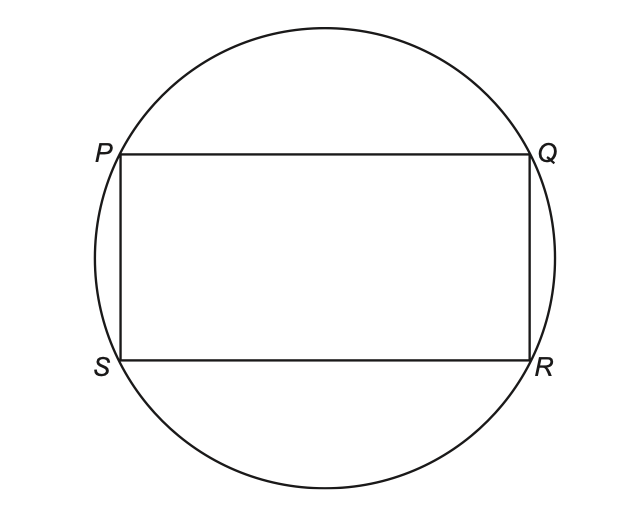
[diagram not to scale]
The ratio of the length of PQ to the length of QR is 2:1
The area of the rectangle PQRS is 96 cm².
What is the radius, in cm, of the circle?
Frequently asked questions
What is the difference between a sector and a segment?
A sector is a region bounded by two radii and an arc (like a slice of pie). A segment is a region bounded by a chord and an arc (the 'cap' of a circle).
How do I know if a line is a tangent to a circle using algebra?
Substitute the equation of the line into the equation of the circle. If the resulting quadratic equation has exactly one real solution (the discriminant ), the line is a tangent.
Does the term radius refer to a line or a length?
It refers to both: the line segment connecting the centre to the circumference and the length of that segment.
Why is the angle in a semicircle always 90 degrees?
This is a special case of the theorem that the angle at the centre is twice the angle at the circumference. Since the angle at the centre of a diameter is 180 degrees, the angle at the circumference must be 90 degrees.