Pythagoras Theorem in Two and Three Dimensions
Updated August 2025
This guide teaches the fundamental relationship between the sides of right angled triangles. Pythagoras Theorem is a staple of the TMUA and ESAT as it underpins coordinate geometry and 3D trigonometry. You will learn to calculate distances in both 2D and 3D and understand how this theorem relates to circles.
Pythagoras' theorem states that in a right angled triangle, the square of the hypotenuse is equal to the sum of the squares of the other two sides: .
The Fundamental Theorem
Pythagoras' theorem is one of the most elegant and essential rules in mathematics. It provides a simple algebraic method to calculate the length of a side in a right angled triangle when the other two sides are known. The theorem states that for any right angled triangle, the square of the longest side, which we call the hypotenuse, is equal to the sum of the squares of the two shorter sides. If we label the shorter sides and and the hypotenuse , we write this as:
It is important to remember that this rule applies only to triangles containing a 90 degree angle. As we noted in our section on trigonometry, the cosine rule acts as a generalisation of Pythagoras for all triangles, where a correction term is subtracted: . In a right angled triangle, the angle is 90 degrees, so and the correction term vanishes, leaving us with our standard theorem.
Pythagoras in Two Dimensions
A common application of this theorem is finding the distance between two points on the plane. If we have two points and , we can form a right angled triangle by drawing a horizontal line and a vertical line through the points. The horizontal distance is and the vertical distance is . The distance between the points is the hypotenuse, giving:
This lead us directly to the coordinate geometry of the circle. Imagine drawing a circle of radius on the plane with its centre at the origin. Every point on that circle is exactly a distance from the origin. Using Pythagoras' theorem, we find that all these points satisfy the equation:
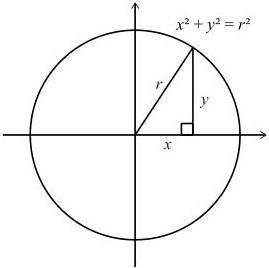
As an aside, recall that all points inside the circle satisfy , and all points outside the circle satisfy . If the circle is translated so its centre is at , we apply our graph shifting logic to get , which is still just Pythagoras' theorem in disguise.
Extending to Three Dimensions
The TMUA and ESAT expect you to use this theorem in three dimensions too. This usually involves finding the distance between two opposite corners of a cuboid, often called the space diagonal. Consider a cuboid with dimensions , , and . To find the diagonal that stretches from the bottom left front corner to the top right back corner, we proceed in two steps.
First, we find the diagonal of the base of the cuboid. This base is a rectangle with sides and . Applying Pythagoras in 2D gives us .
Second, we notice that this base diagonal, the vertical height , and the space diagonal form another right angled triangle. The space diagonal is the hypotenuse of this new triangle. Therefore, . Substituting our expression for the base diagonal, we get the general 3D formula for the distance from the origin to :
This elegant result shows that we can find distances in any number of dimensions by simply adding the square of the new dimension's length to our sum.
Worked Example: 3D Cuboid
Example
A cuboid has a base of 3cm by 4cm and a height of 12cm. Find the length of the internal space diagonal.
-
Calculate the diagonal of the base: . So cm.
-
Use this to find the space diagonal : .
-
Take the square root: cm.
Notice that we could have done this in one calculation: cm.
Finding Hidden Right Angles
In TMUA questions, you may not always be given a cuboid. You might be asked about a pyramid or a cone. In these cases, you must look for the vertical height which is perpendicular to the base. For example, in a square based pyramid with a vertex directly above the centre of the base, you can find the slant height by forming a triangle with the vertical height and half the diagonal of the square base.
Key takeaways
- Pythagoras' Theorem only applies to right angled triangles.
- The hypotenuse is always the longest side and is found opposite the 90 degree angle.
- The distance between two points in 3D is calculated using .
- The theorem is the foundation for the standard equation of a circle: .
When solving 3D problems, sketch the internal right angled triangle separately from the main shape. This helps you visualise which lengths are the legs and which is the hypotenuse.
A common error is adding the squares of the sides when you are actually trying to find a shorter side. Always identify the hypotenuse first and ensure it is the side represented by in the formula.
Pythagoras' Theorem is a special case of the Law of Cosines. It is also deeply connected to the concept of the Euclidean metric, which defines distance in the flat space we study at this level of mathematics.
Worked Examples
whole of the circumferences of both ends of the cylinder are in contact with the sphere.
The diagram shows a planar cross section through the centre of the sphere and cylinder.
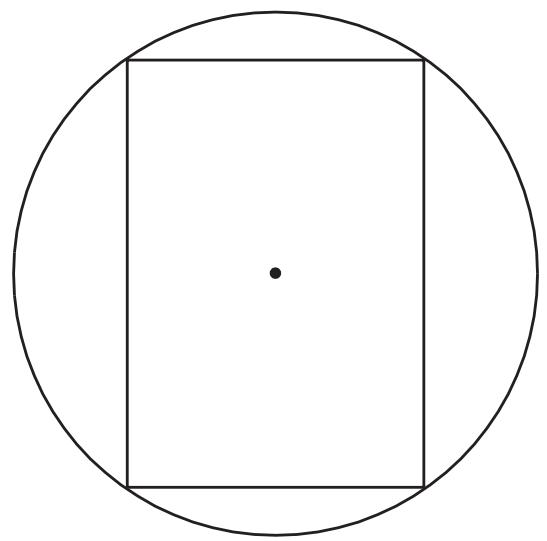
[diagram not to scale]
Find, in cubic centimetres, the maximum possible volume of the cylinder.
Practice Questions
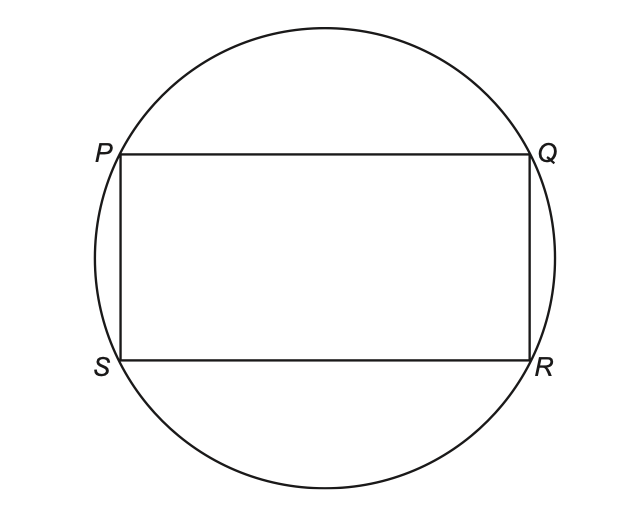
[diagram not to scale]
The ratio of the length of PQ to the length of QR is 2:1
The area of the rectangle PQRS is 96 cm².
What is the radius, in cm, of the circle?
Frequently asked questions
Can Pythagoras be used if the triangle is not right angled?
No, if the triangle does not have a 90 degree angle, you must use the Cosine Rule: .
How do you calculate a shorter side instead of the hypotenuse?
You rearrange the formula to or , ensuring the hypotenuse is the value you subtract from.
What if I get a negative result when squaring in a 3D distance problem?
Squaring any real number result, such as a difference in coordinates, always results in a positive value. If you have a negative sum, you have likely made a calculation error.
How many times should I apply the theorem in a 3D problem?
Usually, you apply it twice: once to find a 2D diagonal on a face, and a second time to find the 3D distance using that face diagonal and a third perpendicular length.